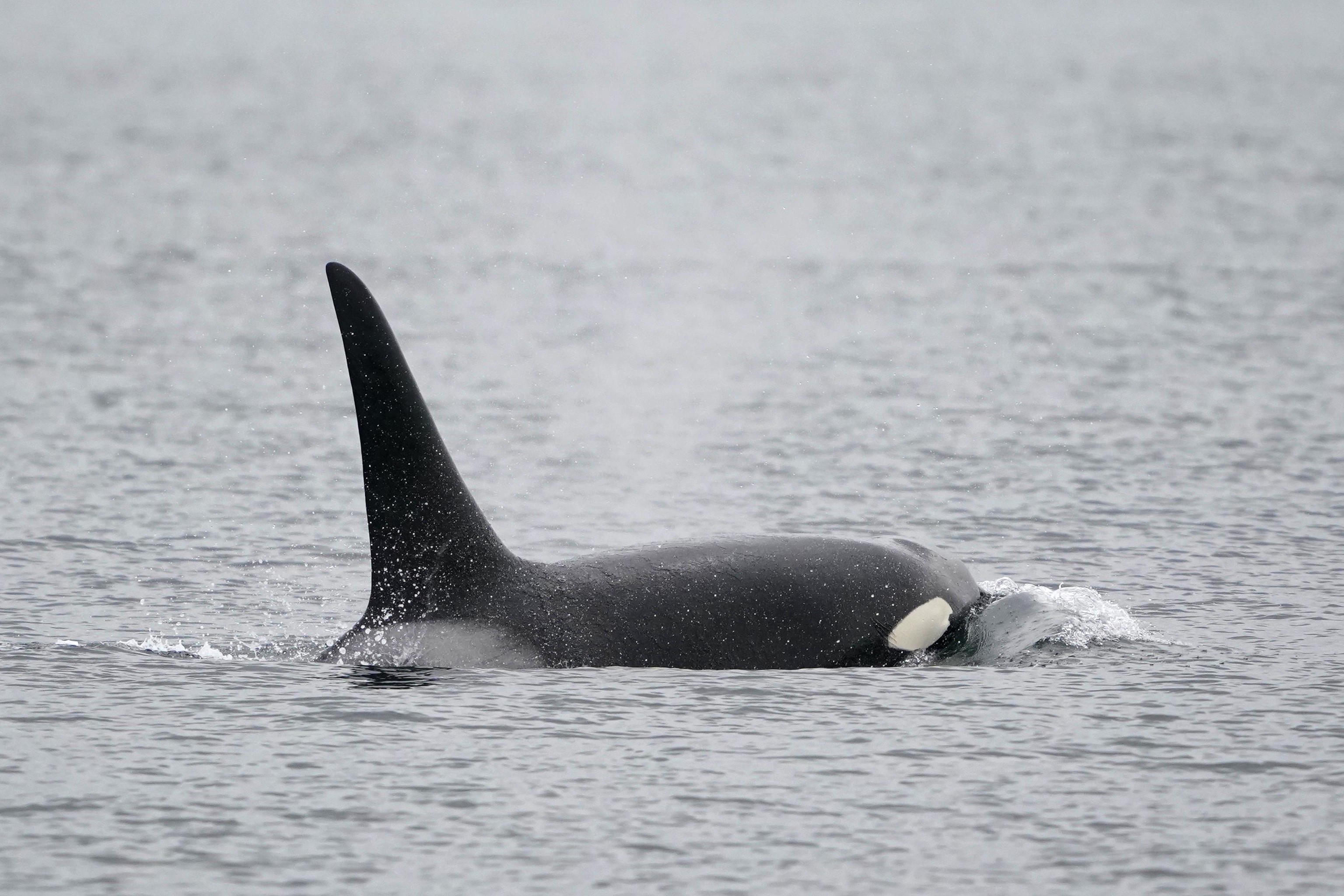
More than 60,000 ships cross the Strait of Gibraltar every year. A water corridor that connects the Atlantic with the Mediterranean and sustains a large part of global trade. Beneath that surface, however, there is another much more fragile world, that of a small population of long-finned pilot whales (Globicephala melas), barely 250 individuals, classified as critically endangered.
For these social cetaceans, daily life has become a constant exercise of survival amidst a highway. They must dodge ships while searching for food, coordinating group movements, finding mates, and raising their young. But the biggest obstacle is not always physical, but rather auditory.
An international team led by Milou Hegeman and Frants Jensen, from Aarhus University, along with scientists from various European countries and the United States, has documented a disturbing phenomenon, that the pilot whales are increasing the volume of their vocalizations to make themselves heard above the noise of maritime traffic.
The study, published in the Journal of Experimental Biology, reveals not only an adaptation but also a limit. The animals try to compensate for the noise, and they cannot always do it sufficiently.
To understand what happens underwater, researchers conducted a campaign between 2012 and 2015 aboard the Elsa ship. They placed recording devices with suction cups on the backs of 23 pilot whales using a six-meter pole. These sensors recorded the movement, depth, and, above all, the sound landscape in which the animals moved. After 24 hours, they detached and floated to be retrieved.
The result was an exceptional archive with over 1,400 calls analyzed in the laboratory, which allowed reconstructing not only what sounds they emit but in what context and with what function.
Four ways to communicate... and one to get lost
The team classified the vocalizations into four types: low-frequency calls, short and pulsed calls, high-frequency calls, and two-component calls. The most important for group cohesion are the low-frequency and two-component calls. They travel further in the water and are essential for individuals to locate each other, especially after long dives in search of food. And that's where the problem arises. Those calls are already at their maximum volume.
The acoustic environment of the Strait leaves no room. The noise levels recorded range from 79 to 144 decibels, a scale that goes from the buzz of a crowded restaurant to the roar of a vacuum cleaner at close range.
In that context, the pilot whales try to adapt by slightly increasing the intensity of their calls when the noise rises. But not all vocalizations can be amplified equally. The softer calls can increase their volume enough to remain useful. The most important, the long-range ones, are already at the physiological limit. In other words, "and they cannot scream any louder," the study points out.
The communication failure is not a minor detail. The most powerful calls are precisely those used by the pilot whales to reunite with their group when they resurface. If those signals do not reach, the group fragments.
With only 250 individuals, any disruption in group cohesion can be critical. The difficulty in reuniting after hunting, in coordinating, or even in locating potential mates in other pods introduces an added risk factor to an extremely vulnerable population.
It is not just about noise. It is about a progressive and invisible isolation that does not leave immediate casualties but slowly erodes the chances of survival.
The study demonstrates that the pilot whales are doing everything possible to adapt to the environment we have created. They have modified their behavior, adjusted their communication, and pushed their vocal capacity to the extreme.
Noise in the sea affects all levels of the food chain today, from plants to cetaceans, passing through phytoplankton and invertebrates. The increase in noise levels in some areas where human activities concentrate implies an adaptation of the present species," points out Michel André, director of the Bioacoustics Applications Laboratory at the Polytechnic University of Catalonia (UPC).
The case of the Strait of Gibraltar is paradigmatic of a global problem: marine noise pollution. Unlike other impacts, this one is not visible. It does not leave stains or residues, but it profoundly alters the life of species that depend on sound to survive.
For the pilot whales, the sea is no longer a natural resonance space, but a saturated environment where each message competes with the constant roar of engines. And if a species has to scream at its maximum capacity just to stay together, the problem is not how it communicates but the world in which we force it to do so.
Reducing noise is not an aesthetic option or a secondary issue. In places like the Strait, it can be the difference between a population surviving or simply ceasing to be heard forever.