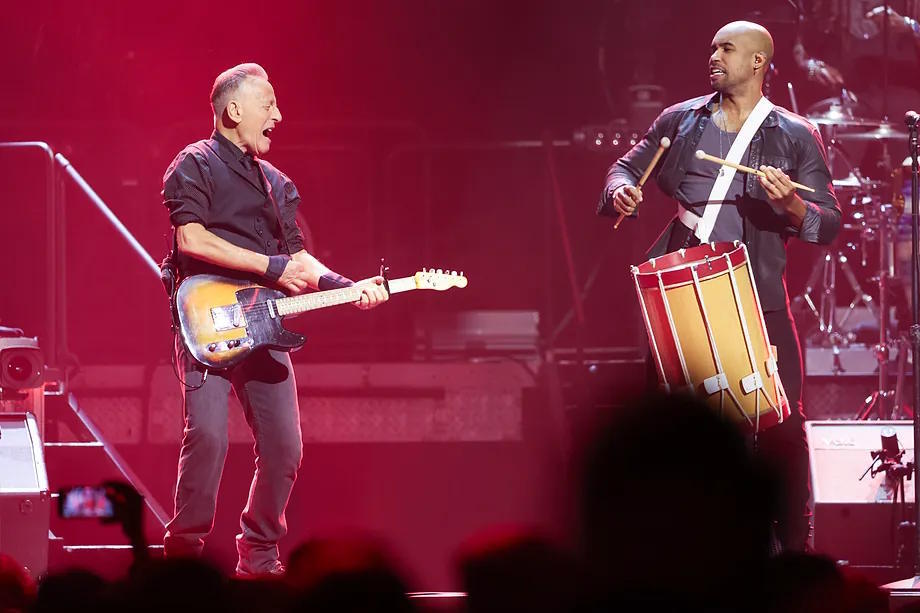
Percussionist, singer, and composer, Anthony Almonte is an explosive fusion of Latin roots and sounds from the Bronx, the neighborhood where he was born and where he developed as a musician. Known as 'the smile of the E Street Band' and a regular collaborator of Steven Van Zandt, he has worked with artists like Karol G, Eddie Palmieri, or the Spanish Harlem Orchestra. Now he takes a decisive step with the release of his first solo album, 'Conversando con la luna'.
How did 'Conversando con la luna' come about?
I have always wanted to create my own project, something where I could express exactly how I was feeling at that moment in my life. Although I have composed and participated in many other projects, I needed a different sound, something more personal. Additionally, we are living in a very strong moment for Latin and Spanish music. After the explosion of the Super Bowl, everything is more present than ever.
I was just about to ask you about that, what did you think when you saw the Super Bowl with Lady Gaga singing salsa?
I loved it. It brought me immense joy to see Latin music - and specifically salsa - represented on such a big stage. The culture, the dance, the celebration... It moved me deeply!
You embody two very powerful forces: Latin culture and the Bronx. What do you take from each of them?
I take both; I am both. My mother is Puerto Rican, my father Dominican, and at home, we always speak Spanish; the culture was always maintained. But at the same time, I was born and raised in the Bronx, with all the American experience. I grew up here, but I never lost the connection with my roots or my family's culture.
In the Bronx, music is in the air at every corner...
Absolutely. It is the birthplace of hip hop and also a fundamental place for salsa. The people are very cheerful, very noisy - noise is normal here - and very passionate about music. The Bronx has a very special energy.
Your passion for music was awakened at a very young age. Is that right?
Yes, I started with percussion at the age of six. During Christmas, we would go to Puerto Rico, where a lot of traditional music was played with tambourines and congas. I was fascinated, and when we returned to New York, I asked my mother to sign me up for classes. Since then, I haven't stopped. Later, around the age of 15 or 16, I started singing for pleasure, influenced by groups like La Sonora Ponceña. At 17, I joined my first salsa group, Arcano, where I really learned what it meant to play and sing live.
What was the story of your joining the E Street Band?
For years, I had two parallel careers: as a Latin music singer and as a percussionist. About ten years ago, I was playing with Gideon Luke & The People, where I met Jack Daley, Lenny Kravitz's bassist and musical director. When Steven Van Zandt decided to reactivate his band, Disciples of Soul, he needed a percussionist. Jack recommended me. I went to a rehearsal, and Steven said, "This is the man." What was supposed to be a three-month tour turned into three years of collaboration with the band. Then, the pandemic hit, and due to a series of circumstances, Bruce Springsteen needed a percussionist. Steven vouched for me, and Bruce personally invited me to join them. That is something I will never forget. Everything aligned perfectly!
With such a big age difference among band members, does that show?
Offstage, it can lead to jokes, but onstage, it doesn't matter. Bruce and Steven make it clear: if you're there, it's because you deserve it, regardless of age. There are no favors. When Bruce found out I was 30 years old, he laughed a lot and said, "You're the age of my kids!"
Is Steven Van Zandt as big a fan of salsa as they say?
Very much so! He is a big fan of mambo, salsa, and Latin jazz. When we go out to dinner, he usually plays Tito Puente. He has come to see me play Latin jazz and gets as excited as a child. And that is evident in his music: he has always had a Latin presence, from Sun City to his friendship with Rubén Blades.
The tours with Bruce Springsteen are long and super demanding in every way. How do you prepare for the challenge?
Physically, I am quite active, so I don't change much in my routine. Mentally, I do: Bruce has a huge repertoire, and I have to memorize it. Additionally, his music usually does not include percussion. I have to adapt sounds and concepts, coordinate with Max Weinberg, and contribute fitting ideas. At the beginning, everything is tested, but now there is complete trust in what I propose.
One of the most fascinating things about Springsteen and the E Street Band is the live improvisation... How is it experienced from within?
Truth be told, I wasn't used to it. It is uncommon in concerts in large stadiums, where everything is perfectly choreographed and every second meticulously calculated. With us, it's not like that. During the concerts, Bruce is constantly observing and feeling the audience, and based on that energy, he adjusts everything on the fly. He looks at Max, who sets the tempo, and the information is transmitted across the stage in milliseconds. The level of connection is such that we can sense when Bruce is about to change something, even if we don't know exactly which song it will be. Being by his side is the best school in the world: just by his presence, by the way he manages to have the audience in the palm of his hand, and by how he connects even with the spectator in the last row.
All that you describe must be emotionally overwhelming... It's very intense!
Indeed! I usually tell the story that during the three-month 2023 tour in the United States, Bruce, who loves Spain, would tell me in the gym: "Get ready for Barcelona," which was the start of the tour in Europe. And when we arrived, I realized that the audience was out of this world. So, when Bruce started with the intro of Bobby Jean - which is a very emotional song - and I saw that human wave with the lights from the mobile phones on, I started crying uncontrollably. Bruce noticed, looked at me, and said, "It's all right, it's all right," and started singing. Then, I cried even more. It's a memory that will stay with me forever.
What happens when a concert like that ends, and you get back to the hotel?
The adrenaline is always very high, whether it's a stadium or a small venue. It takes me hours to fall asleep. I listen to music, talk to bandmates; I need to lower my heart rate somehow. There's no way to go to bed immediately.
In your album, there are also collaborations with E Street Band members, right?
Yes, and it's a huge honor. Steven Van Zandt participates as a guest guitarist; to me, he's like an uncle. Osi Meléndez on trombone, with an impressive career in salsa, and Charlie Giordano on the organ are also featured. I wanted those collaborations to be organic, always respecting the songs.
Let's go back to your album. Singing in Spanish is crucial for you... Isn't it?
Very much so. Representing my culture is essential. Salsa, Latin pop, and positive messages are very important to me, especially in these times. Music should also convey joy and optimism.
Where did you record it?
I produced it with Jonathan Montes, a Puerto Rican pianist and producer. It was mainly recorded in New Jersey, at Studio Mozart, with engineer Javier Raez, and there were also sessions in New York, Los Angeles, Puerto Rico, Miami, and even Cuba. That's the beauty of recording nowadays: the whole world can be your studio.
Are you very perfectionist in the studio?
Yes, but I leave room for creativity. I like to have everything well-prepared, have a clear direction, and respect time, but also allow the musicians to bring their magic. That's why you choose them: because they are masters.
Do you plan to go on tour?
For now, the release is on May 15. On July 9, we will have a special presentation at Jazz at Lincoln Center. Right now, I'm on tour with the E Street Band, but I hope to bring this project to Spain very soon.
How do you see yourself in ten years?
I see myself on stage, leading my own project. Closing my eyes and hearing the audience sing my lyrics would be the ultimate dream.