9:30 a.m. In a building in the center of Madrid that no one from the outside would say is a laboratory, work is already underway with a very specific goal: to ensure that every iPhone product provides the best experience when connecting to the Internet, having coverage, or navigating through GPS. For the first time, Apple opens the doors of the Wireless Innovation Laboratory it has in Madrid, one of the pillars of the company's presence in Spain along with its artificial intelligence center in Barcelona.
Inside, more than 80 people are dedicated to ensuring that every product launched by the company comes out with the best possible connectivity, a term that is becoming increasingly broad. If initially the key was for the phone to receive calls and messages well and be adapted to the coverage available in each country, now the challenges involve integrating dozens of functionalities into devices as small as an Apple Watch: from Bluetooth to the latest addition, direct satellite communications that Apple already has available on its iPhone with the SOS satellite function.
"Our Madrid facilities are among Apple's most advanced wireless innovation laboratories, with engineers from around the world conducting thousands of tests to replicate the real-world conditions that billions of devices face every day," emphasizes Tom Marieb, Apple's Vice President of Hardware Engineering.
Among the merits of the Spanish facilities are the tests of the N1 chip, the new wireless network chip present in the latest generation of the group's phones, the iPhone 17, iPhone 17 Pro, and the iPhone Air, the latter being the thinnest phone the company has ever made, with the technical complexity that entails.
The key element for all the work of Apple's Spanish laboratory in Cupertino is one that has lost aesthetic presence but is gaining more engineering presence, the antennas.
In the early days of mobile telephony, the issue was relatively simple. The antenna was outside the phone, so it received signals from all directions relatively easily when in use.
That has changed, as the number of antennas on each device multiplies. If you have an iPhone 17, you may have wondered about the stripes protruding from the bottom and top of the phone. One might think their purpose is for better grip, but they are a solution to place the device's antennas in their optimal position.
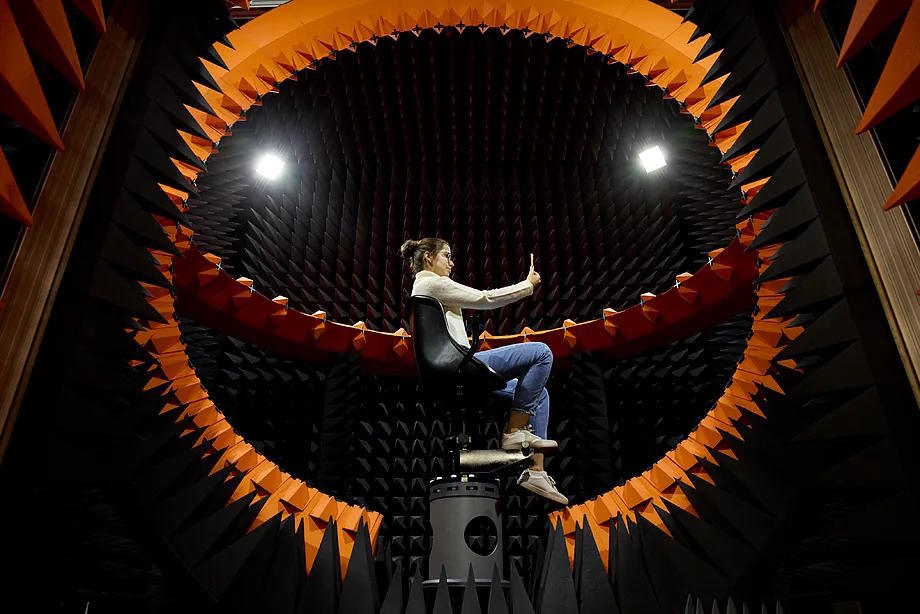
To discover what this is, key are the so-called anechoic chambers. Their interior, full of cones made of a substance similar to foam rubber, may look like a playground, but their purpose is crucial. This 'foam rubber' is filled with elements to emit and absorb signals, allowing the simulation of all kinds of difficult-to-access environments with the iPhone or Mac placed in almost any imaginable position, so that the experience is equally good whether one is lying down, holding the phone with the right hand, or with the left hand.
There are also chambers that simulate the opposite. They repel all signals, allowing the device to be tested in stressful situations where there may be a lot of "noise" on the network, such as events or highly crowded areas.
A whole testing ground compressed into a building in the center of the Spanish city that plays an unsuspected role in the daily operation of millions of devices worldwide.