The first thing many aspiring superstars in South Korea hear when they enter an artist agency has nothing to do with music. "You are products," they are bluntly told. This is recounted by Hark Joon Lee, filmmaker and television producer, and Dal Yong Jin, Communication professor at Simon Fraser University, in K-pop idols: how a global genre is manufactured (Malpaso Ediciones), a raw and shocking essay about the intricacies of the world's biggest idol-making machinery.
In its pages, we delve into a hermetic and billion-dollar industry that has turned Korea into a global cultural superpower. Also into a landfill of complaints about exploitation and psychological pressure on young artists.
"In the West, when something is said to be manufactured, it is automatically understood as something fake," explains Jin in a Zoom conversation. "But the real question is not whether K-pop is manufactured. The question is whether human creativity and emotion can survive within such an organized system. And we believe they can. That's why K-pop is so fascinating."
More than a musical genre, K-pop now represents the most important soft power tool and diplomacy of the Asian country alongside the production of K-dramas, the popular Korean soap operas. A phenomenon that has gone from the success of PSY's Gangnam Style in 2012 to taking the group BTS to the UN General Assembly. Their upcoming world tour - after their members have completed military service - promises to become one of the most lucrative in history, rivaling Taylor Swift's Eras Tour: 80 concerts in 34 cities, including Madrid, with estimated earnings exceeding $1.8 billion.
But behind all the spectacle and fanfare, K-pop fosters a fierce training system that consumes dozens of artists. Unlike the romantic image of the musician as an autonomous creator, the Korean idol system is based on an industrial model where celebrity is planned long before debut. Aspiring stars become cultural commodities: products designed, managed, and marketed within a global business logic. Something like a Fordist assembly line applied to entertainment. "The goal has never been solely to train talented artists, but to create sellable figures capable of attracting international audiences," agree the authors.
Lee knows this well. 15 years ago, he infiltrated the female band Nine Muses for months to film a documentary that became a reference work to understand the industry's dark side. What he found was a mix of ambition, exhaustion, and constant fear of replacement. He confesses that, until recently, he was unable to enjoy the K-pop hits he heard on the radio without recalling "that nightmare experience."
"At first, I thought it was a very cruel system," he recalls. "Aspirants sacrificed almost their entire adolescence. They trained for seven or eight years knowing that they might never step onto a big stage. Only a minimal percentage achieves it, but they still accept that sacrifice because they understand perfectly how the industry works and want to succeed."
"The goal has never been solely to train talented artists, but to create sellable figures capable of attracting international audiences"
For years, major South Korean agencies perfected a star production logic based on intensive training. Children and teenagers were selected in massive auditions and then subjected to long periods of training. Exhausting routines of singing, dancing, languages, image control, and public relations... Their jam-packed schedules resembled those of elite athletes, under the uncertain promise of achieving success sooner rather than later.
Most never debuted.
"There is not really a comparable system in the West," Jin argues. "Korea and Japan developed very specific training models. In Europe or the United States, artists are sought already formed or discovered through competitions, or TV series like Disney, but there is no idea of shaping teenagers within such a rigid business structure."
They point out that this system has partially changed in recent times thanks to reality shows and talent programs. Today, the manufacturing process is no longer clandestine: the public sees future idols compete, suffer, and collapse even before debuting. The machinery has turned into a spectacle. The most recent example is The Pop Academy, a documentary series on the Netflix platform where 20 aspirants undergo the demanding K-pop methodology to form the female group KATSEYE. "Fans not only connect with perfection," says Lee. "They also connect with tears, vulnerability, and imperfections. There is still humanity there."
While the Japanese industry sought to protect its content jealously, Korea quickly understood that virality on the internet could be much more profitable than control. "Korea quickly decided to release its content on digital platforms because it wanted to generate immediate global impact. They couldn't wait for people to rush to buy CDs and concert tickets if the songs were not on Spotify," argues Jin. "K-pop probably represents the best example of completely digital native celebrities."
Idols no longer sell just songs but permanent access to their lives. It is the umpteenth metamorphosis of the K-pop grinder: live streams on social media, home videos, daily chat messages, and a sense of synthetic intimacy with millions of fans thanks to artificial intelligence. Companies like HYBE or platforms like Bubble or Weverse have transformed that closeness into a sophisticated formula of parasocial relationship.
"It is no longer just entertainment. Fans not only listen to music. They generate and translate content, create videos, design choreographies, build friendships, and entire communities around the groups," Lee summarizes. "Fandoms have their own aesthetics and jargon to communicate, like any urban tribe. It has become a limitless social experience."
"Many start training at a very young age and need protection. The future of K-pop should be more ethical, more sustainable, and more respectful"
But all that machinery has an evident psychological cost. Suicides of stars like Jonghyun, Sulli, Goo Hara, or Moonbin are tragic symbols of an industry accused for years of pushing artists to the brink. "There is a real danger of emotional self-destruction," Jin acknowledges. "Many start training at a very young age and need protection. The future of K-pop should be more ethical, more sustainable, and more respectful to the artists."
The filmmaker and producer believe that something is changing, albeit slowly: "15 years ago, many idols accepted almost unquestioningly that they were commodities. Now many are more self-aware and aware of their rights. They begin to see themselves not only as artists but also as individuals."
Both mention the emergence of psychologists within agencies and new regulations driven by the South Korean government after various public scandals. But they admit that the competitive core of the system remains intact. K-pop is nothing but a direct reflection of Korea: of its rapid economic development, its obsession with performance, and a culture marked by extreme competitiveness. "It shows Korea's discipline, speed, and technology," says Lee. "But it also reflects the pressure, competition, and constant desire for success."
Jin recalls that the United States and Europe also have deeply industrialized music industries, although less transparent in their manufacturing mechanisms. "All pop music is connected to the marketing industry. It is an undeniable reality. The difference is that in Korea, the system is much more monitorable," he insists.
The boundary between artist and product becomes even more blurred in the case of female groups, whose members are subjected to impossible physical standards. But both authors believe that hypersexualization now affects practically all artists. "The industry turns bodies into commodities regardless of gender," Jin states. "Previously, the pressure was mainly on women, but now they are also very strict about the appearance of male groups."
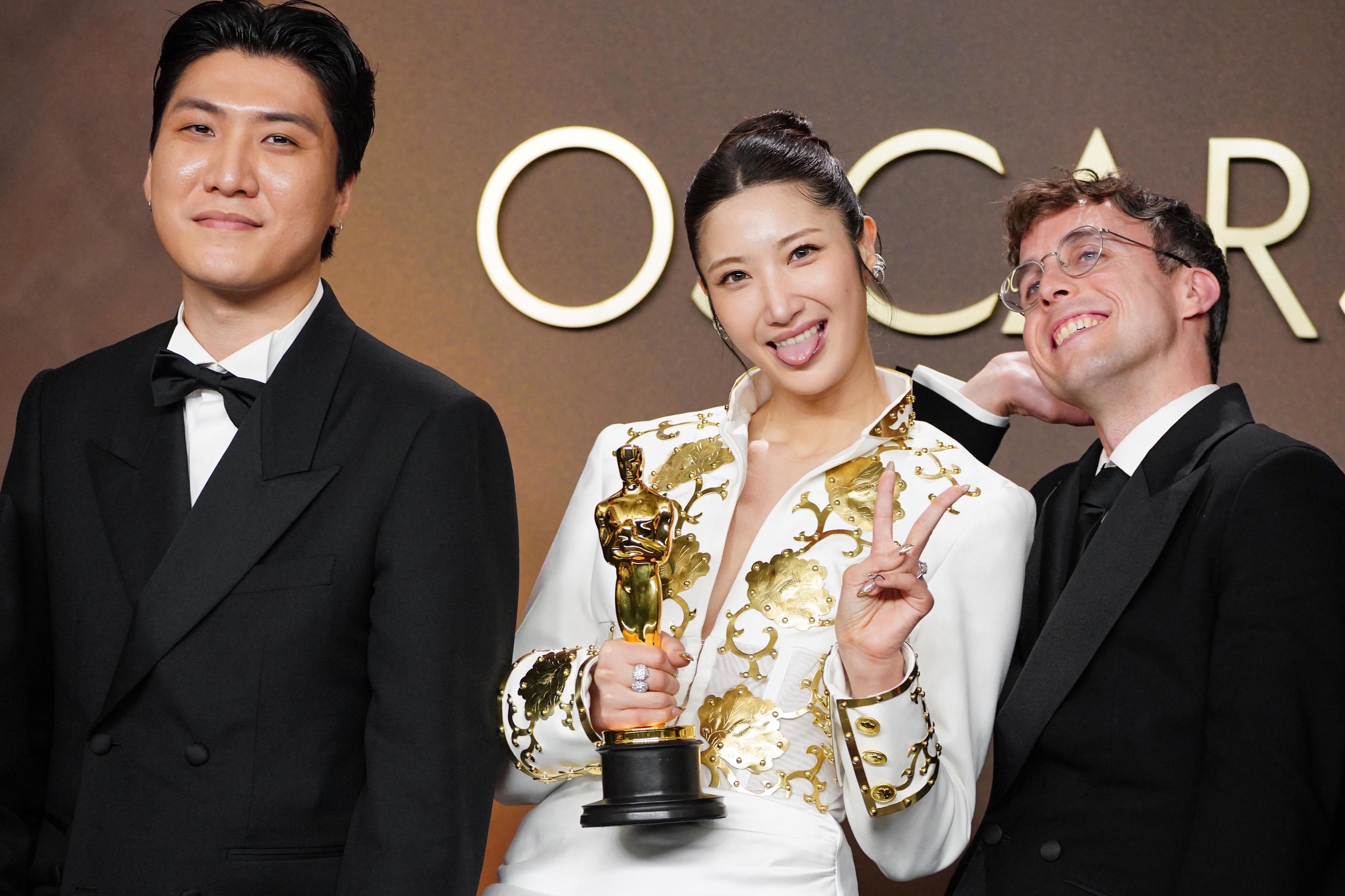
The future of K-pop is no longer in people, but in virtual idols. Lee mentions that even he was surprised to see to what extent the new generations accept fictional digital artists naturally. He mentions the phenomenon of "Las guerreras K-pop," an animated film awarded with two Oscars and whose song "Golden" was the first of the genre to win a Grammy in history.
"My 12-year-old daughter consumes virtual idols with absolute normality," he says with a laugh. "I asked her if she liked EJAE, the real singer of HUNTR/X, and she replied, 'No, I prefer the virtual one.' For her generation, that difference is no longer so important."
The key, he adds, "is not whether the idol is real or virtual. What matters is that the emotion and narrative work." The inevitable question then is how much authenticity and how much manipulation is in that whole ecosystem. And the answer is never simple. The authors insist several times that fandom cannot be reduced solely to commercial exploitation. "Many fans find hope, relief, and companionship in K-pop," the professor asserts. "The songs and performances help them momentarily escape their own problems."
The authors explain that K-pop has not conquered the world just because South Korea learned to manufacture perfect stars, but because it understood before anyone else how to turn emotions into infrastructure. And that ability has elevated it to a fundamental pillar within its geopolitical strategy. Governments know it. Big corporations, too. "When South Korean presidents attend international summits, they want to bring artists like BTS or G-Dragon with them," Jin points out. "They understand that they are essential to winning the hearts of young generations."
Nevertheless, both reject the idea that Korea will forever occupy the global cultural center. Lee recalls a conversation with a famous Korean composer that left a mark on him: "We must not be egotistical. Before, the world consumed American, Japanese, or Hong Kong culture. Now it's the era of K-pop. But others will come after."