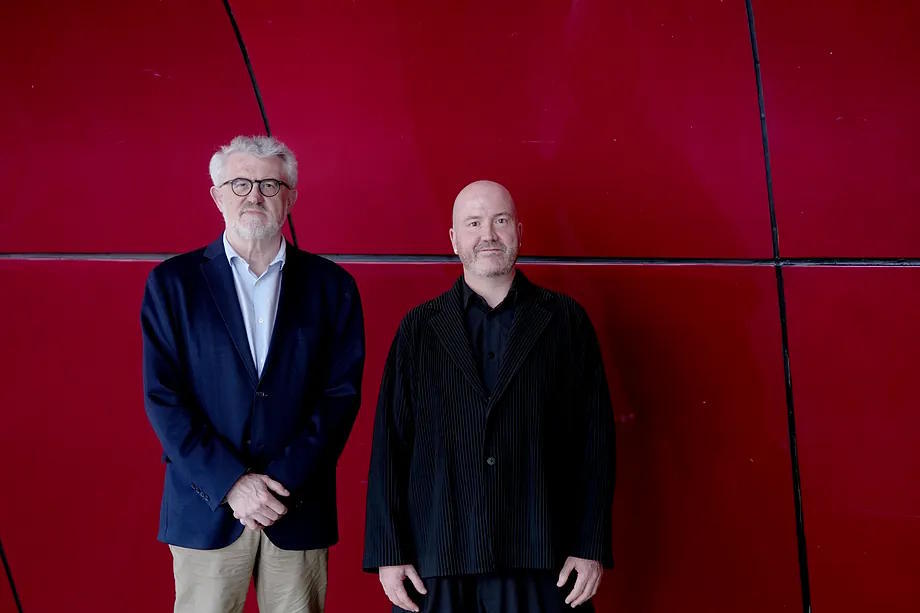
On the blackout day in April 2025, the first call Manuel Segade, the director of the Reina Sofía National Museum, received was from Miguel Falomir, his colleague at the Prado Museum. "Do you know what happened? Let me know if you find out anything. Of course, you too. The kind of call we all made, but with thousands of visitors inside the rooms of both museums.
In reality, Estrella De Diego, a curator and essayist, a woman of 20th-century art who is on the Prado's Board of Trustees, had introduced the two directors. Segade had just taken up his position at the Reina, and De Diego, who is his friend, mediated for him to meet Falomir and the manager Marina Chinchilla, their neighbors across the Paseo del Prado in Madrid. "The first thing Miguel did was encourage me to go to the Administration and ask 'Why can't the Reina Sofía have what the Prado has?'".
These two anecdotes emerged yesterday in the "historic meeting," the first in 35 years of coexistence, between the two directors of the two national museums, the most visited in Spain. Falomir and Segade shared an hour and a half of interview at the Reina Sofía auditorium to celebrate the World Museum Day and to express the collaboration between the two institutions. The Prado director explained that the affinity is not limited to a good personal relationship between their two directors but is more intense at the managerial level. Segade expanded on his description: all teams at the Reina and the Prado are in constant dialogue: curators, restorers, communication professionals, marketing professionals...
The end of the innocent museum: why heritage is today's great cultural battle
This is the most beautiful hospital in the world: tradition and avant-garde in the restoration workshop of the Prado Museum
Antonio Lucas, journalist from the newspaper EL MUNDO, led the conversation between Falomir and Segade and encouraged them, first and foremost, to delve into that institutional friendship, which did not always exist. "In the conflictive years [between the Prado and the Reina], there were no winners. There were losers, we all were," said Falomir. "Today it seems obvious that the two museums share a single collection that starts in one corner of the Prado Museum and ends in another corner of the Reina".
What did Falomir mean when he told Segade that he should demand "everything that the Prado has and the Reina Sofía doesn't"? The legal status, which allows one museum to have more autonomy in its decisions and more financial capacity. "The Prado Law was drafted in a time of plenty [for the State]. The Reina Sofía Law was not. We have a couple of years of work ahead to be able to equalize," said Segade, who explained, for example, that the museum he directs cannot compete in terms of salary for the best professionals in the art sector. "From the year 2000, salaries plummeted, and the promise [of well-paid professional careers] fell through for all of us. Art is a miserable and precarious space."
Is it the same for the Prado Museum? Miguel Falomir made a striking intervention in his colloquy with Manuel Segade and Antonio Lucas: "In 1997, the museum had no capacity for anything. An armored truck would come and take the income to the Ministry of Culture. At that moment, the museum was given autonomy and, since then, has responded very judiciously. We all want more funds, of course. It is said of us that we compete in the Champions League of museums, but we do it with budgets from a lower league. The miracles that are performed in the museums of Spain are incredible. It's fine. All we ask for is trust. If the Prado can create its own resources, and that has been proven, why can't it create an endorsement [a long-term support system] that gives us peace of mind and allows us to plan in the medium and long term? That is the pending task. For 15 years, we have been presenting accounts without any issues. [But there persists] that idea that the Treasury has, regardless of the party in power, that distrust, as if we were going to misuse our resources. If that has not been the case, if we have made good use, if we are credible, let us use formulas that will allow us to plan."
There were more topics in the Museum Day conversation. For example, their place in the public debate of society. In political debate as well. "A museum has to bring together minorities and provide representation. One difference we have with the Archaeological Museum is that we do not shelter objects but subjects that challenge and construct responses," said Segade. The challenge is to find the right tone in a world crossed by populism and polarization. "Something has changed in recent years and is evident in the polis. Many exhibitions were related to agonism and antagonism. Today we see that there must be another space that remains critical but seeks a calmer pattern."
Antonio Lucas, Manuel Segade, and Miguel Falomir.Javier Barbancho
For example, do we talk about a case like the Basque Government's claim for Picasso's Guernica to travel from the Reina Sofía to the Guggenheim Museum in Bilbao? "In 2027, the Reina Sofía Museum has not received any request to lend the Guernica. In 1997, there was such a request. There was a wonderful dossier, with an interesting project, with letters from professors in the US and with a well-structured historical-artistic project. It happened again in 2007. This time it did not. The sad thing is to see that, over these 30 years, the debate in the art space has been impoverished. If the Basque politicians accused us of politicizing for disseminating a technical report that advised against the transfer...," said Segade. "We stopped respecting the channels of art and moved to another place. It saddens me a bit. There is no debate space that is not contaminated by political reasoning."
"When I arrived at the Prado Museum in 2018, I gave 18 interviews," added his colleague. "And in all of them, I said the same thing right from the start: 'Hello. We are not going to ask for the Guernica. My name is Miguel Falomir, please sit down'. The Guernica is wonderfully well placed at the Reina Sofía. Regarding political interference, one must ask what their motive is. A genuine interest in art or short-term instrumentalization?"