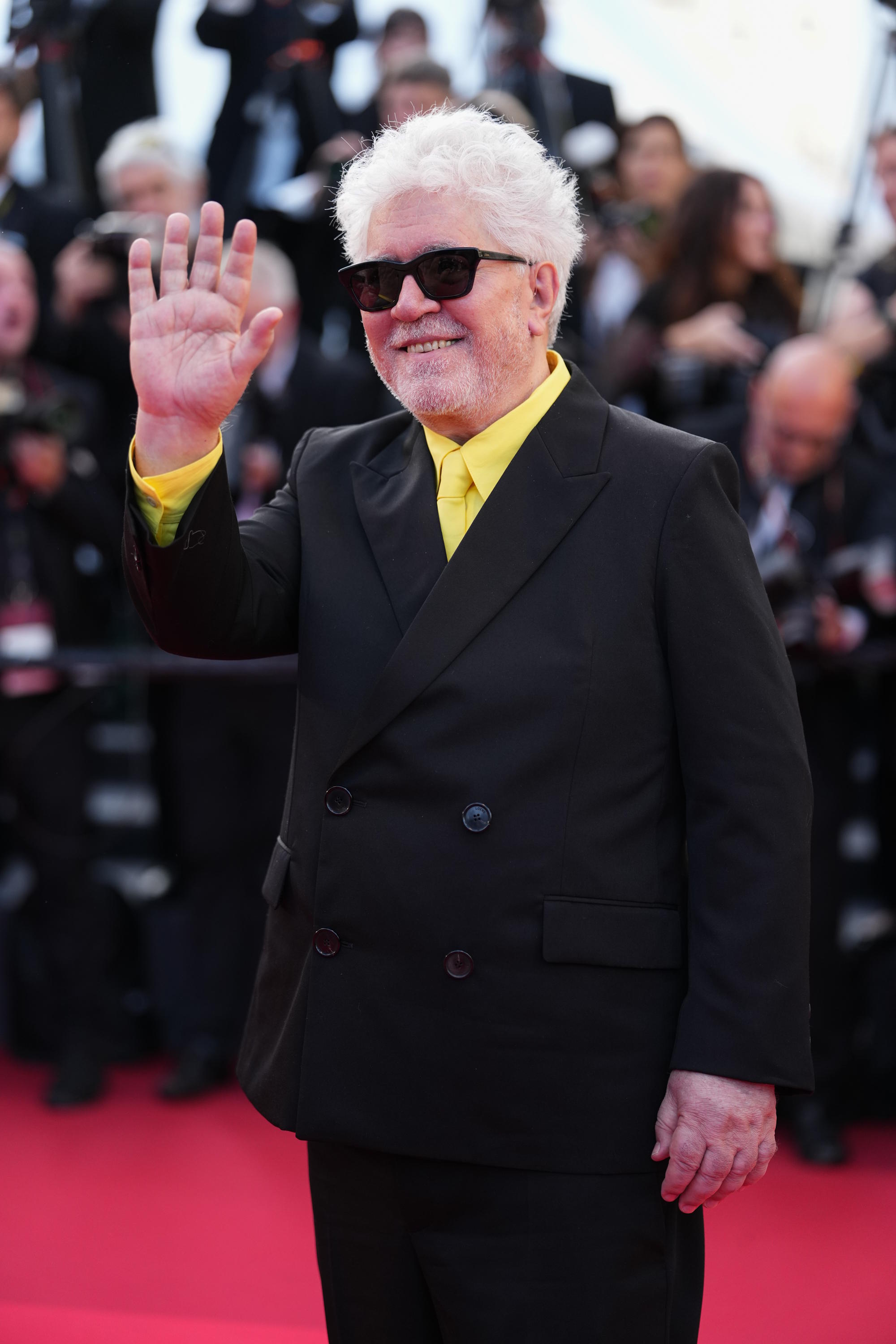
Before, the applause used to be louder. And it's not just an old-fashioned observation, although it is a bit, but rather the realization that there are fewer hands clapping now. Regardless of the event, there are always more mobile phones recording than people doing whatever people do when they are not looking at their phones. After the screening of "Bitter Christmas," by Pedro Almodóvar, at the Grand Théâtre Lumière, the audience started recording and applauding, in that order, and it lasted for 10 minutes. "I know that when I can only watch it on TV at home, I will miss this feeling. There is no warmth like that of the audience in this room," he said with a microphone in hand to thank such fervor. He said it moved and very aware of the audience's dedication, which even interrupted the screening with a barrage of applause after Amaia Romero's rendition of a Chavela song in the movie.
To give an idea, the previous year, very close to the record, "Thelma," by Joachim Trier, received a thunderous 19-minute ovation probably as a prelude to everything that followed. Looking at it from a bit of a distance, it must be acknowledged that there is something indecent about measuring ovations. Not in giving them, but in taking out your phone and starting the stopwatch (the device also serves for that) while others are applauding vigorously. But that's where we are. The democratization of everything (including stupidity) knows no limits, no restraint, and not enough social media platforms.
For all of the above, for the true and the false, and for everything in between, the ovation sounded like a reunion. Or even a reconciliation. The clapping (like storks do) left little room for doubt. Pedro Almodóvar, indeed, has returned to Cannes with all honors. He did so after letting two films pass that he preferred to send to Venice, and after winning the Golden Lion with "The Room Next Door" (in between, let's not forget, he presented the short film and western "Strange Way of Life" here in 2023). Who knows if, like slightly scorned lovers, the manchego wanted to take some time after the slight disappointment with "Pain and Glory" (how close he was before the sudden rise like a tornado of "Parasite," by Bong Joon-ho!). Time heals everything except the wound of time itself.
And more applause. It's difficult to know exactly what is being applauded when applause happens. For some time now, probably since "Talk to Her" (or since the filmmaker's mother's death), Pedro Almodóvar's cinema has become deeper, more personal, stylistically more stripped down, more perfect, more self-reflective, and perhaps even more in need of affection. The director who has best celebrated life, full life, democratic life, life outside the lifelessness of a brutal dictatorship, now seems to be a director facing finitude, facing death itself. This has been explicitly shown in "The Room Next Door" and in a much more elaborate and baroque way in the vindication of creation itself in this "Bitter Christmas" against precisely what is inert, what is given, what dies. And all of this, undoubtedly, deserves applause, and a lot of affection. Even if it's French. 10 minutes seem insufficient for so much, but, as mentioned, hands are scarce with mobile phones.