"They loved each other above all museums. Right hand with left hand. Left hand with right hand. Right foot with right foot. Left foot with cloud. Hair with sole of foot. Sole of foot with left cheek. Oh, left cheek! Oh, northwest of little boats and mercury ants! Give me the handkerchief, Genoveva; I'm going to cry. I'm going to cry until a crowd of everlastings comes out of my eyes. They lay down. There was no other more tender spectacle. Have you heard me? They lay down!".
Federico García Lorca wrote the above paragraph, part of a story titled 'Lovers murdered by a partridge' and dedicated to Guy de Maupaussant, after lying with an American student named Philip Cummings. The story is simple. Cummings had arrived in Madrid to study Spanish at the Residencia de Estudiantes in the summer of 1928. One night, around July 20, he heard someone playing the piano in the common rooms. He approached and discovered that the musician was García Lorca. Pedro Salinas, who was Cummings' professor, made the introductions.
Cummings, who probably knew who Lorca was, told him that he was also a poet and gave him some verses he had improvised after hearing his concert. They spent the night together and dedicated time to each other during the following week and a half. They toured the city as friends and lovers. In the midst of it, on July 27, the first copies of Gypsy Ballads arrived at the bookstores. Its impact was immediate.
On the 29th, Cummings left Madrid, back home to the east coast of the United States. On August 2, he sent a letter after setting sail from Le Havre: "My dear friend: here I am on the great sea and thinking a lot about you - such a nice friend - in Spain the nice - the charming if (so far). I will never forget Spain, the Spanish people and especially my Spanish poet - you - my dear Mr. Lorca. [...] Please forgive my mistakes in the Spanish language, which I know must be many. Your friend always q.b.s.m. [who kisses your hand] Philip".
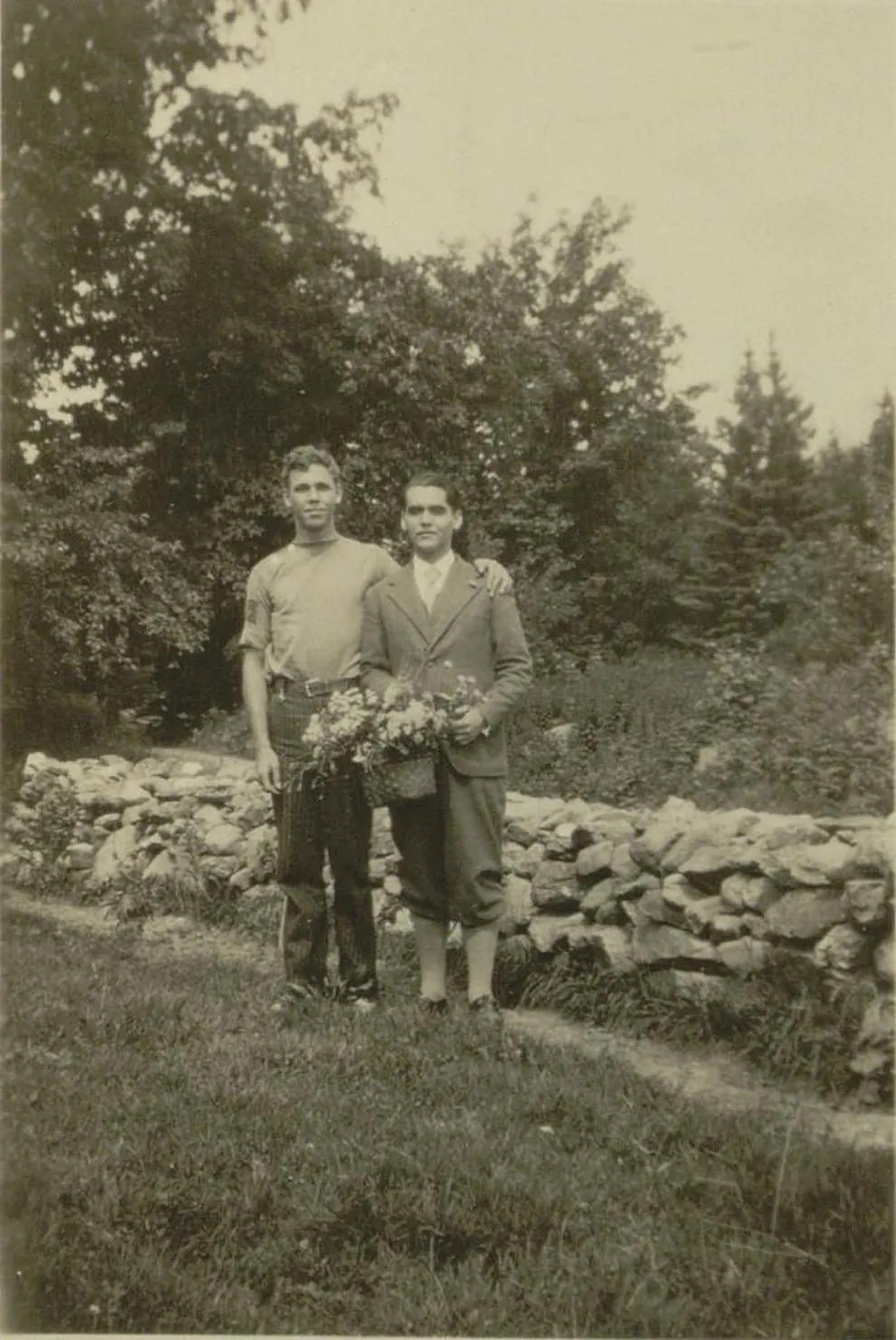
Philip Cummings and Federico García Lorca are embraced in the photograph on the cover of the book Lorca in Vermont (Taurus), by the American researcher Patricia A. Billingsley. The Granada writer carries a basket of flowers in his hands and the subtitle of the book reads: The Spanish poet and his American lover. The fact is not unknown: from the 1970s until his death in 1991, Cummings recounted his love story to Lorca's biographers. This time, their relationship is detailed and projected onto the poems of Poet in New York, written in part under his vital and poetic influence.
"Philip was a fascinating man. He was a survivor. His origins were humble. He was bullied as a child and had a very strict education but, somehow, he got out of there. He was a man with a lot of talent for social life. He understood people, he realized what they expressed unintentionally and what they needed. And that's how he opened the doors to the world. So, if you want, you can say he was a bit manipulative. He knew what to say so that people would adapt to what he wanted. He was a bit of an actor," says Billingsley.
A bit of an actor and a bit of a liar. Cummings invented lives, lineages, friendships, and studies. He was friendly, handsome, and almost red-haired. He had a photo taken dressed as a bullfighter and published a poem in The New York Times. "At that time, poetry was very popular in the United States and Philip had some recognition. He won awards and was published in very popular anthologies after meeting Federico. He wrote in free verse but with a tendency towards modernist ornamentation. I would say he had some talent and he loved poetry. His library was great. I wouldn't say he was a major poet, but he was a good enough writer to connect with Lorca and talk to him about poetry," says his biographer.
And Federico? In July 1928, García Lorca was about to stop being the 30-year-old adolescent he was to become the most important poet in Spain. He was also depressed. Dalí had scorned his Gypsy Ballads, probably influenced by Luis Buñuel. His lover, Emilio Aladrén, had also entered a phase of disdain and disillusionment. The appearance of that American who spoke disastrous and charming Spanish was a wonderful and fleeting relief.
"I'm not sure if Philip saw himself as gay, but I also don't think he felt ashamed of lying with men. He knew, from the beginning, that having homosexual relationships was something not acceptable in public life and accepted the pact of concealment. He assumed the role of heterosexual, got married, and made his life. He had an advantage. His work always allowed him to spend months away from home, to have a double life," says Billingsley. "Federico's homosexuality was more paradoxical. Federico did accept himself as gay, but he lived that choice in a tortured way."
By August, Lorca and Cummings said their goodbyes, exchanged some letters, and thought they would forget each other like summer lovers in winter. That was not the case. During that year, and despite the success of Gypsy Ballads, Lorca was plagued by depression, and some of his friends considered sending him to New York to get some fresh air and broaden his worldview. "That was a very vulnerable moment in his life. The trip to America was an adventure and put him in a position he was not accustomed to. The lack of understanding due to the language barrier, the loneliness... Lorca was far from his family and admirers. New York overwhelmed him with its scale, with its masses and the sound of all its languages. The poems he wrote are of anguish, rage, anxiety, fear... Feelings that were not present in his life in Spain," says Billingsley.
Upon learning of the trip, Cummings invited his friend to visit him at the summer house his parents had rented on a lake in Vermont: Eden. "It's a beautiful place. It's a small lake and is in a very rural area of farms and forests. There is no city nearby, only a few towns. And it remains today as it was in 1929. People go there in the summer to swim and fish and then leave. For Lorca, that was a completely new landscape because the mountain landscapes in Granada are much drier. In Vermont, there is a lot of green. Natural life is everywhere."
And in Vermont was also the lover. In summary: Cummings introduced Walt Whitman to Lorca, was his first translator into English, took him on excursions, and lay with him. But, after a few days, he went climbing with another friend, younger and more handsome than Federico, and flirted with a girl from the town. So the Spanish poet, who did not speak English and depended on Cummings to interact with the world, wondered what he was doing there. And he left. He took a train and spent a few days with the family of another more formal friend, the Spanish professor Ángel del Río, who, after Lorca's death, tried to erase the romantic escapade in Vermont from the poet's biography.
Anything else in the account of events? Yes: the following year, Cummings passed through Madrid again, but Lorca was no longer the same, he had put some distance and protection from the world. Later, Cummings returned to America and continued with his life. His former lover died murdered in another fatal summer.
But that is far from Billingsley's book. In Lorca in Vermont, not only the history of the romance matters but also its projection onto the poems of Poet in New York, first published in 1940. The author's hypothesis is that the escape to Vermont was a radical counterpoint to the loneliness of those months on the island of Manhattan and a bit of light in García Lorca's most difficult poetry, the most surreal and challenging in terms of language.
It would be fair to end with some New York verses by Lorca: New York of mud, / New York of wires and death. / What angel do you carry hidden on your cheek? / What perfect voice will speak the truths of wheat? / Who the terrible dream of its stained anemones? The poem is Ode to Walt Whitman and Whitman, as already mentioned, was the best gift that Philip Cummings gave to his "dear Mr. Lorca."