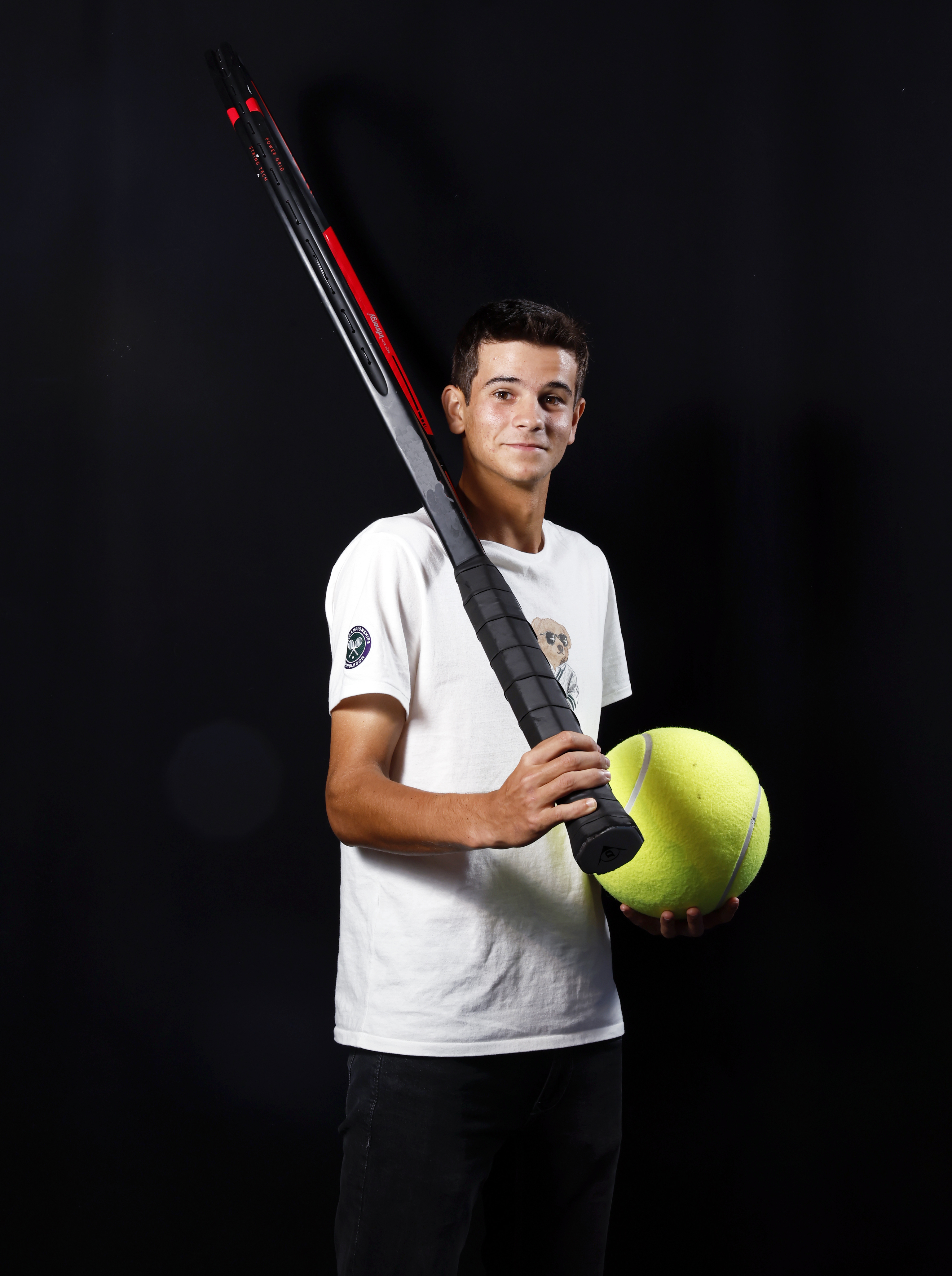
The night before the final of the 2021 National Under-15 Tournament, at a hotel in Cartagena, Rafa Jódar and Luis Llorens shared a bunk bed. They were the two finalists of the tournament, close friends and teammates at the Chamartín Tennis Club. In the middle of the night, Llorens woke up startled. Jódar was sleepwalking next to his bed, holding his racket.
"He said to me: 'Luis, Luis, give me your hand, I've beaten you'. I was amazed. The guy had visualized the victory so much during the day that he was also doing it while asleep," recalls Llorens, who the next day lost to Jódar 6-1, 6-4. "He played me as he pleased. The best part is that when we woke up, we didn't talk about what had happened because neither of us knew if it was real or a dream. It wasn't until after the final that we brought up the subject. Above all, what has always surprised me about Rafita is his competitiveness."
The same boy who learned to hit a ball in the garage of his home in Leganés is now the new sensation of the world circuit at 19 years old, a quarterfinalist at the Mutua Madrid Open and the Rome Masters 1000, and one of the contenders at Roland Garros, where today (around 1:00 p.m.) he plays the third round against Alex Michelsen. EL MUNDO has spoken with those who have accompanied him on the journey to tell how a phenomenon was built.
It all starts with the father. The father appears in all conversations. Behind Rafa Jódar, Rafael Jódar. "I am in the background and I would like to stay that way," he responds when asked for an interview, showing his reserved and discreet character.
A graduate in Physical Education and a Physical Education teacher, those who know him say he came to tennis by chance. It was a coincidence. Before sitting on his son's bench for world tournaments, he was a physical trainer in athletics and basketball, and in fact, he discovered the elite with a women's basketball team. Between 2007 and 2014, he was part of the coaching staff of Rivas Ecópolis, a club with which he won a Women's League, a Queen's Cup, and came close to winning the Euroleague title.
Among his pupils from that time was Amaya Valdemoro, one of the best Spanish players in history. "He was a very hardworking guy, who always told you things straight and was a sports lover," recalls Valdemoro. "We talked a lot about athletics, which we both loved. And by then, his son was already there, carrying his racket." But it all ended abruptly: Rivas went bankrupt, Valdemoro retired, and Jódar's father had to reinvent himself. That's how he came to tennis. From those ruins, this empire emerged.
Rafa son was born on September 17, 2006, at the Severo Ochoa University Hospital in Leganés, grew up without siblings in the Arroyo Culebro neighborhood of the city, and from a young age shared with his father the same passion for sports. He could have been a footballer - he played for several years at Santa Bárbara in Getafe - or even a basketball player, given his 1.91 meters, but he chose tennis.
The first hits, in the garage at home
He took his first hits in the garage at home, with his father throwing balls at him, and the transition to the court came when Rafael father found work as a physical trainer at the tennis school of the RACE Sports Complex in Ciudalcampo. There he met Fernando Varela, a coach who would become the most influential technical voice in his early tennis career.
"At the RACE school, they hired Rafa's father as a physical trainer and he started bringing the boy, who was very young, to receive some classes on weekends," recalls Varela. "That's how we started working together, but the school closed, and we had to find solutions. I managed to get some courts in my urbanization, also in Ciudalcampo, and there I trained Rafa two days a week along with other kids. Then, at Chamartín, where he was a member, he repeated and practiced everything we had worked on with his father."
That dynamic - Varela as the technical guide, the father as the daily coach - would define Jódar's training, along with his eagerness to play. In his many hours at Chamartín, he hit balls with anyone who crossed his path - "even with the veterans," they point out - and there was even a time when he would go to the municipal courts of the Olympia Sports Center in Leganés to add more sessions. There, Lolo Pastrana trained, who is now the sports director of the Chamartín Tennis Club.
"Both he and his father have known how to immerse themselves in the environment. Rafa has always hit balls with all kinds of Chamartín members and listened to their advice. The club has a very particular ecosystem, and that's why Rafa, Martín Landaluce, Dani Mérida, Jessica Bouzas... have come out of here," boasts Pastrana, highlighting Jódar's work as a club player and his work with his father: "He's like the positive version of the Williams' father: very methodical, he even counted the balls his son hit in each session, but at the same time respectful of the coaches' role."
It's hard to find references to the young Jódar because he wasn't a promising player back then, as his entire circle admits. "He didn't stand out," says Pastrana. "He wasn't a particularly good kid," confirms Varela, his coach. "It took him years to beat me," adds Llorens, his friend and teammate. While other players of his generation went to elite academies in Barcelona or Valencia and signed up for online schools to train more hours, the current world number 29 grew up in Madrid without expectations, like any other teenager. Under the influence of teacher parents - his mother is also a teacher - he completed his high school diploma in Science, with Biology and Chemistry, in person at the Rafael Frühbeck de Burgos High School in Leganés, and never gave up on normalcy.
During that time, Jódar also had a flaw that he has turned into a virtue over time. In his childhood and preadolescence, he was a slow tennis player, even very slow. Those who faced him knew that they could beat him by moving him around, so he started playing the way he does now. If he returns so well today, hits with such speed, and is lethal on his backhand, it's because years ago he needed to shorten the exchanges. Boom! and the problem was solved. That's how he began to emerge among the best in the country.
From Promise to Worldwide Phenomenon
After winning the 2021 National Sub-15 Tournament in a sleepwalking state, Jódar remained off the radar until his second year as a junior in 2023. That season started with a victory at the J200 in Valencia, and from there, he took off. "He was 16 years old, and that tournament catapulted him. He had to start in the preliminary phase because he hadn't played much before. He missed many tournaments because they coincided with classes or exams, and his parents never wanted him to skip any," says Álvaro Ribes, coach at Chamartín who accompanied him in many tournaments and recalls how the growth spurt favored him. From then on, his rise: in 2024, he won the US Open for under 18, in 2025 he went to the University of Virginia, and this 2026, now as a professional, the breakthrough.
"He was always at Chamartín with his father, with incredible discipline, seriousness, and professionalism. At that time, I was coaching an American player, Peyton Stearns, who is now among the top 50 in the WTA ranking. I asked him if he could be a sparring partner, and he gladly accepted," recalls Pato Clavet, former Top 20 in the world and winner of the 2000 Davis Cup, now a coach at Chamartín. Those who witnessed the matches between junior Jódar and Stearns admit that the Spaniard would always win "without even pushing himself." "Rafa is very polite, a very correct guy," Clavet describes him in line with all the interviewees.
"He is the kind of guy you can take anywhere, and he will always make you look good. He is not very outgoing, but he always knows what to say," says coach Ribes. "He is a bit reserved, but very kind and, above all, very intelligent. He understands everything that is happening around him, that won't distract him. And he is clear about what he wants," points out Pastrana, sports director. "He has the virtue of hard work. I would even say he is a prodigy when it comes to accumulating training volume," comments Varela, who was his coach. "We make more noise, and he is the calm one in the group, but he is not a quiet or serious guy. He laughs like everyone else, but he is just calmer," concludes his friend, Llorens.
According to reports, Jódar is not very into mobile phones or video games, and the hobby he dedicates the most time to is soccer. A Real Madrid fan, he never misses a match, especially now that he has become friends with Jude Bellingham. Rafita Jódar, the teenager who five years ago woke up sleepwalking with a racket in hand, is now a global star.