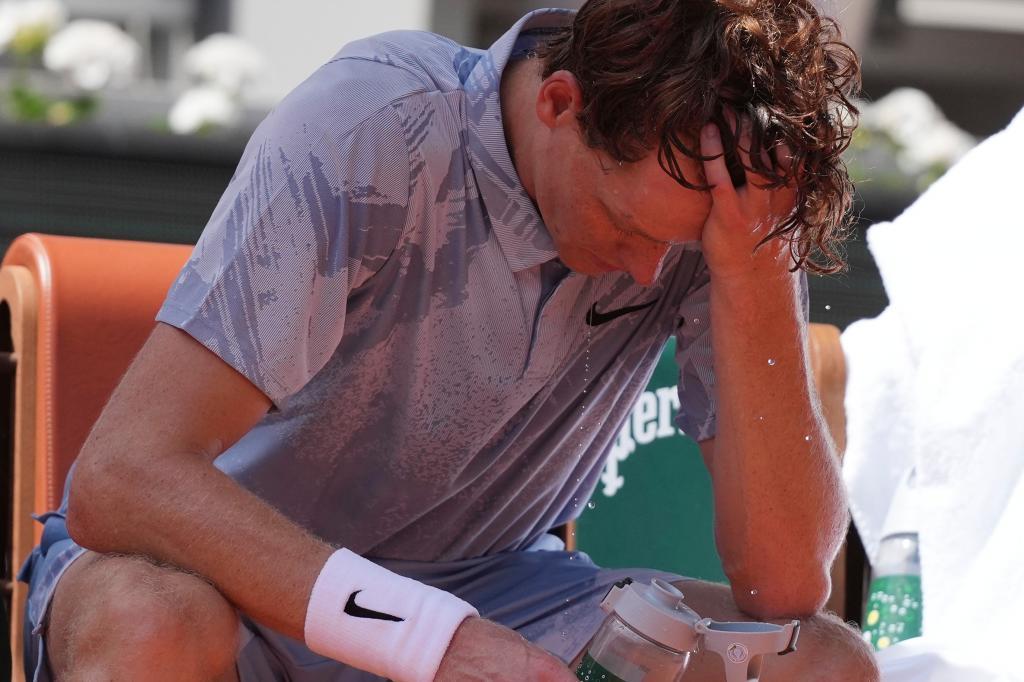
Every winter, Jannik Sinner takes refuge in Dubai. Far from Monte Carlo, where he resides, season after season he meets there with his coaches Simone Vagnozzi and Darren Cahill to evolve in his game and, at the same time, acclimatize to the heat. Intense sessions under the Persian Gulf sun. And his tennis improves, it really does, but as demonstrated this Thursday in his defeat against Juan Manuel Cerúndolo, year after year high temperatures remain his Achilles' heel.
Raised in the Italian Alps, son of the managers of Rifugio Fondovalle, he did not know what it was like to train in the heat until he moved to the Mediterranean coast, to the Piatti Academy, at 13, and since then he has carried the same handicap. With fair skin, and therefore more prone to the effects of the sun, it is not uncommon to see him red-faced during matches or feeling overheated. With stomach issues and cramps as recurring weak points, throughout his career he has already experienced numerous episodes where the heat has led him to retire or left him on the brink of it.
"It's no coincidence that we go to Dubai in the preseason because of the climate. We try to prepare for these types of scenarios. Even so, there are days when things don't go as expected," he acknowledged this season at the Australian Open, where he struggled to defeat Eliot Spizzirri in the third round. A year earlier, he had also suffered cramps and pains in the round of 16 against Holger Rune, and had to retire in both the final of the Cincinnati Masters 1000 and the third round of the Shanghai Masters 1000. "Over the years, I have come to know my body a little better and try to handle certain complicated situations better. I hope that these types of problems will gradually decrease," he commented back then, although for that improvement he will need more than just willpower.
According to several physiological studies, the ideal temperature for sports is between three and ten degrees, and the higher the thermometer rises, the lower the performance drops. Any athlete can lose up to 20% of their capabilities on hot days, and depending on their training and genetics, some are more prone than others to heat strokes.
"Since the 80s, with the studies of González Alonso, the best athletes have worked to acclimatize to the heat. Many events, such as the Tour de France, the Olympics, or the World Athletics Championships, take place between July and August, and there has been a lot of research around them," explains Carles Tur to EL MUNDO, a physiologist, coach responsible for the Q36.5 cycling team, and trainer for the Spanish Sailing Federation (RFEV). Before the Tokyo Olympics, sessions in the heat chamber of the High-Performance Specialized Center in Santander led Nico Rodríguez and Jordi Xammar to medals in the oven that was Enoshima Bay. And in those same containers, where temperatures can reach up to 40 degrees and 70% humidity, the racewalker María Pérez also prepared for months, hating the heat until she learned to master it to become an Olympic and world champion.
Most tennis players do not resort to such training because they rely on the effect of breaks between games and the help of five-minute breaks to go to the locker room, the so-called toilet breaks. But a case like Sinner's might require a more radical solution. Heat adaptation treatment increases athletes' tolerance and even teaches them to sweat more and in more areas of the body - they can go from 70% to 90% of the skin surface -, that is, to better regulate internal temperature. Sweating a lot may be uncomfortable for daily life, but it is a blessing in competition: those who sweat more take longer to dehydrate and are less prone to hitting the wall.
Sinner is already the best in the world, but as long as the thermometer marks continue to challenge his body, he will have a pending debt with the Grand Slams. Science has been offering answers for decades. It only remains for the number one to decide to go beyond his limits to apply them and manage to adapt to them.