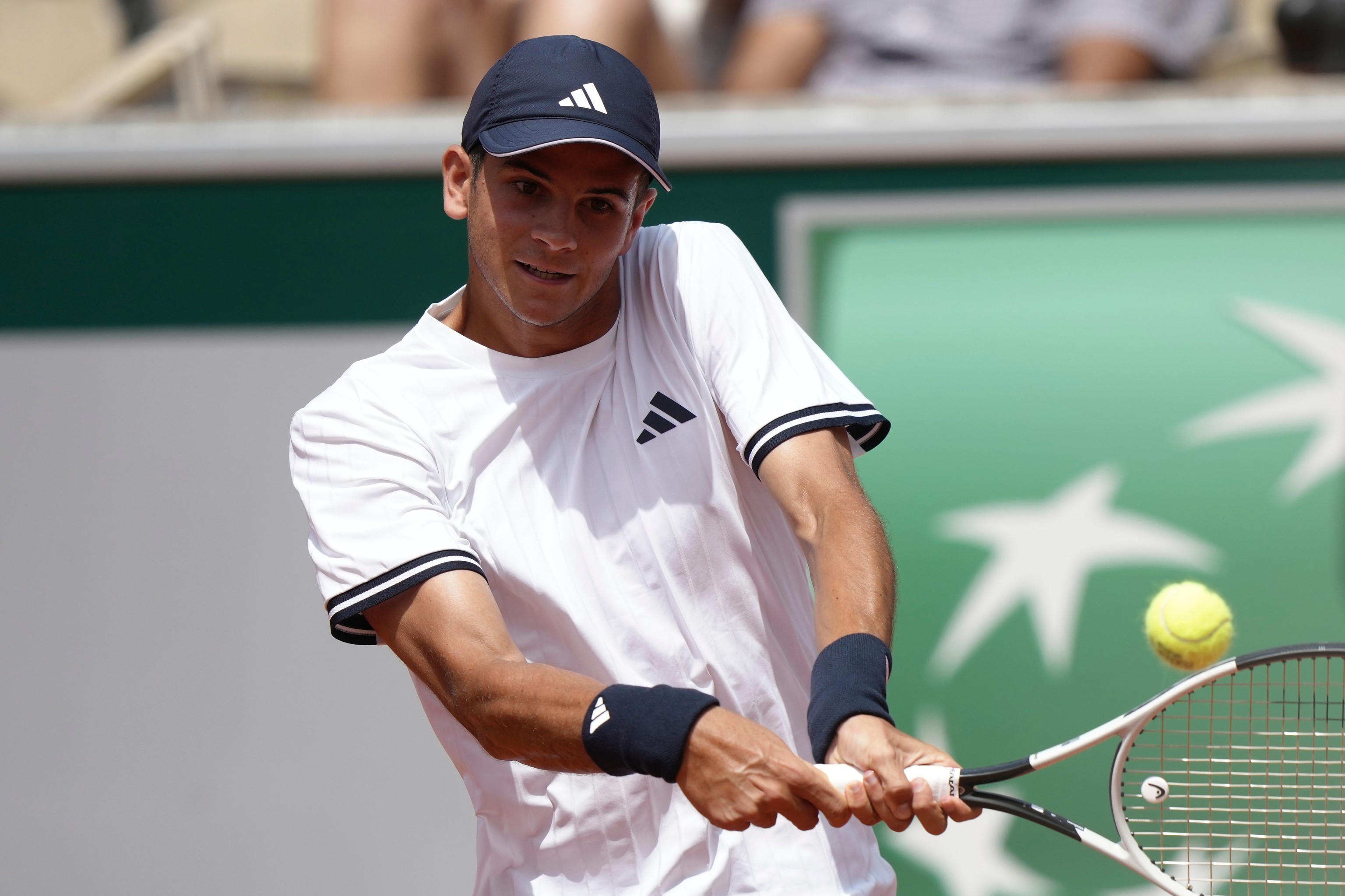
Three rows of six seats: 18 in total. The players' box is a spacious area, usually crowded. Coaches, physical trainers, physiotherapists, managers, doctors, parents, siblings, cousins, and even friends and VIP guests sit there. For example, if the tennis player is sponsored by Nike or Adidas, the representative of that brand usually has a reserved seat. But in each match of Rafa Jódar in this Roland Garros, the box is practically empty. Only his father, Rafael, sits there. No one else.
It is a rarity, something unusual in elite tennis, which even leads to misunderstandings. In the third round against Alex Michelsen, Jódar had to stop the match a couple of times to ask some fans who had mistakenly sat there to leave his area. "Players have the right to decide who sits in our box, and the only one who can sit in mine is my father. I suppose those fans must have had their seats very close and made a mistake, and I just reminded them," the Spaniard defended, rightfully so.
"He has always been with me, has been my biggest support since I was a child," Jódar claimed this Sunday after defeating Pablo Carreño in the round of 16. In his first match on one of the two main courts in Paris, the Suzanne-Lenglen - with a capacity of 10,000 spectators - the solitude of his father was even more pronounced, especially considering that several of Jódar's friends had come from Madrid to support him and chose to sit outside the box.
In reality, there is much symbolism in the decision for the father to be alone. Since he started in the garage of their home in Leganés, Jódar has always followed his father's guidance, although over the years he has had the input of multiple coaches: those from the Club de Tenis Chamartín, those from the University of Virginia, and even some external to both institutions, like Fernando Varela. He and his father, against the world. It was like that in childhood, also in adolescence, and they want it to continue now, in his quest for the elite and on the big stages.
As explained to EL MUNDO by those close to him, the intention is for the structure to remain "at least" intact this year; the future will be seen. Jódar already has help in press management and is considering hiring a physiotherapist, but for now, no one will accompany his father in the box. At the Trofeo Conde de Godó and the Mutua Madrid Open, the Federation's doctor, Ángel Ruiz-Cotorro, briefly joined him, "just in case something happened," and in this Roland Garros, David Ferrer, Spain's Davis Cup captain, has also joined, a place that cannot be denied to him. But that's it.
Jódar's relationship with his father is very particular; from the outside, it is difficult to decipher. At the Rome Masters 1000, Jódar made some reproaches before losing to Luciano Darderi, but it was an exception. At 19 years old, the tennis player does not hesitate to demand solutions when things go wrong, and what he receives are cryptic, brief, and softly spoken directives. There is no continuous exchange or back and forth between them, as with other tennis players. "We have a very special connection. Outside the court, things are seen that are not seen from within, and it helps me a lot," he commented this Sunday.
The figure of the father-coach was starting to become outdated in tennis, although there are still examples in both directions. Alexander Zverev, Jódar's quarterfinal opponent, has always been coached by his father, as have Casper Ruud and Flavio Cobolli, successful models; the case of Stefanos Tsitsipas illustrates, however, that the formula does not always work. For now, Jódar is succeeding with the sole help of his father.