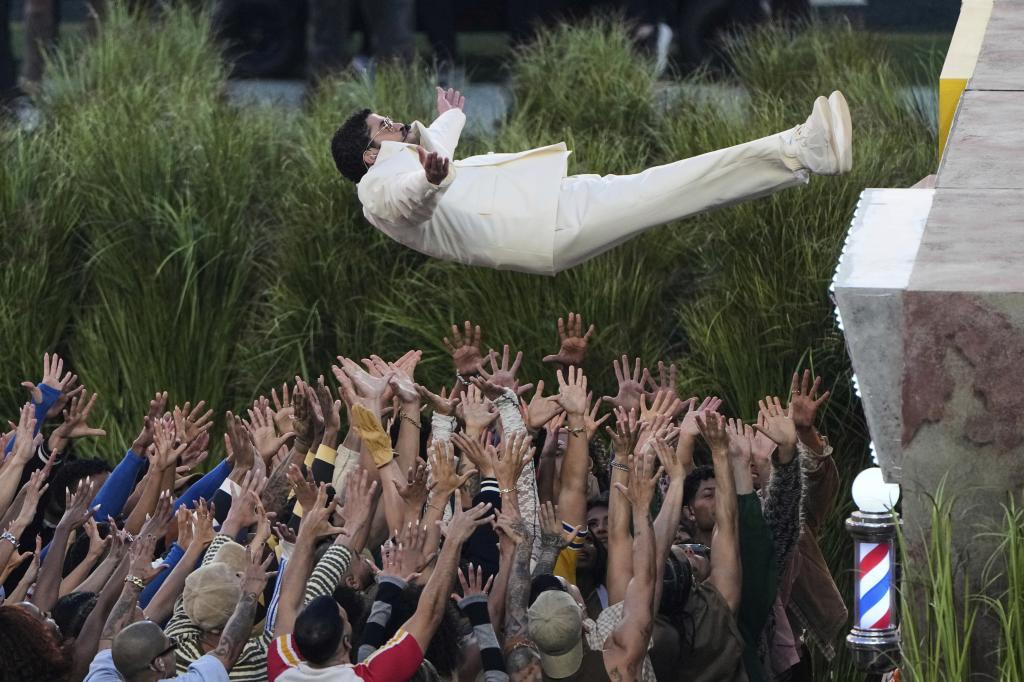
Benito, Benito's son, appears in the center of the stage. He remains still with his eyes closed, enveloped in the explosion of collective enthusiasm bubbling from the dance floor and thundering up the stands towards the Madrid sky. "Benito! Benito!" A deafening minute. 64,000 people shouting with uncontrollable excitement in their bodies, as if the fizz of a soda ran through their veins. They have come in search of fun, they want ecstasy, to exist without limits, even if only for a brief moment.
Bad Bunny wears a suit with a crossed jacket and huge lapels. It's a message: this will be a great urban music party, but it will start with traditional rhythms because roots and authenticity are concepts that will be repeated on this hot spring afternoon at over 30 degrees. Was it a celebration of Latin identity? Were there demands, statements, protests? No, no, no, no. The only message is much simpler: Bad Bunny encourages "to enjoy the small things in life, to laugh, to sing, to dance, and enjoy the people around you" and, above all, "to have a good time." "Madrid, dance and love without fear," he says several times, and that's what the young people have done in each and every song.
This is how the first of the ten concerts that the Puerto Rican prodigy will offer at the Riyadh Air Metropolitano begins, a historic residency in Spain that no international artist had even dreamed of until now. There will be a total of 640,000 attendees only in Madrid, over 750,000 in our country counting the two concerts in Barcelona last weekend. An immense, almost unbelievable record. So the anticipation was huge in the audience, mainly made up of young people, apparently with more girls than boys and with a majority of Spanish attendees (general admission tickets were between 80 and 160 euros, approximately). The show, divided into three parts over two hours and 50 minutes, was experienced with enormous intensity. Bad Bunny had come to offer a great party, and the hyper-excited people were eager to have a blast: the nuclear fusion mechanics worked their magic.
Dancing salsa the classic way
Reggaeton is not the child of salsa, but it has the same purposes: music as a social gathering space, collective dancing, and the carnal touch of bodies. "La mudanza" is a powerful salsa about Bad Bunny's grandparents and parents and about Puerto Rico's struggle for independence. Pride translates into a strident shake of trombones, trumpets, and percussion that the young orchestra Los Sobrinos unleashes at full volume. Atomic Nephews! The concert has just begun, and everyone is already dancing. Time has ceased to exist.
The Metropolitano is half crazy, and maracas sound here to dance "Callaíta," a melodic reggaeton with traces of a ballad from seven years ago. With the orchestra, the song moves completely differently from the original: the piano takes the lead, cheerful and vigorous Latin jazz, while the wind group releases danced flashes to the last row of the stands. It is the only song in this first part that is not included in "Debí tirar más fotos," the Grammy-winning album of 2025 that has turned Bad Bunny into one of the biggest stars in the global pop scene.
The record-breaking album combines reggaeton, dembow, and trap with traditional Latin music genres. It is in that tradition where the concert begins as a sound journey. A beautiful example is the next song, "Pitorro de coco," a tribute to Puerto Rican folklore with the rhythm of plena and jíbaro music, rural sounds of the island's festivities. Without winds or piano, the spotlight is on the cuatro, that little guitar that is to Puerto Rico what the tres is to Cuban music.
More salsa and very melodic and romantic is "Weltita," where the Chuwi singer forms a great duet with Bad Bunny. The orchestra sounds elegant and joyful. There is no electronic bass drum underneath, no reggaeton hint either; not even in "Turista," a deeply melancholic bolero. The artistic gesture of starting with music from the past even changes Bad Bunny's way of singing, interpreting it like a classic, avoiding melodic excesses. Everything flows great, despite the reverberant and confusing sound of the stadium, where nuances are lost, and the voice must be at a very high volume.
Two of the best songs from the album, "Baile inolvidable" and "NuevaYol," light up the end of this salsa section, which lasts 45 minutes. Los Sobrinos is not the best Caribbean orchestra in the world, but it is the best for this Bad Bunny of yesterday and today because it understands the codes of the past and the present. It plays traditional music and adapts it to urban music, doing so in such an organic way that it excites and dazzles. In "Baile inolvidable," there are elements of salsa and bomba linked with trap references. However, the most incredible fusion is found in the powerful "NuevaYol," which swiftly transitions from salsa to dembow, with a heavy flow and the first electronic rhythm of the show bouncing on the buttocks. It is the first time we will see the entire stadium jumping. Something incredible.
'Bellaqueo' at La Casita
The second part of the concert takes place in "La Casita," the stage located at the other end of the field and at the other end of the musical spectrum. With the sophisticated electronic production of "Veldá," a varied cycle of reggaeton and trap songs mainly from "Yhlqmdlg" (an acronym for "Yo hago lo que me da la gana," a title that was and is a statement of principles) and "Un verano sin ti" begins, two of the best albums in reggaeton history.
This is the Bad Bunny that his longtime fans love: with the characteristic theatrical phrasing that has distinguished him, in a tracksuit and without an orchestra, mischievous and naughty, singing boldly about frenzied copulation surrounded by celebrities, with Ester Expósito twerking with a fan, actresses Ana de Armas and María León by his side, Marta Ortega behind, Italian influencer Chiara Ferragni, and footballers Carreras, Ceballos, Camello, and Isi, who could sing "In the morning, coffee/ In the afternoon, rum/ Take me to Leipzig/ Isi Palazón."
"Tití me preguntó," between dembow and reggaeton, accelerates powerfully and rapidly like a bullet train while the stadium is swept by hundreds of laser beams. The ballroom has definitively closed; we have reached the disco. "Neverita" has synthesizers and a classic house bass drum: its chorus is sung while jumping. The disco vibe intensifies with the 'eurodance' arrangement of "Si veo a tu mamá," sounding like a club anthem from 25 years ago. People jump as if the floor were hot coals; it's a big party, a tsunami, a frenzy.
Reggaeton on the rooftop and twerking all the way down
Bad Bunny spends over 15 minutes greeting and talking with people in the front row, shaking hands, hugging, and taking photos. He selects several fans to shout the war cry "Acho, PR."
We have reached the core of the concert, and Bad Bunny's core is reggaeton. The rooftop of La Casita is the stage for a series of songs bursting with sexual tension and declarations of love, the themes the Puerto Rican has always sung about, who, despite his name, is a hopeless romantic. These are commercial crowd-fillers that inject a surge of adrenaline into the audience as soon as the first chords start playing.
The party starts with "Voy a llevarte pa PR" and "Me porto bonito," one of the biggest hits of his career. These are two shakes of classic reggaeton with references to twerking that the singer performs with energy and some cheeky rap verses. The remix of "No me conoce," by Jhayco, is one of the smoother reggaeton tracks in this section, with sentimental pop melodies contrasting with the hard and streetwise sound of "Bichiyal" and "Yo perreo sola."
These two songs evoke the reggaeton of the early 2000s and flow seamlessly into one another, prompting the crowd to shout out choruses they've memorized from countless nights at the club. More pop-oriented and sweet is "Efecto," another mega-hit whose lyrics are recited by thousands of people in a chorus that rises from the dance floor to the stands like a 12-meter wave until it spills out the stadium gates.
Trap with pride
"If you leave here without having perreado, you can't say you were here," is a statement of principles. "I want to see Madrid perreando," he says as Safaera begins to play, one of Tainy's most ambitious and avant-garde productions—many songs in a single track that sounds crisp with beats denser than sweet potato purée. Its succession of changes is accompanied on the giant screen at the back of the stage by perreo for those 18 and older. Bad Bunny moves across the roof of La Casita as if he were a boxer in a ring.
2026 marks the 10th anniversary of Bad Bunny's first well-known song, a dirty trap track called "Diles." It's a hard-hitting track that comes across as a burst of arrogance that old-school fans sing with rage. If the succession of reggaeton hits is like a playlist of disco classics, this part of the concert serves to explain the identity of this dazzling artist. Diles is the beginning of it all and has the metallic taste of pride.
A second dark trap banger, "Mónaco," builds slowly with its serpentine violin sample. There are seasoned rappers who couldn't fill a stadium with this kind of charisma.
Myke Towers, Bad Bunny's special guest
Fellow Puerto Rican Myke Towers appears as the guest for Bad Bunny's first night in Madrid. Together they sing "Adivino," and then he performs a solo, intense medley of several mega-hits like "La playa," "Peligrosa," and "La falda"—a mini-concert within the concert.
La Casita closes with two songs of completely different sounds: the electronic beats fade out and Bad Bunny returns to celebrate his country's roots, playing the most traditional music of the night. Accompanied by a small group consisting of three tambourines and a güira, he performs "Café con ron," a plena that evokes the rural celebrations of Puerto Rico. The group accompanying him, Los Pleneros de la Cresta, stays on to perform a second tune from their repertoire in this tribute to popular music. Meanwhile, the singer slips away to prepare for the concert's finale.
The Grand Finale: From Reggaeton to Pop
Back on the main stage, we find Bad Bunny, who is already one of the world's biggest pop stars.
In these smooth, polished tracks, reggaeton takes on its most pop-oriented and accessible form, starting with "Ojitos Lindos" and "La Canción," his sweet 2019 duet with J. Balvin that remains one of the most popular songs of his entire career. This melancholic tale of heartbreak (with live trumpet and a chorus in mass-karaoke mode) is followed by another song about a broken heart, "Kloufrens," in which the synth arpeggio takes center stage even more than in the original recording.
These three mellow tracks give way to two classic college party anthems. The iconic "Dákiti" is once again a reggaeton mix, but not with pop—rather, with sleek club electronic music. The effect on the crowd is instant: they're danced to and sung along to from start to finish like generational anthems that explode into two of the catchiest and most classic choruses in his repertoire. The same sense of connection overflows in "Yonaguni."
The concert ends where it began, with the celebration of Puerto Rico in "Debí tirar más fotos." Everything the album represents—identity, the dignity of the people, nostalgia, and the sense of injustice regarding the island's situation—is all there in DtMF. And, although it begins on a melancholic note, it is imbued with joy and bursts into a collective celebration of love and affection, and that is exactly how this Madrid night is experienced: its memorable chorus is sung along to as if it were the passport to absolute happiness. Time continues to stand still.
Bad Bunny's decision not to end the concert with this song, but rather with a bang of raw, street-style reggaeton that celebrates perreo, is a statement of intent and, at the same time, a logical move. Reggaeton has been dismissed for many years as simplistic and vulgar music; it has been looked down upon by moralistic interpretations of music that are heavily tinged with classism. Perhaps that is why Bad Bunny does not bid farewell with the beautiful sentimentality of DtMF, but rather by representing the thuggish sound of reggaeton without any pretensions of social commentary—a killer beat that gets right into your gut and is pure party music, which he has never stopped embodying and elevating throughout his career until the entire planet has danced to it.
The song is "Eoo," and its turbulent, syncopated electronic beat is accompanied on the screens by a giant message that flashes before your eyes: "Perreo." Fireworks, columns of fire, and thousands of disco lights fuel the massive frenzy that erupts. If anyone isn't dancing, they should head to the hospital tomorrow.
Bad Bunny takes his leave as the fireworks explode, and a classic reggaeton beat plays on repeat through the speakers. Perhaps it's some consolation for all these people to know that, after all, they weren't such idiots for singing and dancing to reggaeton.