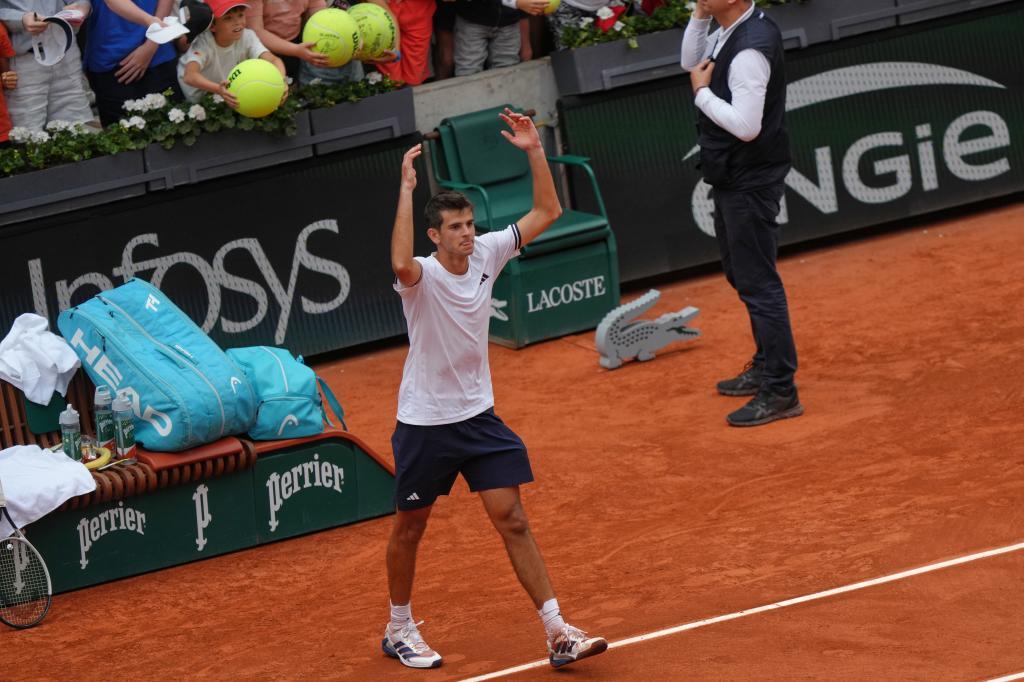
Just a year ago, Rafa Jódar was ranked 671st in the world and was lamenting a defeat in the Tyler, Texas challenger, a tournament so modest that it doesn't have stands or an official website. This Tuesday (around 4:00 p.m., Eurosport), now ranked 23rd in the ATP rankings, he plays in the quarterfinals of Roland Garros at the Philippe-Chatrier against Alexander Zverev. Here there are stands and even a website. The contrast is so surreal that it deserves an explanation.
The summary is that he spent a year studying Economics at the University of Virginia, competing in the NCAA university league, and could only participate in minor competitions in the United States when there were no classes. But what was Jódar doing at the university? He had already been a US Open junior champion, knew renowned coaches, was courted by commercial brands; he already had doors open to professionalism.
But both he and his father were convinced that this year at the university would complete an unfinished education, and it did. "That stage helped me a lot to develop as a person and also to become a better player. They were very important months in the process," Jódar commented last week about an unusual path - his own - to rise to the elite. It wasn't fear; it wasn't studying a degree in case tennis failed. It wasn't ignorance. It was the certainty, shared by father and son, that it was better to grow away from the spotlight of Grand Slams and Masters 1000. There were those who insisted to both of them to turn professional. There were calls, meetings... and nothing.
To understand the story, we have to go back a year earlier, to the spring of 2024. As a player from the Club de Tenis Chamartín all his life, he had been a junior champion of Spain, and the Spanish Tennis Federation wanted to propel him to the top. As soon as he finished his exams at the IES Rafael Frühbeck de Burgos in Leganés, he left Madrid and settled in Sant Cugat, near Barcelona, to train at the prestigious BTT academy under the guidance of Francis Roig, former coach of Rafa Nadal.
"He lived with the rest of the young players in a house we rented, and every day he got into the van like everyone else. We assigned him a coach, Harrison Lambe, a young Australian trained by us, under Francis's direct supervision. And with him, he reached the quarterfinals at Roland Garros junior, won in Rockhampton in his age category, reached the quarterfinals at Wimbledon junior, and in the end, he won the US Open junior," recalls Jordi Vilaró, director of the BTT academy, who adds: "He was slim, but he already had good physical qualities, hit the ball very well and cleanly, and above all, he was very solid. Juniors usually have many ups and downs, and he didn't have them."
That's why, from the Catalan academy, they tried everything to get him to start participating in the big tournaments. "Together with Francis Roig and Javier Soler, sports director of the Federation, we made several attempts to convince the father to bet on the professional world. Even Francis traveled to Madrid to meet with him. But he was very clear that his son would go to university, and there was no way to change his mind," Vilaró recounts, who had to say goodbye to Jódar at the end of 2024. In the end, goodbye to the ATP circuit: he was off to the University of Virginia.
"Rafa joined us in January 2025. We had met at the US Open junior he won, and we already had a good relationship. He moved into the tennis residence with nine teammates and spent his time off the court with them," narrates Brian Rasmussen, Jódar's coach at Virginia, with whom he maintains a close friendship. So much so that at the last Australian Open, he traveled to Melbourne to sit next to his father in the stands. The Spanish player was roommates with the Korean Kim Jangjun and among his teammates were also Americans Roy Horovitz, Keegan Rice, and James Hopper. None of them has debuted in the ATP yet.
Rasmussen confesses that one of the things that amazed him the most about the Spaniard was his grades. "He had two incredible semesters. Coming from abroad and with tennis, in his first year, he maintained a GPA of 3.5 out of 4, meaning he excelled in almost all subjects. He dedicated a large part of his time to being the best student possible. It was very important to him and his family," Rasmussen concludes about the guy who last year was competing to be the NCAA Rookie of the Year - and he was - and today is playing in the quarterfinals of Roland Garros.