"The success of a designer's work is that, when a customer sees one of the brand's cars, they associate it with the values of that brand," Jorge Díez, design chief at Cupra and Seat, told this newspaper some time ago.
"We can create desire and sympathy or the complete opposite," added Juanma López, with a long career and now in charge of the styling of models at the Chinese company Xpeng, in the same interview.
And is it more or less complicated to design an electric one? we asked Alejandro Mesoneros, the head of these tasks at Alfa Romeo: "It has its complexity because the 'skeleton' changes, and therefore, the suit changes too and how it fits," he replied.
FERRARI LUCE. It measures 5.03 meters and is the brand's first electric car. Also, its first five-seater car. It has a motor per wheel, with a combined power of 1,050 HP, and the range reaches 530 kms. Sir Jony Ive, the legendary designer of Apple, has participated in its creation. Its price is 550,000 euros and will be available at the end of the year.
It's as if Ferrari had taken those three premises, put them in a blender, and the result was the Luce, its first 100% electric model and, undoubtedly, one of the most controversial cars in recent years. Because not even when the renowned Italian brand launched the Purosangue - which broke molds with its spacious interior, four doors, and SUV body - did it provoke such rejection.
The car was unveiled on Monday and became the subject of memes and jokes on social media from day one. Even a historical figure like former president Luca Cordero de Montezemolo has requested that "at least they remove the 'cavallino' logo" because "it risks destroying a myth." But beware, few jokes: the design mishap with the Luce, because that was the cause, caused Ferrari's stocks to plummet on the stock market, where it lost 5 billion in just two days.
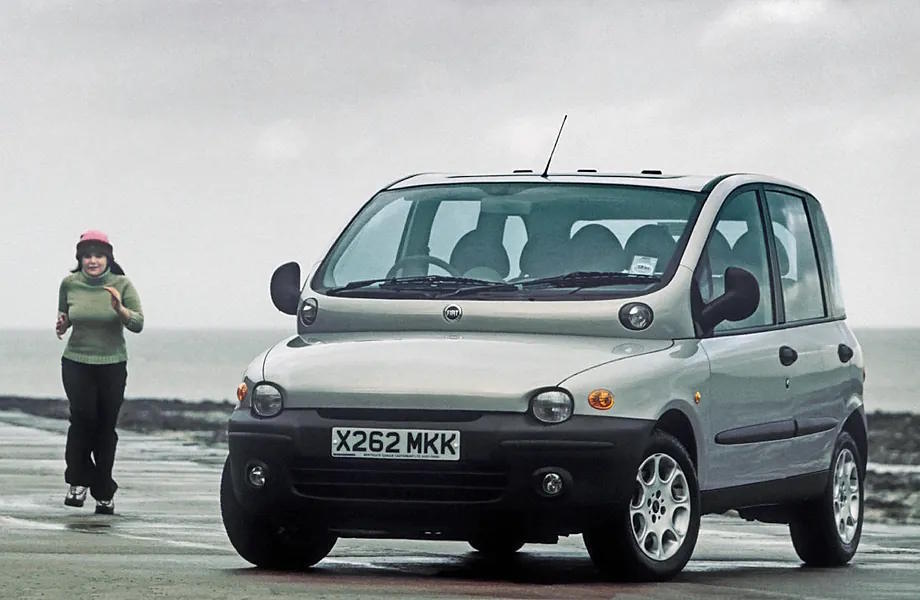
FIAT MULTIPLÀ. The best example of how a disastrous design can ruin a great product. In just 3.99 meters (like a utility vehicle), it made room for six people and a lot of luggage. Besides, it performed very well. Its second generation was slightly more attractive, but it was already fatally wounded. It was sold between 1998 and 2010.
The reasons? By seeking that differential image - and also a new clientele that it doesn't need - it has created a car that no one would identify at first glance as a Ferrari and its traditional values; and instead of desire and sympathy, it has caused widespread rejection.
Given its restrictive production policy and the tens of thousands of wealthy individuals eager to have an Italian car in their garage, the company will have no problem selling the units it produces. There may even be customers - not the classic Ferrari enthusiasts - who see it as a business opportunity to acquire a car that, due to its rarity and controversy, could appreciate in the future. And there will always be China, where the Luce, with its very technological imprint that makes it almost like a smartphone on wheels, has a fertile ground.
JAGUAR TYPE 00 CONCEPT. It is the prototype that previews the main features of the Type 01, figures that indicate it is electric and the first model of the new era of the British brand. The production model will be a sedan of over five meters and around 1,000 HP that will be available for sale before the summer of 2027.
But controversy is neither new nor will it be the last. We can remember that even Porsche purists were outraged when the Cayenne SUV was launched in 2002. Not because it was a failed design, but because, for those customers, the whole concept itself was almost a heresy for the brand that invented the 911. Later, this family SUV turned out to be as sporty as one could expect and, it is universally acknowledged, saved the German company from bankruptcy.
More recently, in 2024, Jaguar also made headlines. The British brand, practically absent from the global scene, will reinvent itself solely as 100% electric and will launch its first new model, a sedan called Type 01, next year. With large proportions, it aims to be a kind of luxury batmobile, and the prototype that previews it, the Type 00, also sparked a great debate as one of those creations that evoke love and hate in equal measure. Although the climax came with the logo change: we will no longer see the iconic jaguar leaping over a hood; it has been replaced by the name chiseled in minimalist letters.
LAMBORGHINI LM 02. It originated from a failed military project and ended up being a beastly off-road vehicle for wealthy Arabs. Its V12 engine with up to 450 HP consumed so much that a 290-liter tank had to be installed. Between 1986 and 1993, only 300 units of the so-called Rambo-Lambo were made, highly valued today: it does not drop below 400,000.
According to the brand, the intention is to break with the past and leave behind an "outdated" image. For enthusiasts, it is a betrayal of the values of a manufacturer whose first car, the Jaguar SS100, was introduced in 1935. And for Gerry McGovern, the design chief, his last work for a company where he spent 21 years: last December, he was abruptly dismissed by Tata's new boss, the owner of the British brand.
Because all studies agree that design - or brand image in a broad sense - is one of the determining factors for purchasing a car. Even above price or technology in the case of premium manufacturers, where the customer's budget is much more comfortable.
NISSAN CUBE. It was like a shoebox on wheels with asymmetrical windows, but it provided a lesson in interior space utilization. Produced between 1998 and 2018, it became a cult favorite in Japan, and only its third generation reached Europe, with minimal success. Its designer said he designed the rear inspired by Jennifer Lopez's behind...
And the shape of cars is determined by many factors, such as meeting safety requirements or pedestrian protection. In the case of an electric model, achieving the best possible aerodynamics is essential as it translates into more autonomy in kilometers. And although the absence of a combustion engine provides greater freedom, the battery placement also poses a challenge as it raises the vehicle's height, resulting in more wind resistance. Therefore, although the SUV silhouette remains dominant in the market, the trend is towards seeing increasingly lower models.
Without neglecting the fully electric world, the initial approach was, above all, to propose cars with a different style that would set them apart from their combustion siblings and offer a distinctive image - as is the technology - to the general public. Just remember the first Nissan Leaf from 2010 and in recent years, the EV model family at Kia, although in its sister company Hyundai, each of its electric models is a mix of both.
SSANGYONG RODIUS. Launched in 2005, it was very unlikely to be visually appealing, but it compensated with its seven seats and a large trunk, at van level, but being a car. It also had all-wheel-drive versions. It had a second generation in 2013, more aesthetically acceptable, and ceased production in 2019.