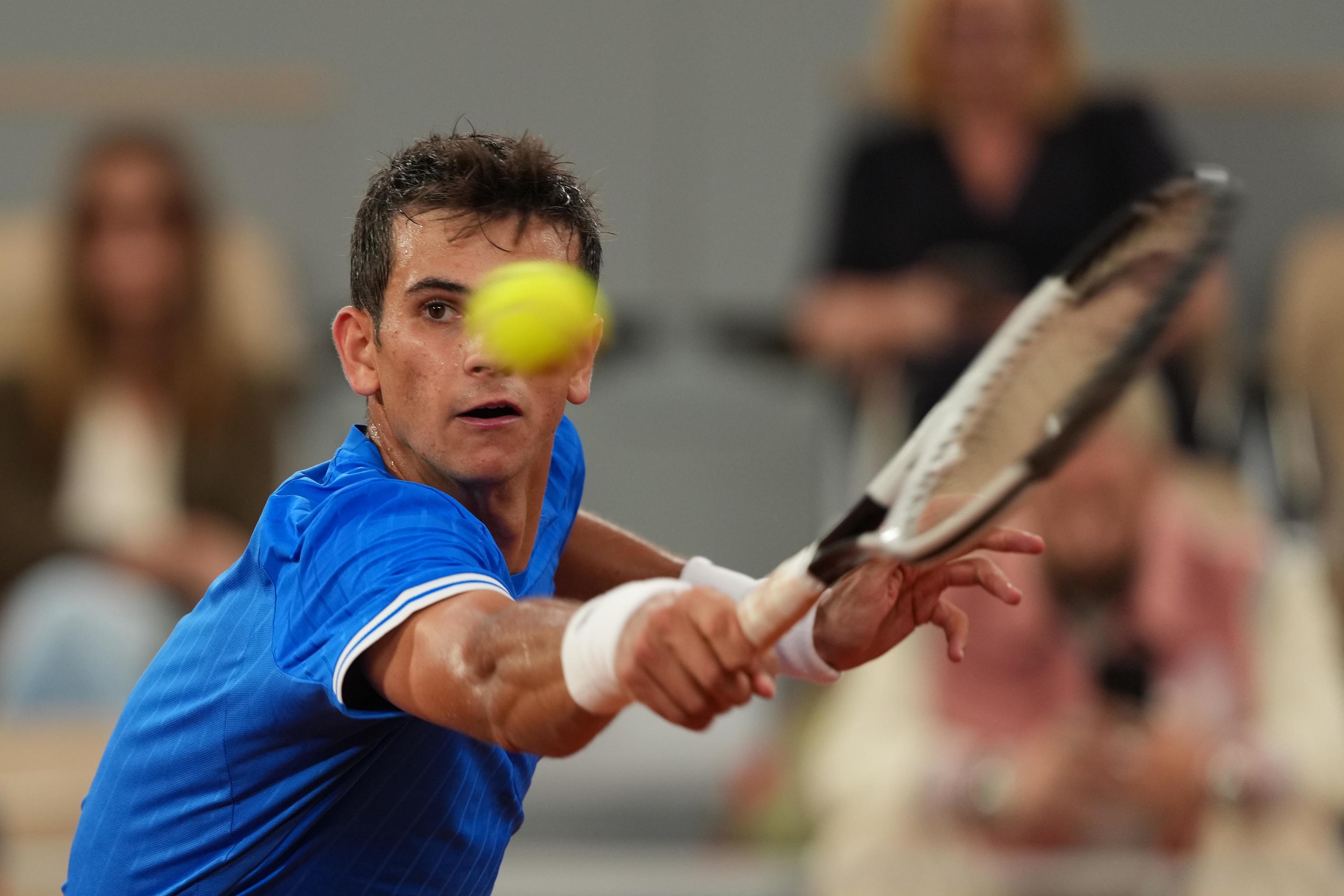
An American journalist from one of the most read media outlets approaches the long table where the Spanish correspondents work in the press room on the ground floor of Philippe-Chatrier with an intriguing theory. "Hey, do you know if Jódar was named Rafa after Nadal?" he asks, and the question requires clarification: "How?" "Of course. Nadal won his first Roland Garros in June 2005, and Jódar was born just a year later."
The reality is less novelistic. Rafa Jódar is named Rafa just like his father, grandfather, great-grandfather - and 200,000 other Spaniards. But the international press's interest in his name, his story, and everything surrounding him confirms the magnitude of the phenomenon: this Roland Garros sparks madness for the new Rafa.
"Meet the new Rafa planning to conquer Roland Garros," titled a report by the BBC. "The new Rafa: Rafael Jódar is captivating the French Open crowds," highlighted ESPN. "Jódar, the new Rafa from Spain," emphasized L'Équipe. Despite his defeat this Tuesday against Alexander Zverev in the quarterfinals, the Spaniard experienced his debut with a name loaded with memories and captivating tennis as an argument.
"He is the revelation of the season. He plays like a tornado. In the end, he was defeated, but I am sure Sascha [Zverev] was a bit shaken when he found out who he was playing against in the quarterfinals. It was a real test for him," analyzed Boris Becker, a six-time Grand Slam champion, who highlighted Jódar's game's "aggressiveness" as "refreshing."
"He has something unique, quite unusual. He has taken things from several players. These young guys play with tremendous natural power," added John McEnroe, a seven-time Grand Slam champion, in conversation with EL MUNDO, along the same lines.
Farewell to the "Spanish tennis archetype"
Jódar's style at this Roland Garros was so surprising that The Athletic, the sports section of The New York Times, dedicated an analysis yesterday that concluded as follows: "He has shown the tennis world that the archetype of the Spanish tennis player, the tireless player who leaves his opponents exhausted during an endless afternoon, may have died and disappeared forever."
In Spain, interest in Jódar transcended tennis during the Trofeo Conde de Godó first and, especially, at the Mutua Madrid Open. Carlos Alcaraz's injury shifted the spotlight to the young player, who experienced his first peak of attention in his match against Jannik Sinner in the Madrid Masters 1000 quarterfinals.
But outside of Spain, this fascination has been a snowball effect that started relatively small at Roland Garros and grew throughout the tournament. In his debut against Aleksandar Kovacevic, he already filled the modest court 12 with fans eager to see this new 19-year-old prodigy, and progressively, the interest grew. There came a point where it was necessary to schedule him on courts with higher capacity.
In the second round, he played on court 7; in the third, on Simonne Mathieu, the third most important court of the French Grand Slam; and his round of 16 match against Pablo Carreño took place on Suzanne-Lenglen, with a capacity for over 10,000 spectators. The quarterfinals this Tuesday against Zverev, of course, took place on the central court, with a sold-out crowd.
After each match, Jódar has been sought after by fans, thanking them for their affection, attention, and eagerness to know about him, although at his age, he is still learning to manage it. Throughout the tournament, he has always stopped for photos and autographs when asked, but he has also sought calmness.
All his training sessions have been on reserved courts, away from fans, unlike what Carlos Alcaraz usually does, who likes to prepare in front of the public and has hardly left his hotel.
"During tournaments, I don't get distracted much. I go from the courts to the hotel and from the hotel to the courts. I spend hours resting, talking to my friends on the phone, and, if anything, watching a series. In this Roland Garros, I started the new season of La Casa de Papel. I like the professor," the tennis player told the Spanish press.
Despite his defeat against Zverev, the world now knows the new Rafa, a phenomenon that has made its mark in Paris. Now, the future is his.