After a few hours, they returned to their activities while Roscosmos and NASA continue working to definitively resolve the issue. Currently, there are three Russians, three Americans, and one French astronaut on the station.
The International Space Station (ISS) experienced a crisis this Friday that led NASA to instruct five astronauts to take refuge in their spacecraft for a few hours and put on their spacesuits to be prepared in case an evacuation was required. The reason was an air leak that worsened this week in the Russian segment of the orbital laboratory, called Zvezda. The other two crew members currently on the ISS, two cosmonauts, have been working to contain the leak.
According to NASA's press secretary, Bethany Stevens, this decision was made "as an extreme precautionary measure." After a few hours, the astronauts were instructed to return to the ISS and resume their activities, once the Russian space agency, Roscosmos, "paused structural repair efforts in the affected area while further measurements and data are evaluated."
The transfer tunnel of the Zvezda service module, known as PrK, has had cracks since 2019, causing minor atmosphere leaks and requiring continuous monitoring and repairs by Roscosmos. As noted by the U.S. agency in a statement, "NASA and Roscosmos have worked together to identify the root cause of the problem, while Roscosmos has been implementing leak mitigation measures, including temporary and permanent sealants."
However, during the week of June 1, as part of the cargo operations of the Soyuz Progress 95 spacecraft, Roscosmos observed an increase in the leak rate and identified new suspicious leakage areas. Following this detection, the decision was made to start more thorough inspection and extensive structural repair work on Friday morning.
This strategy involved cutting a support to better access an area identified as a possible leak source and conducting a more detailed inspection, using a method that could have posed a high risk to the structure of that area. Therefore, NASA instructed the four members of the SpaceX Crew-12 mission, who arrived at the ISS on February 14, and NASA astronaut Chris Williams, who traveled to the station aboard the Soyuz MS-28 spacecraft in November with Sergey Kud-Sverchkov and Sergei Mikaev, to adopt a reinforced safety posture, known as safe haven, inside the SpaceX Dragon spacecraft during the procedure.
The four astronauts of the NASA Crew-12 mission are Americans Jessica Mair and Jack Hathaway, French astronaut Sophie Adenot from the European Space Agency (ESA), and Russian astronaut Andrey Fedyaev from Roscosmos.
Later on Friday morning, Roscosmos suspended the work and decided not to carry out the structural repair, opting instead for additional measurements and a more thorough evaluation of the data. These activities included inspecting the areas of interest and reviewing the zones where sealant had been previously applied. NASA supported this decision, and as a result, the five astronauts who had taken refuge in the spacecraft returned to normal operations aboard the orbital laboratory.
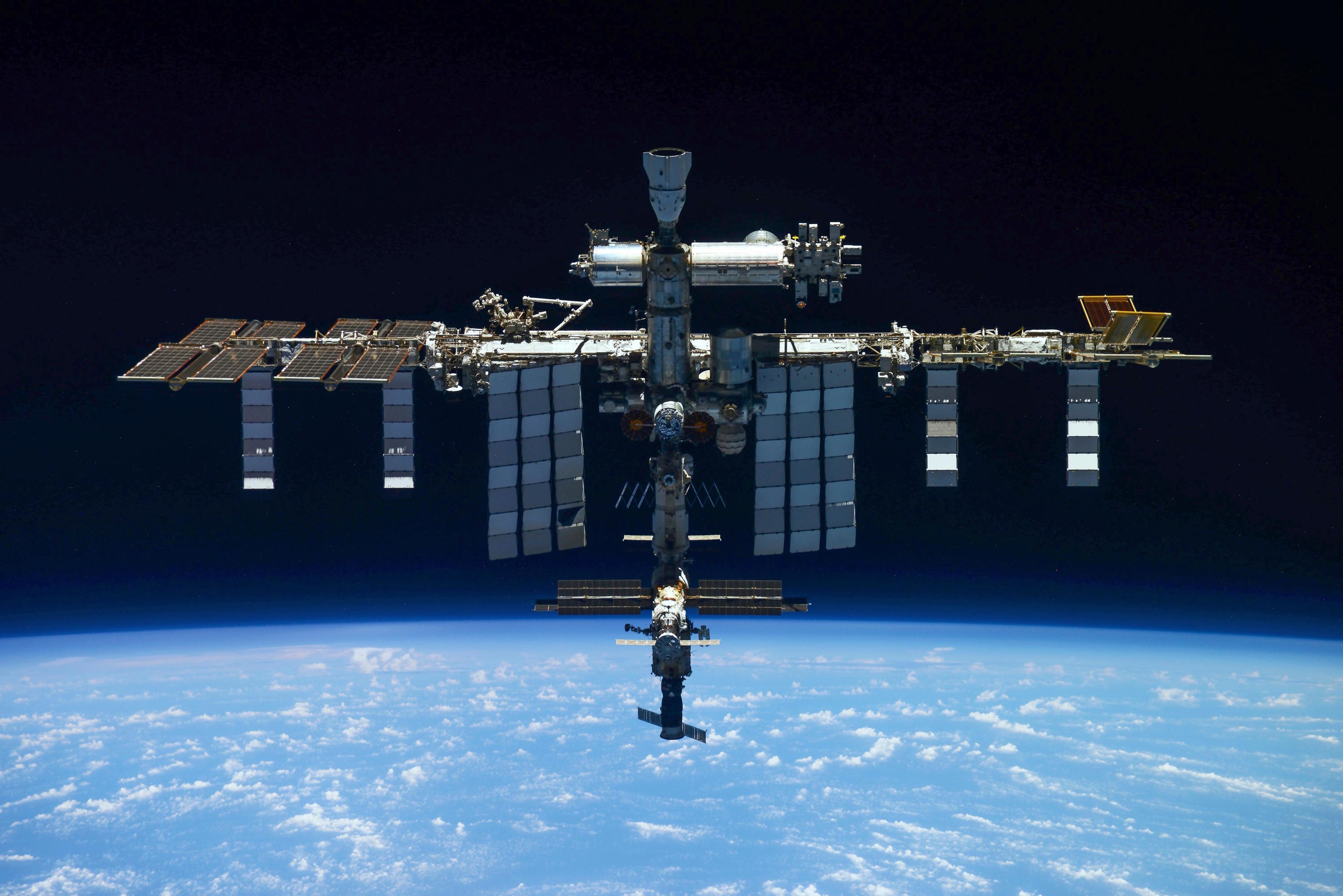
The International Space Station (ISS).
Both space agencies will continue working with their partners on the ISS to find a definitive solution to the problem.
In the event of an evacuation being necessary, each team would have to travel back to Earth in their respective spacecraft, as the Crew Dragon requires special astronaut suits for that vehicle.
The International Space Station (ISS) is an orbital platform located 400 kilometers above Earth, which has been permanently inhabited since November 2, 2000, when the first manned expedition docked.
Since then, astronaut crews from the US, Russia, Europe, Canada, Japan, and other partner countries regularly travel to its facilities for stays of varying durations: from a few days to over a year. Currently, most astronauts typically stay for about six months, conducting scientific experiments to help understand how to live longer in space. The Crew-12 mission is expected to last around eight to nine months.
On May 28, cosmonauts Sergey Kud-Sverchkov and Sergei Mikaev conducted a spacewalk lasting over six hours to retrieve two completed scientific experiments and install a new one. They also placed a device in the Zvezda module to measure solar radiation bursts from solar flares.