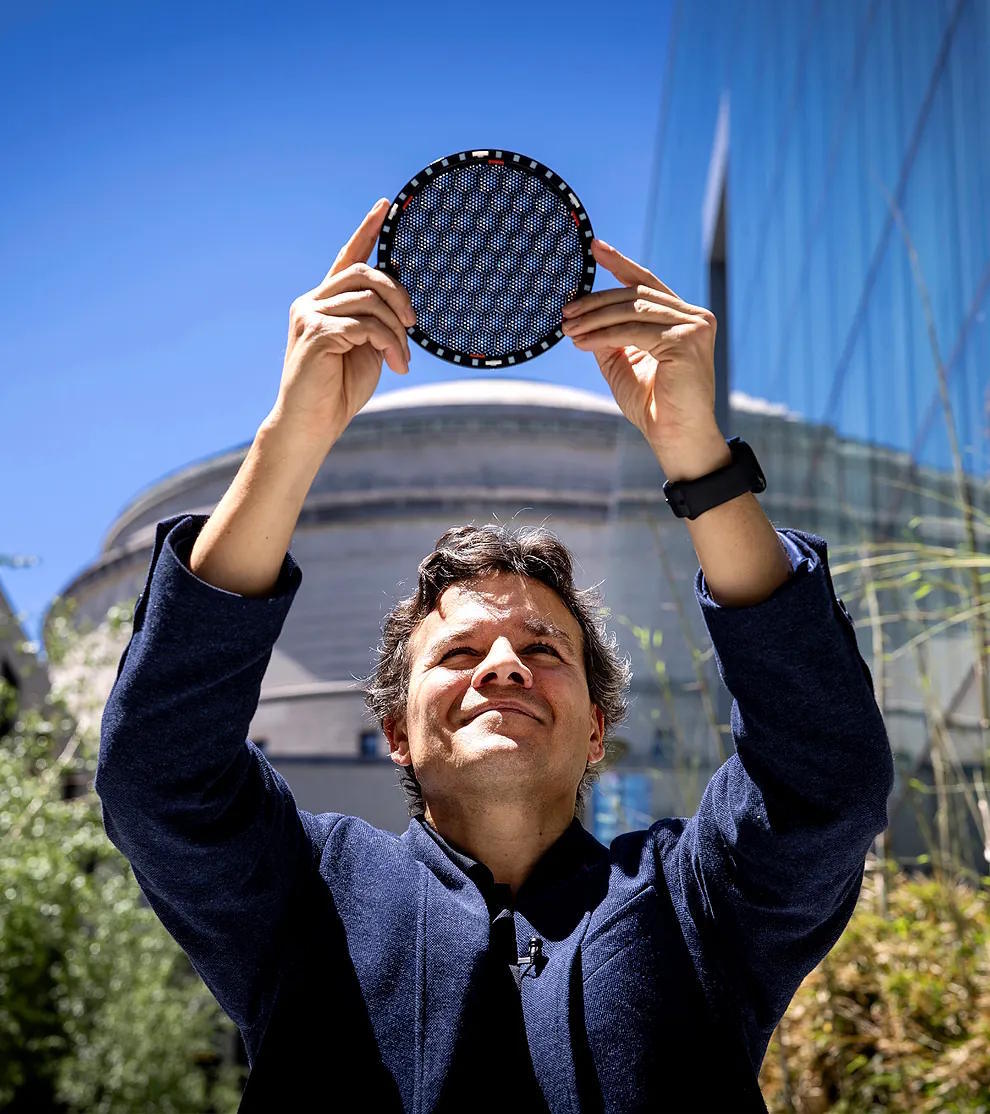
The stairs leading to the main entrance of the Massachusetts Institute of Technology (MIT), flanked by Ionic columns, become the backdrop for photo sessions at any time of the day in late May. It's graduation week, and students, dressed in formal attire, proudly pose with their stoles, indicating they have completed a course, degree, or doctorate at what is considered by several rankings as the most prestigious university in the world.
We are in Cambridge (Massachusetts, United States), the epicenter of global academic excellence. This bucolic town separated from Boston by the Charles River attracts brains from all over the planet every year. Just a 20-minute walk away is Harvard, another research landmark joined by institutions like Lesley University or Cambridge College.
EXCELLENCE+CURIOSITY. A large sign hanging in the MIT lobby reveals to students and visitors the formula that has led to over a hundred Nobel laureates emerging from the laboratories and classrooms of this institute founded in 1861, among professors, researchers, and students. The next one could be a Spanish physicist: his name is Pablo Jarillo-Herrero, who will turn 50 next Thursday.
This Valencian scientist revolutionized the field of new materials in 2018 from the laboratory he leads at MIT. With his experiments on the so-called magic angle of graphene, he has made it possible for this two-dimensional material composed of carbon, flexible, extremely thin, and resistant, to adopt the behavior of any other material. An extraordinary achievement that has put him in the running for the Nobel Prize. "It is true that since 2018 I can no longer say that it is impossible for me to receive the Nobel, but of course, it is not guaranteed," he says as we walk down the infinite corridor, as the main artery of MIT is known. "Normally it is full of students, but now they are celebrating."
He leads us to his new office, where he has just moved in and still has unpacked boxes. From the window, you can see the tree from a cutting of the historic Newton apple tree planted in the MIT courtyard. Alongside photos, letters, and gifts from his students, he displays some of the prestigious awards he has won, including the Wolf Prize, and this year he has added another major recognition: the BBVA Foundation's Frontiers of Knowledge Award in Basic Sciences. He shares it with the Canadian Allan MacDonald, who in 2011 laid the theoretical foundations of the magic angle of graphene, predicted some of its properties, and gave it that name.
On June 18, he will receive the award during the ceremony that the BBVA Foundation will hold in Bilbao, accompanied by his father, Carlos Jarillo, and Javier, one of his three brothers.
"I come from a humble family; my parents started working at 16 and 17 years old and did not have university studies. I am the only scientist in my entire extended family, which consists of 50 cousins," he recalls. He says that at home, they have always instilled in him the value of hard work.
On the occasion of being awarded the Frontiers of Knowledge Award, Papel spent a day with him at MIT, touring the nanoelectronics laboratories where he cooks the materials of the future and accompanying him during a day of work. Spending a day at MIT is literal, as he lives with his family on the same campus, in a spacious and bright residence located in front of the Charles River, within one of the student residences. Both he and his wife, Empar Rollano, who is also a physicist and from Valencia, act as household heads, a figure that facilitates some tasks for the students and, if necessary, helps mediate in potential conflicts.
At seven in the evening, we share dinner with the couple and their three children: Marta, 15, and twins María and David, who have just turned 11. Regarding meals, American schedules are followed in this house, but the Mediterranean diet is maintained. Tonight's menu includes baked vegetables and fish, and for dessert, the physicist has prepared a new recipe: curd cheese cake with strawberries. Cooking is one of his hobbies, and although he prefers baking, when he has the necessary time, he prepares traditional Valencian paellas for his students and friends.
He also loves dancing, squash, and is now getting into climbing, which he practices with his family at the gym: "We lead a normal life, although I travel a lot, and it is true that what seems normal to us may not be so. Most of our friends are professional colleagues, and some we have met through the children's school. Many of us are foreigners because we almost all gather together. They are our family here, and we help each other."
Jarillo-Herrero moved to Cambridge in 2008, when he was already a very promising physicist. After graduating in Physical Sciences from the University of Valencia in 1999, he pursued a master's degree at the University of California in San Diego and obtained his doctorate at the Delft University of Technology (Netherlands). Shortly after, he joined Columbia University in New York for a postdoc with Philip Kim, a world-renowned graphene expert who is now at Harvard: "Shortly after arriving at Columbia, Harvard invited me to a seminar. As I later found out from a friend, MIT thought that Harvard was trying to recruit me as a professor and invited me to apply for an available position. I already had an agreement with my wife that we would stay in the US for two to three more years and then return to Spain, but to my surprise, they offered me the professorship. That's when I said, 'This is too good to say no to; it's like if Real Madrid wants to hire you and you reject it'."
He was convinced by the fact that it would be seven years, the duration of the assistant professor contract: "After that time, there is a very tough evaluation. In my time, half of the professors were dismissed because they had not achieved the expected success. I thought I wouldn't stay, but in 2015, they made me permanent, and in 2018, full professor. It has been 18 years, and my wife still teases me about it," he says, laughing.
A few days after joining MIT, he realized what he had gotten into: "One of the vice chancellors invited me to one of the Random Faculty Dinners, which are dinners attended by about 20 professors where you are randomly seated with your colleagues. I accepted, and it turned out that on one side, I had the Physics Nobel Prize winner Wolfgang Ketterle, and on the other, the mathematician Peter Shor, inventor of the most famous quantum computing algorithm, Shor's algorithm, which decrypts information. It was incredible for me," he recalls.
From the beginning, he says, he has had "100% freedom" to choose his research projects. "At 30, they gave me a lot of money, much more resources than I would have ever received in Spain to start, and they told me, 'In seven years, we'll talk, let's see what you do.' "I was given total freedom to do what I found most interesting."
Now he has to secure funding for the projects he chooses: "I increasingly seek not only funds from federal agencies, as there are now fewer due to budget cuts, and attract more funds from private foundations and industry. For example, Samsung and Honda sponsor me. And I also have internal resources from MIT for research."
We arrived at the university wing dedicated to quantum materials research, where the Jarillo-Herrero Lab is located. These are materials where interactions occur at the atomic scale and cannot be explained by classical physics because at this extremely small scale, matter acquires new properties and behaviors. It is the nanoworld, where atoms and molecules are manipulated. "In this hallway, there are six professors, and only one whose parents were born in the USA; almost all of us are immigrants or children of immigrants. And more than half of the doctoral students and postdoctoral researchers are foreigners. There is a very meritocratic environment. These are people who have left a lot behind - family, friends, security - and I think in certain aspects, they are a bit more adventurous and entrepreneurial," he reflects.
Currently, his team consists of 11 students, although he has had up to 20: "Every year, between two and three enter, and those who have finished leave. They are usually with me for about six years to complete their doctorate. And I also have postdocs, that is, they have already obtained their doctorate but continue with research. The vast majority are Asians, mainly from China. I am very excited because a Spanish student will start in September," he summarizes.
"My students are very smart and work very hard. Two-thirds of them are much smarter than me, and they teach me more than I teach them, especially after six months," he assures. "I don't force them to do anything, but they are super motivated. I tell them that being at MIT is like being in the Olympics. In the end, you do it for yourself, so you decide if you work very hard or very little, but then you won't get a medal. And people come here for the gold, and they give it their all." He emphasizes, however, a difference with sports. "A scientist's career is very long-term, so you have to pace yourself to avoid burnout, but you have to work hard."
The culture of effort is well established: "Here, you can work 24 hours a day, 12 months a year if you want. It's rare for a student to dedicate less than 60 hours a week. I have always worked between 60 and 80 hours. Now the most common is between 50 and 60, but until I had children, 80 hours was normal. I try to ensure my students have a balance, but you can have it working 60 hours if you are efficient," he defends.
The Jarillo-Herrero Lab consists of three large laboratories and a smaller one, equipped with all kinds of electronic components, sophisticated microscopes, computers, or helium tanks for experimenting and measuring the physical properties of two-dimensional materials such as superconductivity.
Regarding graphene research, on one hand, there are studies on graphene in general, and on the other, research on the magic angle of graphene, which is much more novel.
Graphene, a material that is only one atom thick, was first synthesized in 2004 at the University of Manchester by the Russian physicists Andre Geim and Konstantin Novoselov, using the adhesive tape method still used today to take samples for research. Geim and Novoselov, whom Jarillo-Herrero visited to learn their techniques, won the Nobel Prize in 2010 for this material that gained worldwide fame for its enormous potential.
Shuwen Sun, a doctoral student, demonstrates the delicate process of obtaining graphene samples from graphite crystals and Scotch tape. "We have achieved graphene with more or less good quality, but still with defects. It is very difficult to transfer and incorporate it into production chains, and I think it will take between one and two decades to achieve it. But there are already startups and large companies trying to introduce it gradually; things are being done, and they are being done well," Jarillo-Herrero evaluates. As examples of its use, he mentions batteries, sensors for infrared cameras, or sensors in the brain.
But the main achievement of his career and the one he aspires to the Nobel Prize for is the magic angle of graphene, which has given rise to a new field called twistronics or the electronics of rotating things: "Graphene is a conductive metal. It is not an insulator or a superconductor, it is simply a good metal. When you have a single layer of graphene, the electrons move very fast. But if you place another layer of graphene on top of a layer of graphene, and you rotate it at 1.1 degrees, it turns out that the speed of the electrons decreases practically to zero. Then something very unusual happens. Very unexpected behaviors of matter occur," he points out while showing us the exact location in the laboratory where they made the measurements that revealed their discovery.
Simplified, the physical process they have managed to reproduce in their laboratory generates a repulsion energy in quantum materials that gives rise to all phases of quantum matter. "For everything to work, for the magic to happen, it must be rotated at 1.1 degrees. It was a huge surprise. We saw that this graphene, which is not a superconductor, insulator, or magnet, when you place it on top of another layer of graphene and rotate it at 1.1 degrees, it could suddenly become an insulating material, a superconductor, a magnetic material, a ferroelectric material.... In fact, it can be transformed into all the phases of matter that we know in the universe." The study describing his achievement was the most cited in 2018 in all Nature group journals.
"I was looking for something and I found something different and much bigger than I expected," admits the physicist, who describes the magic angle of graphene as the philosopher's stone in reverse: "In the Middle Ages, alchemists sought a stone that would turn everything it touched into gold. The magic angle graphene is something like that, but in reverse," he compares. "You can turn it into all other things. It turned out that by playing with geometry, I can change the behavior of matter. Even though they are all carbon atoms."
However, manufacturing a magic angle graphene device is still a handmade process: "It takes a person between two and six weeks, depending on the complexity of the device. Because we have evolved and make them with more than two rotated layers. One of the latest had 12 layers. That's why I say my students are like medieval monks, who create something precious and unique. We still don't know how to make many at once," he admits.
"Engineers, physicists, and chemists have to work together to solve a lot of basic problems, and once solved, we'll see if it can be made good, beautiful, and cheap, because if it's not cheap, it won't be widely applicable." It is something that, according to the scientist, could take decades of work. However, he believes that "the magic angle of graphene could have niche applications in fields such as defense, security, or space technology, where what matters is not that it is cheap but very good."
Among the possible uses of this developing technology, he mentions infrared light or ultra-sensitive terahertz sensors for applications in astronomy or satellites; ultra-efficient neuromorphic computing (inspired by how the brain computes) for applications in artificial intelligence, and topological quantum computers, robust against errors and with electrically adjustable qubits. It may sound like science fiction, but to translate these and many other innovations being made at this university into applications in electronics, medicine, or energy, they have built MIT.nano, one of the most advanced academic nanoscience and nanofabrication centers in the US.
In this building inaugurated in 2018, they manipulate and create materials on the nanoscale to make new types of transistors. "My students come here to connect that magic angle graphene sandwich to the external world. I hardly come because I never have eight consecutive hours to do something and this requires a lot of time," he explains.
On the day of our visit, for example, he will give a talk to a group of Latin American entrepreneurs after lunch and in the evening, he will take a flight to Spain to be part of the Jury of the Rei Jaume I Awards, in his homeland, Valencia.
The futuristic atmosphere of MIT.nano, with yellow light in the laboratories, state-of-the-art electronics, and researchers in head-to-toe protective gear to avoid contaminating the equipment, coexists naturally with the solemnity of the historic building, which was erected over a century ago when the university was moved from downtown Boston to this side of the river.
If the facade nods to ancient Greece with its colonnade, the famous dome covering the library, built in 1916, mimics the Pantheon in Rome. He often comes here to concentrate, and here he reflects with us on his future plans, as now that he is about to turn 50, he is considering doing other things.
Due to his successes, many universities have tried to recruit him: "I was very tempted by a staggering offer made to me by Princeton in every way: personally, salary, research funds, resources... But I decided to stay here. It was for many reasons, but one of the main ones is because MIT has offered me the opportunity to try to help Spain in science and technology," he points out.
"I have always felt committed to my country and have aspired to do things there, although it is not easy because there is a lot of bureaucracy, in Europe in general. One of my dreams, in fact, is to create a prestigious university in Spain like MIT," he asserts. He argues that our country "has the potential to attract international talent, although it would take a lot of resources and implement a radical meritocracy; we must try to recruit the best and offer good conditions for research, good salaries, and good personal conditions."
The strategy, he argues, is not so different from that of football even though the figures are different: "Everyone knows what needs to be done for Real Madrid to be Real Madrid or Barcelona to be Barcelona. I believe that one excellent person does more than three mediocre ones, and it costs almost the same. It is also necessary to have more culture of scientific risk and more trust in young people, who usually have the most disruptive ideas." He has been an example and now wants to contribute to it happening more frequently in Spain. However, he does not consider leaving the US: "When I think about my future, I still see myself at MIT."