All great stories, whether fiction, reality, or a curious mix of both, begin with a feat done out of love. The story of the Mercedes-Benz brand is no different. Or maybe it was, but time and society have blurred its details. Perhaps that's why today the name of Bertha Benz (Germany, 1849-1944) doesn't resonate like that of her husband Carl, and perhaps that's why only her legacy is remembered, not her life decisions. Someone once said that "women are, almost literally, the origin of the world." Plato may have assumed it in The Republic or Courbet may have claimed it in his painting of female genitals, but the phrase doesn't belong to either of them. Instead, it is the Economics professor at the University of Cambridge, Victoria Bateman (Oldham, 1979) who, in a more subtle but no less provocative way, alludes to the importance of gender. And she doesn't say it just to mention a feminist slogan, but with knowledge after thorough research on the subject.
The British academic doesn't hesitate for a second to point out that the history of civilization is written "by and for men." "For every Carl Benz, Hernán Cortés, or even Genghis Khan, there was a much more unknown female equivalent. All of this stems from sexism, and also from a misinterpretation of History." She says this as she watches the landscape pass by through the window of her car. She is heading to an awards ceremony while thoroughly analyzing the intricacies of her new work: Economic. A global history of women, wealth, and power (Ático de los Libros), a compilation of testimonies and profiles in the shadows that now see the light.
Among the more than 200 names she mentions, steadfast is the name of Bertha Benz. "We have to prove that great civilizations were not built only by men. I wouldn't be here without them," she exclaims. And she doesn't just mean metaphorically, but also in the literal sense of where she is currently. As she travels through the English countryside aboard a Mercedes-Benz, it seems impossible not to think about the origin of the star brand, and, of course, about vehicles in general.
A quick internet search provides the answer to the question posed: "The German engineer Carl Benz invented the first automobile powered by an internal combustion engine in 1886." Who could question what the browser says in tenths of a second? Bateman does. And not only that. She also contradicts it. "He tends to be seen as the most iconic inventor of Mercedes-Benz when it was actually his wife Bertha who worked with him and even discovered things that her own husband didn't know." The story of the German woman is a long one, one that takes time to tell. She was a daughter, wife, and mother of five children, as well as a student, investor, and entrepreneur. But above all, Benz was the first person in history to drive a car, and the precursor of what is now a leading company and a global reference. Although it may seem impossible, almost like a utopia to embellish what happened, she truly did everything out of love. To understand it, one must know her.
On May 3, 1849, began like any other day in Pforzheim, Germany, when, with her cry, little Cäcilie Bertha Ringer inflated her lungs for the first time. The start of her life resembled that of a thousand girls of the time, at least during her early years. Born into a wealthy family, the young German was able to enjoy a good education from the age of nine, something atypical in 19th-century society. During her adolescence, late Romanticism dresses, tight corsets, and bustles filled her wardrobe, as did suitors. None of that mattered. For Miss Ringer, the appeal was in business and capital investment.
"Just as we now see banking and finance as something masculine, we assume it has always been that way, but women also invested," Bateman asserts. This was the case for Bertha, who in her twenties decided to allocate part of her financial cushion to an iron construction company. At that time, her only romance was with her father's mechanics and carpentry. But, as all things end, so did her single life, and in 1872, at 23 years old, her last name changed to that of the famous contemporary car brand, and love finally made its long-awaited appearance.
"Bertha Benz was able to diagnose and solve the faults. She didn't drive a car, she drove an industry"
Young Carl Benz was an engineering intern. He didn't have many resources or followers of his work. What he did have were ideas. He was convinced that there was a more efficient way to travel than horse-drawn carriages. He believed in the future of gasoline transportation. "Here is where Bertha comes in again, who used her entire inheritance to finance her husband's experiments," the British academic sponsors. And her contribution was not only financial. "She often got to work and worked alongside Carl in the workshop," Bateman points out. And she adds, "She had more faith." They would certainly need it.
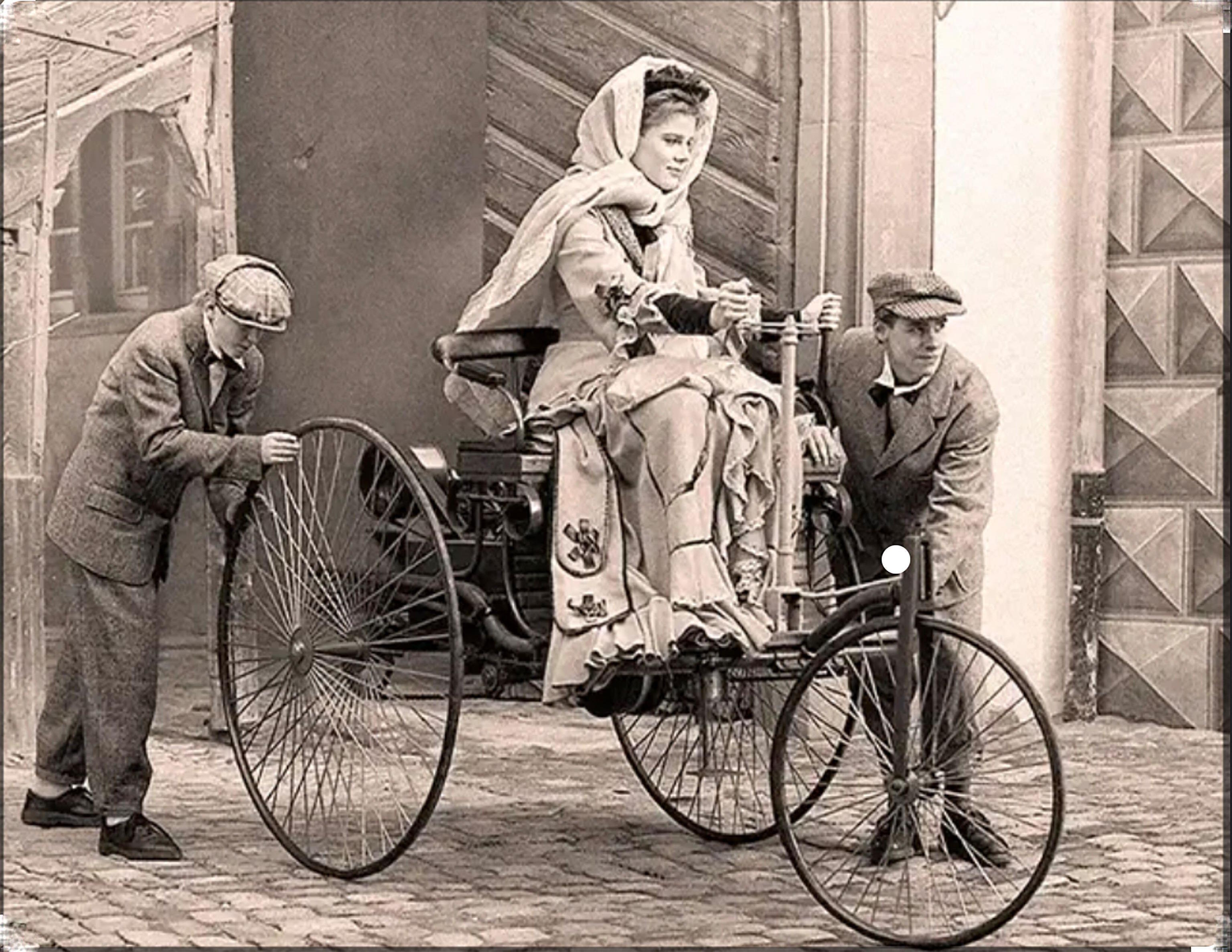
Carl patented the first car in history in 1886, the Benz Patent-Motorwagen. And what is now a guaranteed convenience was just a useless attraction in the 19th century. But not for Bertha. "She wanted to show the world the potential of the motorwagen." Said and done. It was her money that facilitated the construction of the prototypes, and once completed, she was the one who tested them. Ignoring her husband's prohibition and with the help of two of her sons, Bertha Benz drove the invention towards prosperity.
THE FIRST FEMALE DRIVER IN HISTORY
"It was a bright summer morning in 1888...," states Bateman in her work. "On August 5 of that year, while her husband was still deeply asleep, Bertha quietly and without his permission took the car prototype out of the workshop," narrates, excited, the British economist. The only evidence of the feat? A brief note: "We are going to see grandma," it said. At that time, the Benzes were located in Mannheim, about 100 kilometers from the family home. Reports analyzing that route concluded that, considering the sunny conditions and the straight route the woman faced, the journey by horse would have taken about three full days. Seventy-two hours that were reduced to 12 just by using a combustion engine.
Mrs. Benz reached her destination, yes. With that, she became the first woman to drive a car, as well known. But the reality is that this round trip was full of inconveniences and faults that the young German had to solve on her own. "She climbed onto model number three and traveled kilometers and kilometers through the German fields, surprising all who watched her and overtaking horse-drawn carts, but along the way, she had to solve all the problems that arose in that first test drive," Bateman points out. What becomes clear, then, is that the German woman's goal was not so much to take the shortest route, but to test the invention and demonstrate its usefulness to the public.
The car had little resemblance to the modern product that fills 21st-century garages. Built from lightweight steel tubes and with three large wooden wheels, the motorwagen resembled more a carriage with a steering wheel than what comes to mind when talking about a Mercedes today. As recorded in the engineer's writings, the engine was not what one might imagine either. The first difference lay, in fact, in the type of fuel the car needed: ligroin. It seems logical to think that this was the first problem the businesswoman faced.
"Bertha ran out of fuel and had to stop at a pharmacy in the small town of Wiesloch to fill the tank with cleaning solvent and continue her journey," Bateman recounts.
A HANDCRAFTED INDUSTRY
Halfway between the "grandmother's house" and the beginning of the journey, Bertha Benz encountered another problem that needed to be solved: braking. This prototype had rudimentary wooden blocks that collided with the wheels, and although their usefulness was clear, their design left much to be desired. At least, that's what the documents of the time reveal. "She asked a shoemaker to make a leather piece to fix the flaw."
An achievement that, years later, would crown her as the inventor of brake pads, as acknowledged by the company itself. "She was always able to diagnose and solve faults with her own hands. In the words of Mercedes-Benz USA: 'Bertha Benz didn't just drive a car, she drove an industry'," Bateman points out, while ensuring that due to her unparalleled career, she is one of his favorite figures in history.
The young Bertha Ringer achieved unimaginable milestones. Passing away two days after her ninety-fifth birthday, her legacy and contribution to the automotive industry remained intact. As Carl Benz said: "My wife has much more courage than I do, and her journey has been decisive".
Benz's audacity and intelligence are not exceptional. In reality, thousands of women around the world have followed a similar example. The only difference is that their stories have not yet come to light: "In today's society, there has been an attempt to popularize versions of the past that seek to marginalize women." Victoria Bateman has changed the narrative. Where there has always been a male face, now rises irreverently the no longer unknown Bertha Benz. And all thanks to a love story.