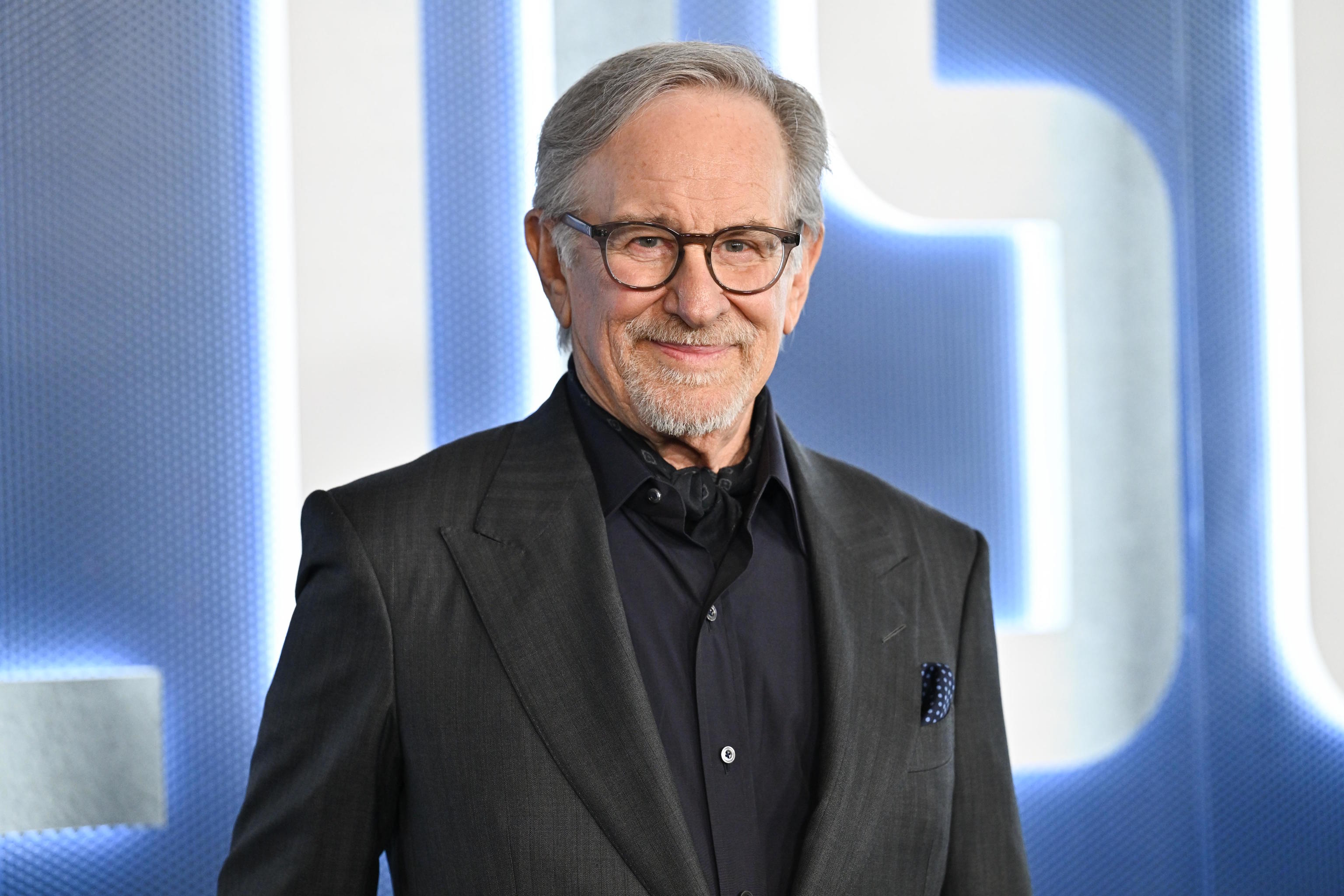
Steven Spielberg (Cincinnati, 1946) remains exactly the same as Steven Spielberg, even if 50 years pass. Or 80. Or even more. In a central hotel in London and shielded behind an excessive, or even immense, production team, the most popular film director on the planet is about to discuss what would happen if at some point someone from outside (far from the outskirts) dared to challenge him, Hollywood, and each and every one of his most successful films, from Jaws to ET to Indiana Jones, for the privilege of the pinnacle of popularity. What would happen if one day we were contacted (not necessarily invaded) by Martians or their distant cousins? "Honestly," he says to quickly reveal what motivates his latest film, "I believe that everything I considered as a mere possibility in Close Encounters of the Third Kind is happening right now." Wait, have the Martians already arrived while we are all caught up with the Leire case? "There is enough evidence that we are not alone," he adds, and we are reassured. As they say on Twitter, there is no proof, but no doubts either.
To set the stage, The Day of Revelation, as Spielberg's 37th film is called, insists on many of the arguments that have driven his cinema and, by extension, all of us. It was in 1954 when his father woke him up to witness the unheard-of spectacle of a meteor shower. Then, in what is probably the most repeated anecdote of his biography, he was just five years old. "He then built me a homemade reflecting telescope, with which I could see Jupiter's moons and Saturn's rings. So I owe to my father for instilling in me the values of science and imagination," he likes to remember. The revelation, as it was, would obsess him to the point of trying at least three films that recreated that first contact with the mystery of the cosmos before the definitive film: Close Encounters of the Third Kind (1977), of which this new release is a replica, remake, continuation, or, if necessary, a response, as one may see it.
Half a century has passed since Close Encounters, and whether due to emotion or obsession, it seems that nothing has changed. Spielberg remains exactly the same. "I have had a relationship with what we could call the unknown since I was a child, as I said," he states and continues: "I have always been interested in topics such as life on other planets or the possibility that other species have visited Earth and interacted with humans. I have read all possible stories and watched all documentaries available." Pause. "The difference now is that it's different." Is he trying to say that it's true now? "Well, now it has made front-page news in a newspaper as unsuspecting as the New York Times. In 2017, the newspaper published an article about combat pilots who photographed the so-called Tic Tac, which were basically spacecraft maneuvering in space with technology far more advanced than any other known." Another pause. "I have always believed that we are not alone. The big question is: Are we alone now? Have we been alone for the past 80 years? Or even more, have we been alone for the past 3,000 years?"
And one more as a coda: "When I made Close Encounters of the Third Kind, I still had a certain creative freedom in my cinema. I wouldn't want to call it science fiction, but it resembles something that could be called scientific speculation... That was 50 years ago, believe it or not. 50 years later, this film is indeed fiction because I co-wrote it with David Koepp, but the foundation it is based on is something that I can now firmly say I believe in." It's clear, Spielberg can only be Spielberg.
The Day of Revelation completes a journey that began on screen in the seventies with Richard Dreyfuss, with the invaluable help of Douglas Trumbull in special effects, Carlo Rambaldi as the puppeteer creator of big-eyed extraterrestrials, and even filmmaker François Truffaut turned by the quirks of the French New Wave accent into an impromptu organist. After the famous level three encounter on Devil's Tower in Wyoming, there would come the intimate and irreplaceable ET and, pushing from the opposite side, the controversial adaptation of H.G. Wells' War of the Worlds. Only in this last one, perhaps as a metaphor for the state of shock after 9/11, the aliens are unfriendly and not inclined to make friends. Completely oblivious to the wise advice of Stanisaw Lem, the Strugatski brothers, Ted Chiang, and many other storytellers about the impossibility of understanding what is by definition different, for Spielberg, on the contrary, those from outside are always those from within, they are us.
Now, Spielberg is a bit scary. Not much, but somewhat. Just as terrifying is the possibility that a government has been lying to its citizens for 80 years as it is that all this about extraterrestrials is just another smoke screen to avoid what's important. When Spielberg was one year old, an unknown object crashed on a ranch near Roswell, New Mexico. Or so they told us to not think too much about, for example, the military spending of the Cold War. Conspiracy after conspiracy. Only recently—and hence the opportunity (did someone say opportunism?) of the film—many of the documents (the term disclosure in English or revelation in Spanish refers to this) kept secret for so long have been declassified. The UFOs of then are the UAPs (Unidentified Anomalous Phenomena) or ANIs (Anomalous Unidentified Phenomena) of now.
And at this point, it's time for the ultimate confession that at this stage seems very unsurprising: Spielberg believes. "I don't know if I will ever meet an extraterrestrial in my lifetime, but the circumstantial evidence that they are here is convincing. There are people in prison with less evidence than currently exists of interaction between the human race and an extraterrestrial," he concludes.
Spielberg remains Spielberg.