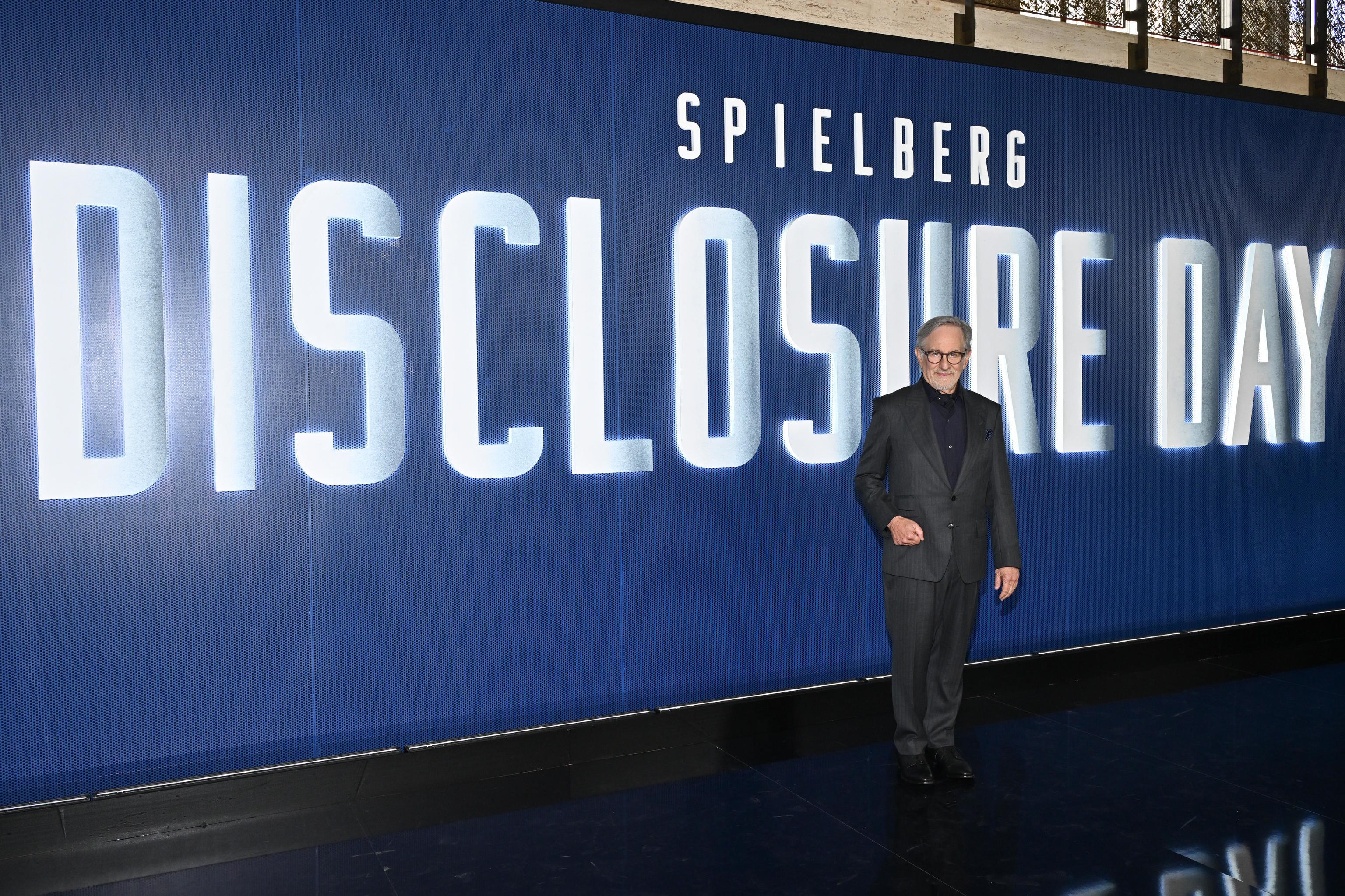
Spielberg is not Stanislaw Lem. Nor is he many other people —not even the Spielberg of now is exactly the same as he was 40 years ago—, but in a radical way, there is no one as fundamentally different from the American filmmaker as the Polish writer, author of, among other major works, Solaris, who left this reflection for posterity: "We don't need other worlds. We need mirrors. We wouldn't know what to do with other worlds." Spielberg has been interested in UFOs and extraterrestrial contacts his whole life (his confession), since he was exactly five years old, and he is convinced that Fermi's famous paradox (If, as it has been proven, there are so many possibilities of life outside our planet, why do we still know nothing about our neighbors?) is almost (but almost) ready to be nothing more than a solvable misunderstanding with an intergalactic hug. And to make his profoundly humanistic stance in favor of aliens and their other worlds clear, first came Close Encounters of the Third Kind, then ET, later he took a break from so much optimism with War of the Worlds, and finally, Disclosure Day, the definitive one, despite its mystical and just strange deviations.
The film, the 37th in his filmography, can be seen as a perfect summary of his conception of cinema in its most enthusiastic, addictive, and popular aspect. And as such, it works in substance and form. The film, starring Josh O'Connor and Emily Blunt with skill and affection, places the former in the role of the obsessive and essentially good hero who actors like Roy Scheider, Richard Dreyfuss, Harrison Ford, or Tom Hanks made their own before him (O'Connor is less macho than all of them), and the latter (superb) as those women who have emerged in the latter part of his cinema alongside Meryl Streep in The Post or Michelle Williams in The Fabelmans. Both of them, or one and the other, better, appear on screen dazzling and perfect (and very entertaining) as the representatives or spokespeople of viewers who see in them the improved version of what any of us always wanted to be: sensitive, kind, intelligent, tenacious, and good in the best sense of the word. Few directors understand the power of the cinema to capture the most secret yet common ambitions of the audience as well as he does.
Disclosure Day speaks, as mentioned, of the possibility of contact on Devil's Peak or wherever. But beyond the obvious, its focus is on the struggle to disclose (reveal, therefore) the vast information accumulated about the various encounters that have already occurred in human history. Thus, on one side are those who believe in the need for everything to come to light, and on the other, those who fear that too much light will blind rather than illuminate. Like in The Post, but without the Washington Post in between. Let's say that Spielberg's coordinates axis leave little room for helplessness, confusion, or even irony.
With this starting point, and practically from the very impressive first image of the first sequence, the entire film unfolds, at a pace that is both hilarious (not just thrilling) and unhinged, running with that masterful choreography of action scenes that only the director is capable of. Pay attention to the train sequence. Meanwhile, in a parallel plot between mystery and bewilderment, a strange and very wise man (Colman Domingo) constructs the setting of a house. Yes, it's not a house, but an optical illusion representing a home. And meanwhile, a villain (who is not really one and played by Colin Firth) rehearses, thanks to technology from other worlds, a sort of out-of-body travel in a relentless pursuit reminiscent of Indiana Jones. And meanwhile, an epic John Williams score. And meanwhile, the director's most bizarre, uninhibited, and at times, bewildering version in a long time. And meanwhile, the emotion, the emotion of a Spielberg determined of late to write his own life testament. If The Fabelmans told the story of the author's path to cinema, this one dares to narrate the reason for his persistence and, ultimately, his eternity. That ambitious. And even strange.
The film is enjoyed in its entirety like a sigh, like an event, like a celebration of cinema for cinema's sake, of optimism against the naysayers, of hope against the cynics, and of humanism in its least committed and anti-Voltairian version even. The more controversial or, in a way, metaphysical scenes are debatable (we won't say exactly which ones to avoid setting expectations). And the naivety with which the media are portrayed is more characteristic of a man from the last century (which, ultimately, is what Spielberg is and what many of us are), when it was possible for truth to seem true and a lie simply offensive. That which is seen in the film no longer happens. Let's say that, of the two overlapping endings, one shines in its bold and almost mischievous innocence, and the other is disheartening in its abrasive naivety. But even this is a trademark of the director. To push the critique further, and outside the film in its strict sense, it is not clear whether it is controversial or not that the film coincides with the new frenzy resembling a dense and stupid smokescreen with which ufology has returned to the most absurd political agenda. But that is another matter.
What remains is a film to dive directly into and, hand in hand, celebrate the inexhaustible myth of Steven Spielberg, despite everything and despite all of its quirks. Perhaps Lem's reflection is not far from that of the filmmaker himself: other worlds are indeed mirrors, and no mirror compares in depth, clarity, and emotion to Spielberg's cinema.