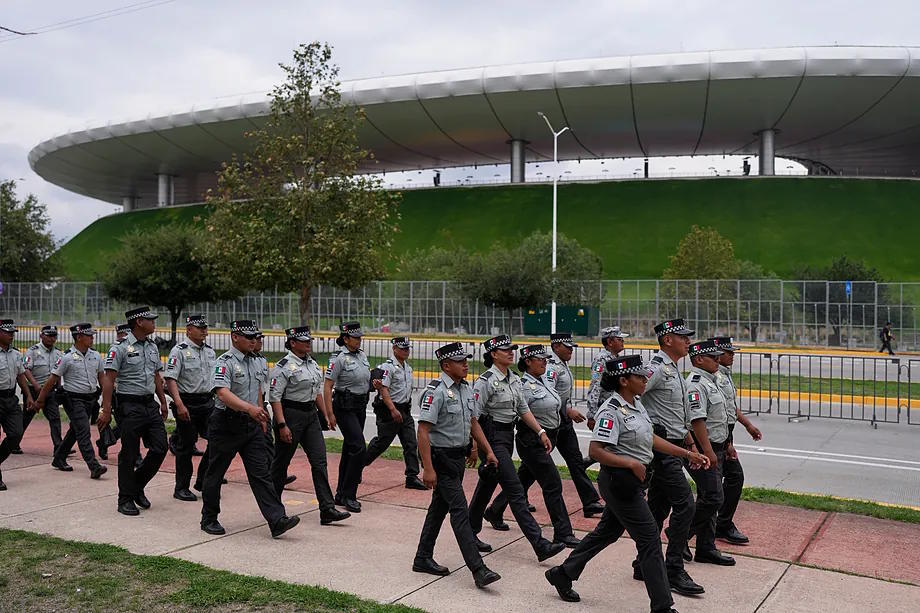
More than 50,000 police officers mobilized in United States, 100,000 agents, soldiers, and private guards in Mexico, and thousands more in Canada. The National Guard, the most famous federal agencies on the planet with the FBI leading the contingency plans, tens of thousands of additional security cameras at all venues and borders, and one of the largest drone deployments in peacetime history. The World Cup is about to begin, along with one of the most demanding security exercises in memory, coinciding with the celebration of July 4th in the US, with festivities for the country's 250th anniversary and parades in major cities. And even with President Donald Trump's birthday, who expects to host thousands of guests for a mixed martial arts evening in the gardens of the White House this Sunday.
The US Department of Homeland Security has classified the World Cup as a Level 1 event in the Special Event Assessment Rating (SEAR), the highest security rating that requires the "integration of physical barriers, surveillance, and emergency protocols," as explained in a recent report by S&P Global. In March, Mexican President Claudia Sheinbaum announced the Plan Kukulcán, a security deployment that includes "around 100,000 personnel, over 2,000 military and police vehicles, and 10,000 new cameras in 10 cities." Similarly, the security plan for Vancouver and Toronto, under the Royal Canadian Mounted Police, has expanded border controls, installed thousands of temporary surveillance posts, and created a trilateral coordination center against aerial vehicles. In recent months, dozens of agents from 30 jurisdictions have received special training on drone risk reduction at the FBI facilities in Huntsville, Alabama.
Concerns are high amid a tumultuous geopolitical scenario, especially with the wars in Iran and Lebanon. Particularly concerning are terrorist attacks, bombs, stabbings, or vehicle ramming incidents. Not to mention possible reprisals for operations against cartels, which just weeks ago brought violence to the streets and the airport of one of the venues. FBI Deputy Director Christopher Raia told ESPN that his main concern was "local extremists," like the man who last year crashed a truck into people on Bourbon Street in New Orleans, in an attack inspired by the Islamic State. Or the white nationalists who were arrested while planning to launch explosive drones against power facilities.
On April 25, an armed man was arrested after trying to sneak into the White House correspondents' party where President Trump was present. In the following weeks, two other men were shot in two separate incidents after firing at the Secret Service near the White House. In total, throughout 2026 and until May 31, 170 mass shootings (with four or more victims) were recorded in the United States, resulting in 175 deaths and 695 injuries, a similar average to 2025. The latest in Kansas City, not far from the English team's headquarters for the tournament, this week.
"The World Cup is like playing 78 Super Bowls in 40 days," said Andrew Giuliani, the official appointed by the White House for the tournament. But with the added challenge that US police are not accustomed to managing football fans. "The planning also includes thorough monitoring of the behavior of fans from different countries to avoid misinterpreting celebrations or marches that, while common in some football cultures, may seem disorderly to local police. What may appear as a disturbance to a local police officer may actually be a normal practice in another country," acknowledged Giuliani. FIFA has provided reports on the typical behavior of fans from each country, their customs, or specific risks.
The Federal Emergency Management Agency (FEMA) has allocated $625 million to the 11 host cities in the US to cover part of the associated costs. Another $250 million will be solely allocated to tracking and neutralizing suspicious drones. In January, thousands of agents and specialists from dozens of agencies and departments involved in World Cup security conducted joint exercises to simulate crowd surges, car and truck ramming attempts, and mass shootings. However, shortly after, the US attacked Iran, multiplying the possibilities of retaliatory attacks.
Giuliani and his Task Force team have traveled to all major sporting events in the past year, professional or collegiate, to study security protocols, deployments, and systems. They are preparing for all kinds of scenarios: shootings, attacks, uncontrolled protests, massive attempts to access stadiums without tickets (as in the 2024 Copa America). Object throwings (the reason for not allowing water bottles despite the heat in most venues). Even in case of an outbreak of contagious diseases, such as ebola, which has required daily contact with the Congolese national team.
Unlike other events or Olympics, the US has opted for a regional, not national, approach. According to authorities, over 400 police agencies are collaborating with the federal government and private security firms to ensure the security of stadiums, celebrations, base camps, and hotels for the 48 teams.
Local experts will be in charge, with a special effort regarding the potential use of drones, for which they have partnered with cutting-edge technology start-ups. One of these companies, Fortem Technologies, claims to have a multimillion-dollar contract with the Department of Homeland Security to provide quadcopters capable of launching nets against drones to catch them in the air, for example.
Last Sunday, the FBI announced the mobilization of its tactical teams to ensure security during the tournament, including bomb squads, Special Weapons and Tactics (SWAT) units, Critical Incident Response Group (CIRG), and Hostage Rescue Team (HRT). As well as experts in behavioral analysis. "Rest assured that we are prepared for any scenario. We are making available the full range of our tactical and crisis response capabilities," stated Director Kash Patel.