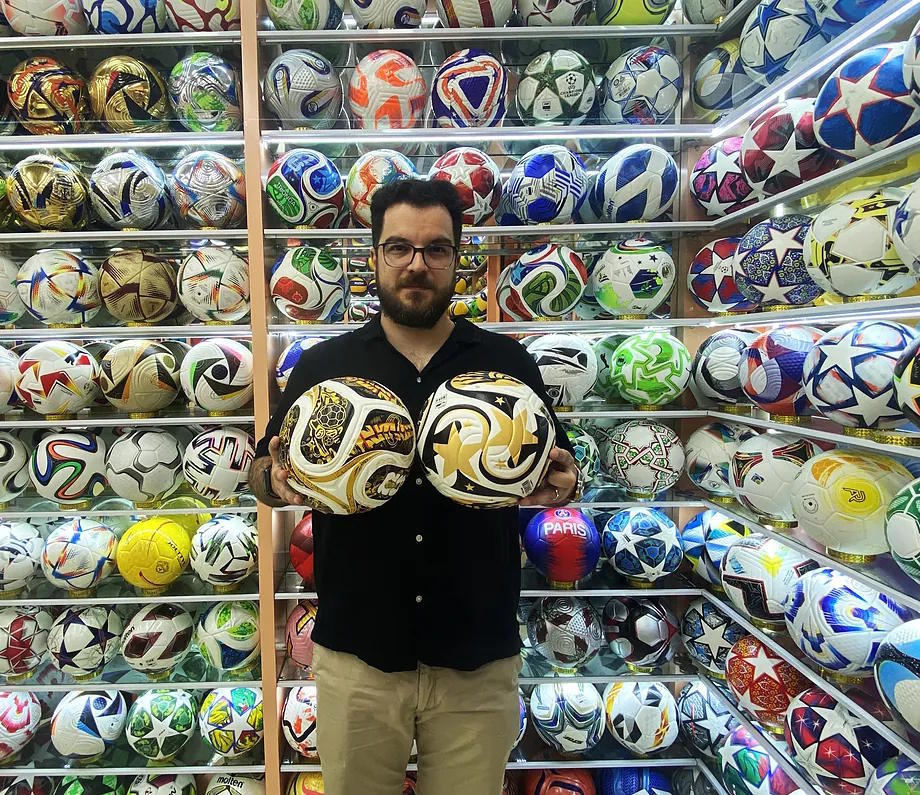
In District 3 of the world's largest bazaar, the World Cup has already begun, even though the ball has not yet started rolling in North America. Among endless aisles, endless rows of fluorescent lights, and signs in Arabic, Russian, English, and Spanish, teams compete for shelf space.
In one of the crowded football merchandise stalls, a Spanish flag hangs next to an Argentine one. Next to them, hundreds of stacked balls in perfectly ordered columns form a multicolored wall. Further on, replicas of all sizes of the trophy that the champion will lift and scarves from Mexico, Canada, and the United States, the three hosts of the competition.
"At the end of last year, we filled several containers with thousands of balls that ended up distributed worldwide," says the Spanish Jaime Horvilleur, a purchasing agent who has been living in Yiwu for 16 years, a city in eastern China absorbed by the world's largest wholesale market for basic products. From here, a large part of the balls, flags, scarves, and souvenirs that will accompany the World Cup starting on June 11 have been sent.
Horvilleur (36 years old), founder of the company Sinergia Trading, acts as a guide for Crónica through this gigantic commercial labyrinth with over 75,000 stalls, where buyers from all continents come in search of any imaginable product.
"If a client from Argentina needs several containers of balls or flags for the World Cup, we organize them. If a French importer wants to fill their stores with tinsel for Christmas, we do that too. And if a supermarket chain in Spain asks us for a million beach shovels for the summer, we find the right manufacturer, supervise production, check quality, and ensure that the merchandise reaches the port and boards for its destination," he explains.
Horvilleur's office is located in one of the modern skyscrapers that have been built in Yiwu in recent years around the market. "Four years have passed since Qatar, and we continue to sell more Messi products than any other player," says Zhang, a young shop assistant selling boxes full of figures of the Argentine star. In another stall, two buyers from Saudi Arabia negotiate the price of thousands of flags.
According to figures from the Yiwu Sports Goods Association, the city accounts for around 70% of the world's production of World Cup-related goods. Chen Guoqiang, another merchant, explains that in the sports section of the market, they have been working exclusively for the competition for over eight months. In his shop window, there are several counterfeit Spanish kits. What is missing from his store are jerseys from the Chinese national team. "We manufacture almost all World Cup souvenirs, but then we have to watch the tournament on TV," he states.
The Asian giant dominates the global football business chain. What it still fails to achieve is to form a national team capable of being present on the field since Korea and Japan in 2002. The expansion of this World Cup from 32 to 48 teams seemed like a historic opportunity for the world's second most populous country. Asia went from having four direct slots to eight. On paper, qualification should have been more accessible than ever. But China didn't even make it to the final decisive rounds. It ended up behind teams like Oman, Indonesia, or Palestine.
Football is one of the biggest frustrations of President Xi Jinping, who made football development a national priority. It was in 2015 when an ambitious reform plan was presented. Chinese companies bought European clubs. The Super League attracted international stars like Oscar, Hulk, Carlos Tévez, Paulinho, or Yannick Carrasco. Salaries surpassed those in Europe. Some Premier League executives even feared that China would become a serious competitor in the global football market.
But the bubble burst. Debts grew, the real estate crisis hit many club owners, and salary restrictions were imposed. The pandemic accelerated the deterioration. And then came the scandals of corruption, match-fixing, and illegal betting. While cities like Yiwu grew thanks to thousands of traders making decisions from the bottom up, constantly adapting to the market and responding to real demand, Chinese football moved in the opposite direction: from top to bottom.
"It's a shame that China is not in the World Cup", complains another merchant from District 3 of a market that receives around 220,000 daily visitors. Such a gigantic place that walking through it entirely would take several days. The stalls function more as interfaces than as direct sales stores; showcases of an immense network of small factories scattered throughout the region.
A buyer enters, chooses a sample, and negotiates the price. Hours later, the industrial machinery starts moving. That is the true secret of Yiwu. While the West usually associates Chinese industry with huge manufacturing complexes, Yiwu thrives thanks to a decentralized network of thousands of extremely flexible small and medium-sized enterprises.
"Each area develops a specialty," explains Spanish Horvilleur. "The neighboring Datang produces about a third of the world's socks. Another nearby town, Qiaotou, manufactures the vast majority of buttons and zippers. And Wenzhou dominates the production of lighters. When an order arrives, entire regions spring into action. The result is a reaction speed that is hard to match."
Yiwu merchants proudly recall how, just hours after the assassination attempt on Donald Trump during the U.S. presidential campaign, T-shirts with the image of the then candidate raising a bloody fist were already circulating. The market detects a global trend and turns it into merchandise almost instantly.
The same happens with the World Cup. Thousands of kilometers away from the stadiums in Dallas, Los Angeles, or Mexico City, Yiwu traders began manufacturing World Cup souvenirs when many months were still left to know all the qualified teams.
Before becoming an exporting power, Yiwu was known for a popular practice called "chicken feathers for sugar." For decades, farmers in the region traveled between villages exchanging small amounts of brown sugar for feathers used as fertilizer. It was a tiny, almost insignificant trade born out of rural poverty.
When China began economic reforms after Mao Zedong's death, that commercial tradition turned into an opportunity. In 1982, the first Yiwu commodity market opened. No one could have imagined then that that experiment would end up becoming one of the largest shopping centers on the planet.
China's entry into the World Trade Organization in 2001 boosted the city's growth. "Local traders understood something fundamental: they couldn't compete in advanced technology or sophisticated products, but they could in speed, price, and adaptability," details Horvilleur. "Yiwu then specialized in what seemed banal: Christmas decorations, toys, costume jewelry, promotional items, stationery products, and sports souvenirs."
The model worked. Today, almost 600,000 containers leave Yiwu every year bound for over 200 countries. And over 80% of Christmas decorations sold worldwide have some connection to this city. That is why, for many economists, Yiwu serves as a barometer of global trade. When orders increase here, it usually means that global consumption is also accelerating. The 2026 World Cup has confirmed it once again.