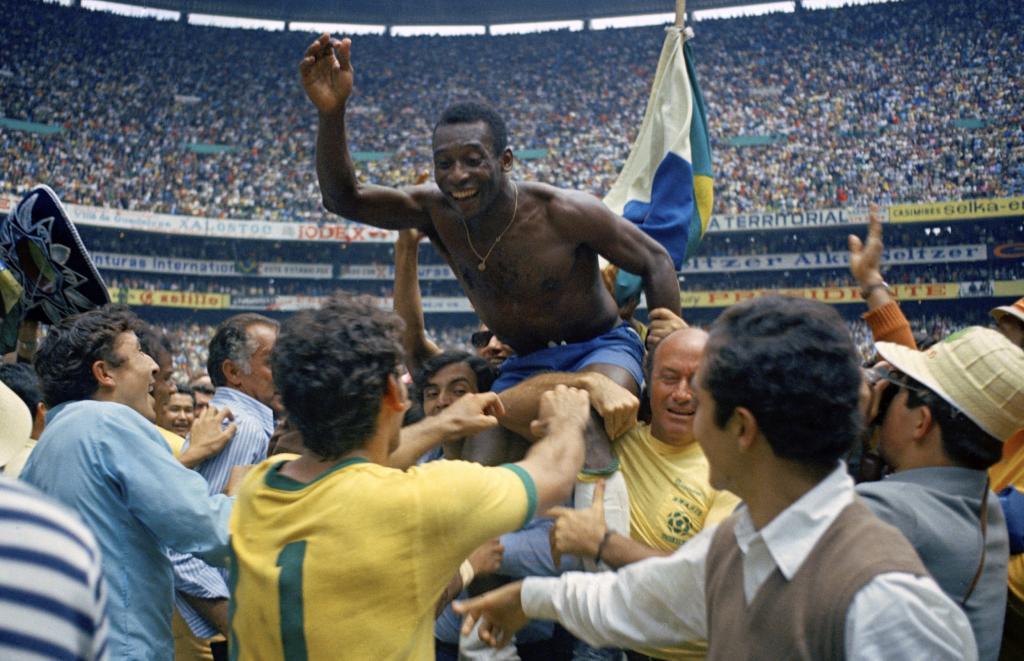
Football as "the last great ritual" that endures, a spectacle that gathers a multitude to unite in a collective ceremony of emotions. This is how Italian writer and filmmaker Pier Paolo Pasolini saw it, and the World Cup is the ultimate expression of that religiosity, with the Azteca Stadium in Mexico City as its chosen temple. Today marks the start of the World Cup in a setting with a mystique that has made it immortal, featured in pages of world literature and in verses sung at massive rock concerts. Because on its turf, the greatest feats of 20th-century national football were achieved.
When Mexico and South Africa take the field, the cement and steel giant inaugurated in 1966, which has undergone intense interior remodeling, will become the only stadium to have hosted matches in three World Cups: the 1970 and 1986 finals that consecrated Pelé and Maradona. Now it will be the match that kicks off a unique World Cup, the first shared by three countries so close on the map yet so far in almost everything else.
The Azteca has a father, businessman Emilio Azcárraga, owner of Televisa and Club América. He needed a stadium for his club and ended up promoting a national icon: a 100,000-seat stadium built in four years despite the enormous technical challenges of dynamiting and excavating 180,000 tons of volcanic rock from the lava flows of the ancient Xitle volcano. That's why it grew vertically like a monumental bowl. Its solidity meant that on September 19, 1985, nine months before the 1986 World Cup, it remained undamaged during one of the most devastating earthquakes to hit Mexico City. By then, football history had already passed through there.
At that moment, despite the heat and the 2,200 meters of altitude, football exploded. The extra time was goal after goal at a pace of less than five minutes. No one could look away from the television during a match that, like the rest of the tournament, was broadcast in color for the first time. Not even the guards at the Tixtla prison, where an escape occurred during that half-hour when Müller scored (1-2) to put Germany ahead, Tarcisio Burgnich equalized for Italy (2-2), Gigi Riva put Italy back in front (3-2), the Torpedo leveled again (3-3), but a minute later, almost out of energy to keep going, Gianni Rivera (4-3) led Italy to the final.
The Azteca once again captured the world's attention in 1986. The World Cup returned to Mexico after FIFA confirmed that it could not be held in Colombia, the chosen host, for security reasons. The Mexican Federation, with the help once again of Azcárraga, fought side by side with the United States and won. If in 1970 it was Pelé who left the stadium consecrated as a global star, 16 years later it would be the birthplace of the player competing to be the greatest in history: Diego Armando Maradona. He did so in two matches at the Azteca.
Maradona, arriving at 25 years old as a star of Napoli and in his prime, scored five goals and provided five assists in that tournament, but the two he scored against England in the quarterfinals are legendary.
On June 22, 1986, the stands of the Azteca witnessed the magic of the Argentine captain. In the 51st minute, a faulty English clearance sent the ball soaring into the area. Maradona sprinted towards the ball alongside English goalkeeper Peter Shilton and, despite standing at just 1.65m, he jumped and, with a street footballer's cunning move that would have been overturned by VAR today, he lightly punched the ball and scored. Neither the referee nor the linesman saw that it wasn't a header. "A little with the head of Maradona and a little with the hand of God," explained the Argentine star, christening an iconic goal. But that wasn't the only one he scored that afternoon to defeat the English 2-1. From the 'Hand of God' to the 'goal of the century'. In the 55th minute, just four minutes later, he received the ball in his own half, dribbled past five opponents one by one over 60 meters to blast a left-footed shot past Peter Shilton. Maradona had entered history. In the semifinals against Belgium, also at the Azteca, the number 10 once again produced two masterpieces to defeat Belgium (2-0) and reach the final against Germany on June 29, 1986. He didn't score in the 3-2 victory: Brown, Jorge Valdano, and Burruchaga did, but Maradona lifted the second World Cup for his country eight years later, becoming a legend.
In this World Cup, the mystique of the Azteca will only last until the round of 16, mainly embraced by the Mexican national team led by Javier Aguirre. Currently, in its vicinity, protests have been called by the National Coordinator of Education Workers (CNTE) and by Searching Hands, relatives of the disappeared in the country.
Mexico City's Secretary of Government, César Craviotto, recommends arriving at the Azteca Stadium well in advance. In recent days, demonstrations have congested access points, and even some small explosive devices have been seized. President Claudia Sheinbaum has guaranteed that the rights of the demonstrators will be respected, but security measures will be heightened. In fact, the city will come to a standstill as telecommuting has been mandated for all non-essential activities, including education, to facilitate circulation in the city.