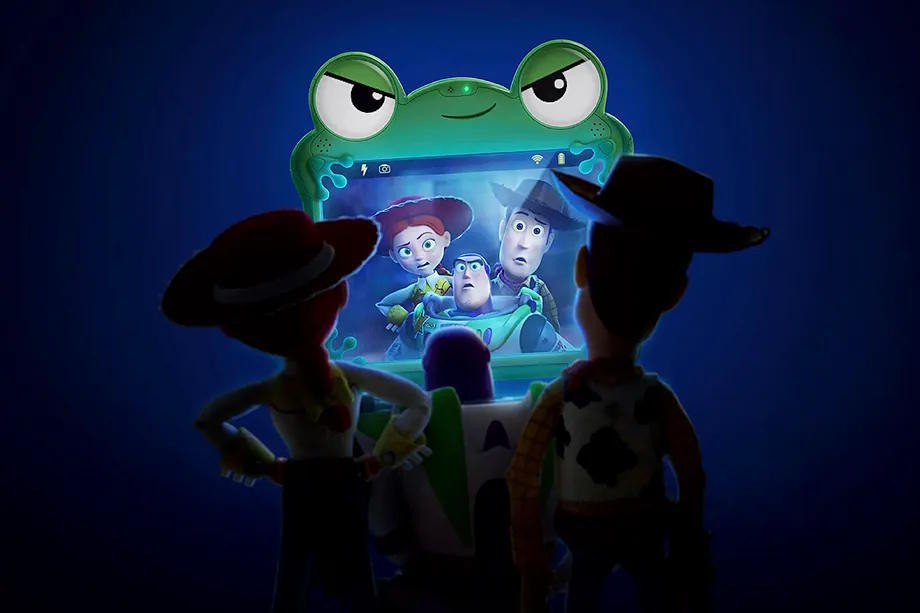
Toys as understood by the consumer society that consumes us did not always exist. As Walter Benjamin recalls in the book that collects his old radio interventions, precisely titled Toys, until the 19th century there was no specialized industry in such a thing. The usual thing until then was to buy wax dolls from the candle maker, wooden animals from the turner, and lead soldiers from the tinsmith. Toy Story 5, the latest installment of the most famous, revolutionary, and fun saga in animation, proposes a world where the toy, in the traditional sense mentioned by the philosopher, is in danger of extinction. That is, it returns to the not-so-distant place of its improbable existence. Directed by Andrew Stanton, and with Pixar's own head Pete Docter in the executive production supported by Lindsey Collins, the film does not propose so much a dystopian madness, as the realization of the most evident technological reality. Screens can do it all.
Let's say the inexhaustible saga has done it again. Until now, we had seen toys acting as servants of tyrannical and capricious masters, but guarantors of life: toys only made sense if they were played with. Not if they were replaced by another (1) or collected (2). Their true drama was the arrival of their owners into adulthood (3). Toy Story 4, one step further, proposed their almost total independence from humans. And now? As if they were clumsy dinosaurs unable to adapt to the digital meteorite, the saddest of extinctions arrives. Or not.
Will evil technology really end everything, including children's imagination, as the doomsday boomers say? "Well," Docter begins while fidgeting in his chair, "we're not trying to demonize technology. We prefer to think of technology like fire. You can use it to warm yourself and survive the coldest winter, or indeed, you can get burned. Like everything, it depends on its use." By his side, Collins raises the stakes: "It would be a contradiction for Pixar, a company as creative as it is technological, to now claim that technology is evil. I think, for example, about the role it played during the pandemic. It was what saved us, thanks to it we could stay connected. At Pixar, we are convinced that simplifying is the most direct path to boredom. The character that takes on the role of the villain in the new installment, a tablet named Lilly, is not really that bad. She does everything with the best intentions, just like any other toy. It's just that maybe she has a few wrong ideas."
To put it in context, what the new installment of the saga that began 31 years ago with John Lasseter proposes is a new return to the edge of the abyss. It has always been like this. In each of the installments, a new danger emerged in the peaceful world of childhood with no time to threaten everything. Now, as mentioned, it's a screen (Lillypad), with its addictive and slightly alienating charm, that appears in Bonnie's world to threaten the undisputed reign of Jessie, Buzz Lightyear, Rex, and the rest of the gang. Woody, remember, is almost retired. Everything happens three decades after, indeed, everything happened for the first time. Back in 1995, a young Docter was already there as a screenwriter alongside Lasseter and Stanton. "The truth is that everything has changed a lot," recalls the current Pixar's artistic director.
And he continues: "Back then, I had just gotten married and I never felt like I was working. We were a group of friends who behaved as if we were still in school. In fact, in the mornings, when I left home, that's what I would say: 'See you later, I'm going to school.' When the movie premiered, I couldn't believe that someone had bothered to make billboards with our movie. And when I read the reviews in the film magazines, it felt like I was dreaming. I was 25 years old and when someone says that the animation world was revolutionized with Toy Story, my impression is that they are pulling my leg." Collins, on the other hand, joined Pixar from Disney just in time to join the team for the second installment of Woody. With a bit more perspective, her diagnosis is less modest: "Certain movies are a cataclysm and change the history and narrative of cinema. Pulp Fiction, for example, is one. E.T. is another. And undoubtedly, Toy Story also changed the course of the conversation and opened a new path."
The movie that now occupies us and the debate, in addition to controversy associated with it, arrives in theaters with the noise of Artificial Intelligence already at a deafening level. Pixar seems to have it clear, much to the despair of deniers. "The curious thing is that when we released Toy Story in 1995, all the promotion was haunted by a similar fear. People asked: how long will it take until all actors are replaced? And I think that's what usually happens when something is new and not fully understood: people assume the worst. And perhaps rightly so. There are terrifying things with AI, but it also has enormous potential to expand the capabilities of artists. And that's what excites me. It seems like a great toy, and certainly we are not approaching it with blinders on. We try to be as open as possible to reality, and it seems that it will allow us to produce things that you haven't seen before, and that's what excites me," comments Docter. "Our stance has remained virtually unchanged from the beginning: if technology can help creatives do something never seen before or bring something to the screen that we couldn't have done otherwise, go for it. We are a technological company, but we have always had a strong inclination towards creativity," adds Collins so that Docter, once again, concludes: "In general, there is no guideline on the matter at Pixar. And there isn't because we have long forbidden ourselves from setting rules about anything. We have unofficial guidelines, but storytelling is fundamentally subversive. Pixar's philosophy against norms is always to think about how to break them." It's clear.
Both confess that they are not always so consistent in prohibiting their children from what they themselves cannot give up. They talk about their addiction to the phone. Both have fun remembering the moment when the joke about (spoiler alert) Woody's baldness was born. "There comes a time in life when shame diminishes. When you reach 40 or 50, you no longer care if someone sees you in pajamas or if your pants fall down. That's Woody's attitude now," Docter reasons. And both agree with Benjamin that the important thing about a toy is not the toy itself but what the toy makes you imagine. "The child wants to drag something and the broom becomes a horse, wants to play with sand and becomes a baker, wants to hide and becomes a thief...," writes the philosopher. And so on.