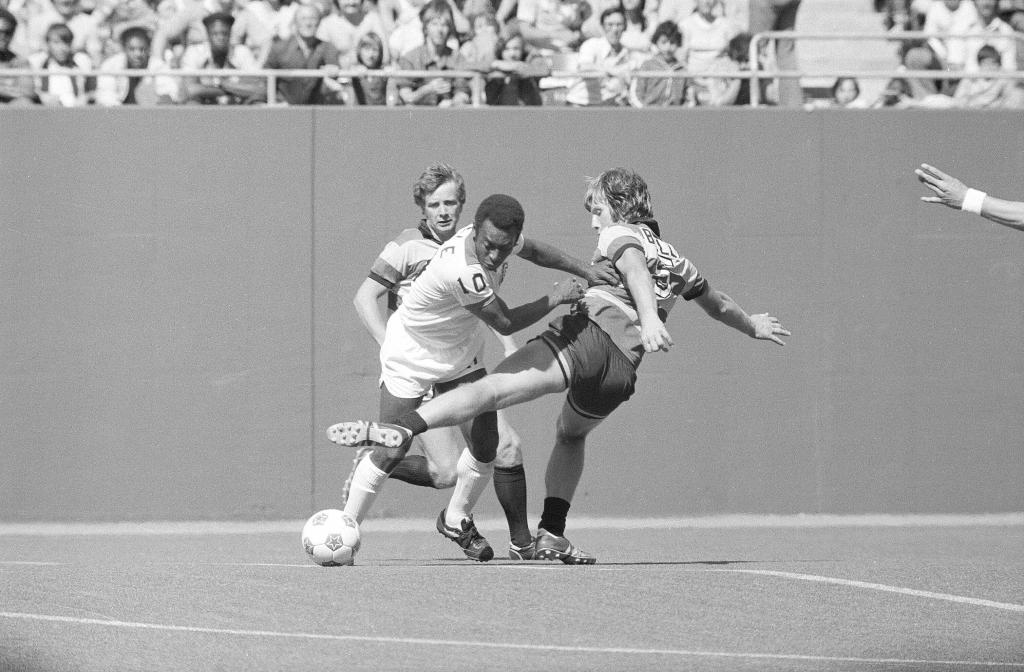
During these months, the intersection of Shea Road and Meridian Road, in the heart of Queens, the largest district in New York, is named after Pelé. A detail from the city council for the World Cup and a tribute to the man who half a century ago propelled 'soccer' throughout the United States. On June 15, 1975, Edson Arantes do Nascimento made his debut with the New York Cosmos at Downing Stadium, whose grounds today, rebuilt to form the new Icahn Stadium, still exude the smell of soccer.
"Here we still keep the giant Cosmos logo that was at the top of the press area of the old stadium," Louis Vazquez, director of the Icahn Stadium, shows this newspaper a few minutes after entering through the main gate. The field is located on Randall's Island, north of New York, between the Harlem River and the East River. In the initial hallway, to the left, a painting of Pelé's debut dominates. Immaculate white jersey and thousands of people in the stands. 21,278 gathered that day, with 300 journalists from 13 different countries. "This photo is the most iconic in the history of soccer here in New York," he adds.
The Downing Stadium was located a few meters from where the Icahn Stadium stands today, with only 5,000 seats. At the time, the field that saw Pelé land was one of the largest in the city, behind Yankee Stadium and Shea Stadium, owned by the Yankees and the Mets of the baseball league. It sparked interest, although it had some issues that had to be resolved at the time with the arrival of the Brazilian star and the subsequent media pressure.
"he took off his boots and got scared"
"The playing field had many dirt areas, and with the global attention his debut received, two CBS employees, the television broadcasting the match, used green paint on the brown mud. At halftime, Pelé, nervous, took off his boots and socks and got scared because his hands were stained green, but Julio Mazzei, a member of the Cosmos staff, reassured him by telling him it was green paint from the ground," Vazquez recounts.
Pelé had retired from soccer on October 2, 1974, after playing his last game with Santos, but he decided to return to solve his serious financial problems caused by bad investments. "I remember when the accountant came home, he was sweating a lot, he was pale," he recounted in his biography. The Brazilian decided to turn down offers from Europe, some from clubs like Real Madrid and Juventus, and accepted the deal that Clive Toye, a Cosmos partner, had been proposing for years: almost three million dollars a year, one of the highest in the sports world at that time.
"His arrival brought glamour to soccer. The North American Soccer League became a cultural phenomenon, attracting celebrities like Muhammad Ali, Andy Warhol, and Mick Jagger," explains Brian D. Bunk, a History professor at the University of Massachusetts and author of From Football to Soccer (University of Illinois Press, 2021).
Pelé was 34 years old, had not played for eight months, and yet he was by far the best player that Sunday and in the league during the years he was there. "The Great Pelé," read the match poster. "He has captivated the rest of the world, and now he will captivate the United States. They are the luckiest fans of their generation because they will be able to see Pelé play," it added, next to an image of the Brazilian celebrating a goal.
That match ended 2-2, and Pelé would win the title in 1977, after the Cosmos had moved to the Giants Stadium, newly built on the grounds of the current Metlife Stadium and larger, before retiring for good.
"It was tough to play against him at first, but then we got used to his passes and movements," Mark Liveric, one of his teammates, said after the match against the Tornado, in statements reported the next day in the New York Times. The article, titled "21,278 people go to see Pelé and the Cosmos draw," states in that chronicle that "the Brazilian millionaire" was supposed to play only the first half, but "he was motivated by the game" to continue in the second. "He was fouled many times, but it didn't seem to bother him much," the text adds. He scored the first goal from a pass by the Israeli Mordecai Spiegler. "I didn't see the ball," said the opposing goalkeeper, Ken Cooper, afterwards. Pelé also assisted Spiegler for another goal and left a backheel pass to his teammate Liveric that "was the best of the match," according to the Times.
"We will be a great team," the Brazilian assured. And they were. Tickets for that June 15 cost two dollars for minors, four for adults, and six for those with reserved seats, but prices multiplied in the following months.
Pelé raised the level of the league, which would later welcome Franz Beckenbauer (Cosmos), Bobby Moore (San Antonio Thunder and Seattle Sounders), or Johan Cruyff (Los Angeles Aztecs and Washington Diplomats). "The evolution of players like Landon Donovan or Tim Howard, the launch of the MLS in 1996, and the boom of the 1994 World Cup are directly related to the interest generated by Pelé in the late 80s," Vazquez states. "What we have now is the culmination of that whole process. But it didn't all start with Pelé. The Cosmos already had 10,000 people per game the year before his arrival; it's not that soccer wasn't being played," Bunk clarifies.