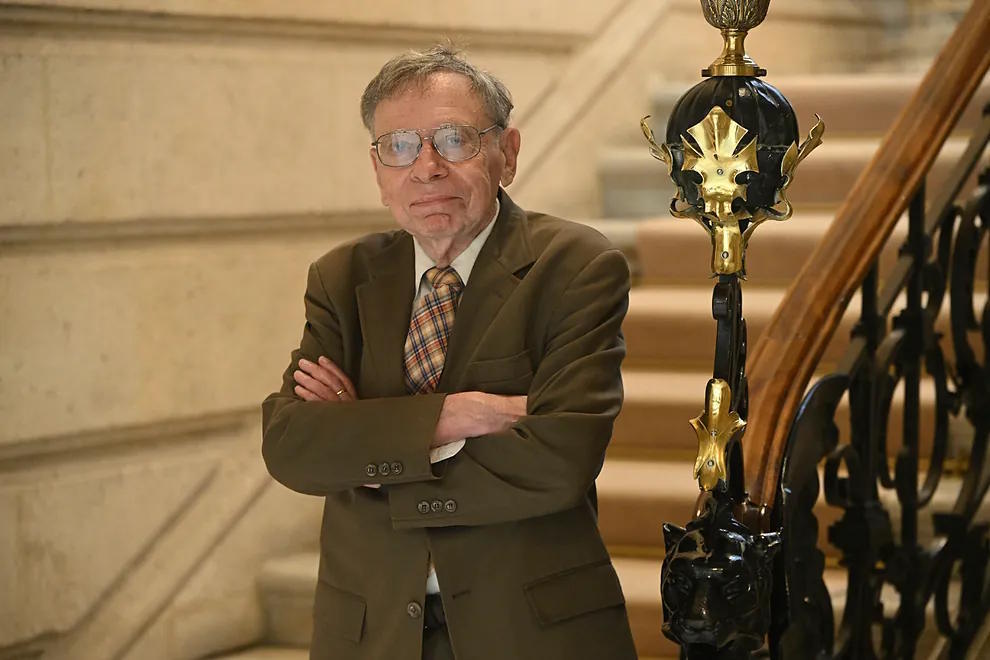
When we talk about climate change, we usually think of smoke, factories, heatwaves, or melting glaciers. Carl Wunsch has been reminding us for over 60 years that there is a fundamental protagonist missing in that story: the ocean. Beneath an apparently calm surface, a gigantic machinery circulates that stores heat, redistributes energy throughout the planet, and helps determine Earth's climate.
From the Massachusetts Institute of Technology (MIT), where he developed most of his career, Wunsch led a scientific revolution that transformed the way we observe the oceans through a combination of mathematics, physics, and space technology. Born in Brooklyn in 1941, Wunsch is considered one of the fathers of modern physical oceanography. His research has helped demonstrate that the oceans are the planet's great thermal regulator and an essential piece in understanding climate change. That is why he is receiving today in Bilbao the XVIII Frontiers of Knowledge Award from the BBVA Foundation in the Climate Change category.
If we are going to talk about climate change, we can already prepare ourselves to receive a lot of insults on social media. The problem is that many people see it as a threat to their way of life. For example, if you are in the oil sector. Another more recent difficulty in the US is the lack of trust in science. Science coexists with the possibility of being wrong, and some people use it as an excuse to tell you that you don't know what you're talking about. The historical perspective is that science self-corrects and sometimes becomes a threat. The classic example is the sun not revolving around the Earth. For many, this was a terrible idea that contradicted all their beliefs. On a small scale, this is what is happening now. It is more a problem of psychology and sociology than of science. I have a colleague who used to say that, for scientists, asking the right questions is much more important than getting the right answers. Science has to ask questions, and of course, there will always be people who don't like the answers.
How is the research being affected by science, especially climate science, becoming an ideological battleground?
In the US, it is a disaster. We are losing a generation of scientists, and it will take several generations to recover from this. There are people doing interesting things and have lost funding. And it is not easy now to encourage young people towards climate science. The Trump Administration is undermining science in almost all areas. For example, it is dismantling the ocean observation system that has taken us decades to build. One of the priorities in climate science is to have global records that outlast our human life. When you destroy these records, it is almost impossible to know what has happened. It creates a lot of uncertainty. My successors will have to rebuild the systems and make sense of it without the observations that will be missing.
You have dedicated a whole life to studying something that most people do not see: deep currents, ocean circulation, heat stored beneath the surface. Do you think society really understands the magnitude of what is happening with the planet's climate?
Talking about society is not so easy. Most of the Earth's surface is water, and humans do not have an intuitive understanding of it. People like me have spent decades trying to develop this intuition, and it is partly counterintuitive. For example, the flow of the oceans on a large scale is controlled by the Earth's rotation, and almost no one has an automatic or instinctive understanding of that.
If we were to stop emitting greenhouse gases right now, what changes would still occur?
It is a very profound question. Predicting the climate is extremely difficult because there are parts of the system that respond very slowly. So I will talk about general things. I can say that there is so much excess CO2 that there will be severe changes even if emissions stopped right now. What exactly will these changes be? Will there be drought in Mexico? Well, I don't know if we can predict that specifically, but effects like drought in Mexico will be more likely, but there can also be a lot of rainfall. The system will take hundreds of years to return to what we call equilibrium. And in the process, many things will happen. Probably, the Earth will continue to warm, and there will be more melting, and this could last 30, 100, or 150 years. We are not sure. The problem is that we have to be prepared for all kinds of changes without being very clear about exactly what they will be. The oceans react very slowly. Much slower than the atmosphere. Some deep water masses take centuries to renew, so they may still be responding to climate changes that occurred hundreds of years ago. There are parts of the ocean that, according to our interpretation, are still cooling because there was something called the Little Ice Age that lasted until the 19th century, and we are now paying the price.
What advice would you give to a student who is the same age as you were when you arrived at MIT?
I am concerned about two issues. On the one hand, there are those who develop large climate models, and on the other hand, those who are dedicated to making measurements and observations. The problem is that both communities do not always understand each other well. Modelers often know little about the complexity of real data, while those working with observations often have difficulty understanding the strengths, limitations, and uncertainties of the models. So, if I had to advise a bright student, I would say: get in the middle. Learn from both worlds. Understand what the observations are really telling us and what the models are telling us. There are very few scientists who are comfortable in both fields at the same time. Looking back, I think that reflects a certain lack in our educational system. We have not trained enough researchers capable of moving between both disciplines. Although I must also say in our defense that both are extraordinarily complex. You can dedicate an entire career to understanding in depth how observation instruments work and what their data mean from a physical point of view. And at the same time, another career is needed to understand climate models composed of millions of lines of code capable of simulating the future evolution of the planet.
What question about the ocean still keeps you up at night?
I did not think I would end up studying the oceans. I studied geophysics, seismology, geomagnetism, but I met a very charismatic individual, an oceanographer who made his own measurements with paper and pencil, and I found the work at sea fascinating. My scientific strength was in the mathematical field, so I took measurements at sea and returned to my office to confirm what was in my models. Then, in the 70s or 80s, it became clear that global climate change was very serious, and things in the ocean change day by day, and year by year, and we set up an observation system, which is what these awards are about. What worries me is that there are parts of the ocean that have not yet been sufficiently observed, especially in the southern hemisphere. And in the north, the ocean is on average 4,000 meters deep, and on the surface, there are also problems because it is turbulent, and changes all the time in random ways. My concern is that our successors will say, why didn't you measure this? Because once the phenomenon passed, it passed, and most observation systems measure every ten days. Is it enough? Well, I don't know, and I am very aware of what we are not measuring.