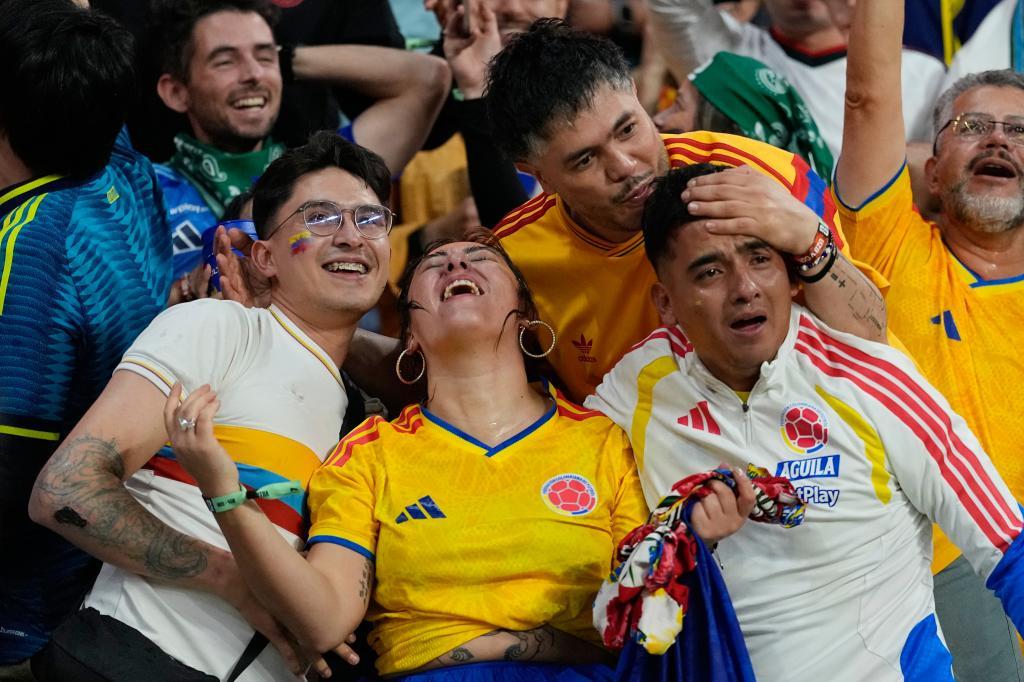
On 8th Avenue in New York, there is no other topic of conversation, in different languages and accents, beyond the World Cup. Nor on the planes crossing North America. It is the World Cup of diasporas. Among food stalls, restaurants, and small businesses in downtown Manhattan, the flags of Morocco, Ecuador, Colombia, Mexico, Brazil, or Senegal wave, much more numerous than the American flags. On flights, passengers wear the colors of their countries. The World Cup, a success that has already attracted over a million spectators to its stadiums, full and colorful, has found fuel in the displaced. In the country with the most immigrants, football knows no borders.
The United States, the tournament host along with Mexico and Canada, is home to over 52 million immigrants according to UN data. 15% of its population. More than any other country. And that mix of nationalities, languages, and cultures is evident in New York and in this World Cup.
The images of full stadiums are far from what was seen in the Club World Cup, where the audience was much more local, except in the cases of South American clubs, and matches were played with many empty seats. It is debunked that football in the United States does not generate interest, but it is explained by the immigrants.
"A lot of prejudice towards Latinos"
"We are following it much more, of course," replies Wilson, a Brazilian waiter at a bar on 8th Avenue who has been living in New York for a decade. He resides in the Jamaica neighborhood and acknowledges that "in the neighborhoods of Queens or in Astoria," the Latin heart of the city, is where the most interest lies.
"Tickets are very expensive, but I have many friends who have saved up and have been able to go," says Andrés, born in New York to Mexican parents, a reflection of that new generation of Latinos, born and raised in the USA, who are increasing the country's passion for soccer. "In the local soccer league, we are mostly Latinos, but more are joining," he says.
"Let's win!" shouts Sami in English, a Senegalese who has a food stand on the street. Billy was also born in New York, but his parents are Colombian. His accent gives him away. He runs another food stand and jokes that "there are too many Colombians here," saying, calling out to Americans: "There is still a lot of prejudice towards Latinos. I have an accent, but I am from here. It's tough for us."
Senegal fans, on Tuesday, during the match against France.AFP
The World Cup has turned entire neighborhoods even more into extensions of the participating countries. Ecuadorians gather in Corona or Jackson Heights, where Néstor heads: "We experience the matches as if we were in our country, even though we have been residents here for two years." The same happens with Moroccans, who colored Times Square red before the match against Brazil. "It's expensive, but this is a once-in-a-lifetime experience," says Ahmed amidst the lights of the screens. Arab restaurants, like Haitian ones, have become football embassies for those who could not enter the stadium.
In many communities, the joy of enjoying the World Cup is mixed with anger for those compatriots who could not cross the border. Marcus Epwo, a Congolese leader in Texas, explained this week that the diaspora of his country exceeds 25,000 people between Houston and Dallas, but many could not travel from the origin due to restrictions imposed by Trump. "We will cheer for those who are not here," he said on CNN.
Not everyone in New York are football tourist, like the Scots filling the bars, but they work in restaurants, construction, and businesses, and play in amateur soccer leagues. "I had to disband my team from the local league because the players, mostly Latinos working here as cooks and cleaners, were getting injured and not showing up for work," the manager of McHale's bar on 8th Avenue tells us.
On planes, the hustle is constant. "We just watched the France-Senegal match and now we're going to see Cristiano in Houston. $700 each, but it's historic," explains a Senegalese passenger living in Staten Island. Next to him, a Mexican who is also revisiting Mbappé and Ronaldo.
In Houston, Juan, the taxi driver, a Colombian who provides reliable sources in each city, taking us to the hotel insists that "it is the immigrant people living here who are going to the stadiums." "With the visa issue, many do not dare to cross the border," he adds.
Those who once came to the United States to build their lives are now creating the permanent celebration of a historic World Cup. The record set by the diasporas. The World Cup of immigrants.