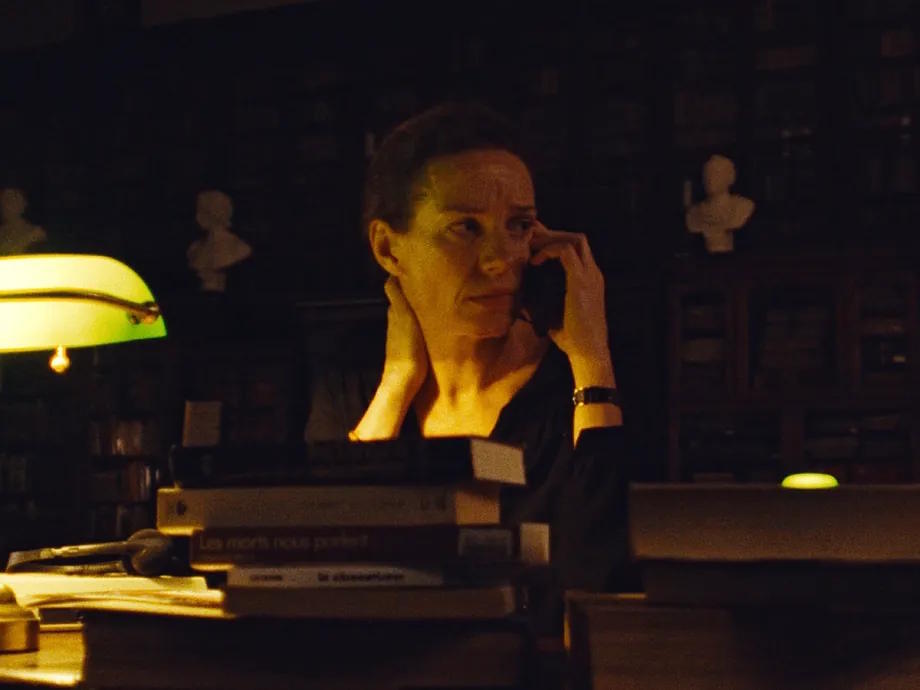
"The diameter of the Aleph would be two or three meters, but cosmic space was inside it, without any reduction in size." The quote is the most famous from The Aleph and just because Borges next to Umberto Eco, bibliophile with bibliophile, mirror in front of mirror, are mentioned in the credits at the end of Chronovisor, the quote is well placed. The film by American newcomers Kevin Walker and Jack Auen burst onto the scene at the Cinemajove Festival on Saturday like revelations do: without asking for permission and completely oblivious to norms, traditions, or a sense of measure. Previously premiered in Rotterdam and with the appearance of a must-see, the entire film is conceived to be read. Yes, you read that right. From start to finish, book upon book, magazine upon magazine, text upon text, the viewer is invited to follow the trail of the greatest of mysteries, an enigma that grows, expands, and manages to encompass, without a doubt, the entire universe from the most ridiculous and vulnerable of its creatures to, pay attention, the viewer's own consciousness. A device, the chronovisor of the title, to see in which, in the end, indeed, you see yourself. The nuance (as warned by the Aleph itself) matters.
Basically, it is about the investigation that a scholar, played by Anne Laure Sellier, carries out from the present day to find the key to the said device. The chronovisor, believe it or not, occupied a good part of the most extravagant news of the 50s and 60s. It was a supposed observation device of the past invented by the Benedictine monk Marcello Pellegrino Ernetti. According to this man who would have shared the invention with Enrico Fermi and Wernher von Braun, the machine worked by capturing the electromagnetic radiation and sound waves that historical events emitted even in the present. In truth, its argument, or the argument that the film dares to tackle, is more ambitious. According to this man's thesis, everyone would live in a unique time in which present, past, and even future would coincide. The reality of here and now would be something like the only one that our poor senses can reach. But with the chronovisor, things change. Then, like the Aleph itself, the entire cosmos would be within our reach. All of it with all its most dangerous secrets. The chronovisor not only sees the past, it also sees any WhatsApp message. Not to mention what is kept in folders labeled Top Secret. Fascinating? Ridiculous? Both?
Walker and Auen's film starts from here to compose an absorbing, unheard-of, and completely unprecedented thriller through meticulous, extravagant, and very analog work in the archives. The viewer is invited to enter the mind of the protagonist and only character and, through each of her meticulous readings, read with her and get lost in a labyrinth, which is also a library, which is also a mirror, which is also Borges. And Eco. Only occasionally, the reading continuity, let's call it that, is interrupted by a phone call or by a very slight interlude on the streets of New York where the non-action unfolds in a memorable and purely dizzying way.
Shot on celluloid with the weight of doctoral theses or manuscripts from another time, with a chiaroscuro photography reminiscent of Caravaggio so close to a sigh, and with a soundtrack by Gustav Holst almost mesmerizing (whatever that may mean), Chronovisor advances with bated breath, convinced of offering the viewer what few films have ever achieved: the perfect representation not of a nightmare, but of their own nightmare. An artifact, we said, to see that sees you and, pushing it, sees itself like a memory-filled Funes stopped in the contradiction of remembering everything, seeing everything... even his own death. "Let heaven exist, even if my place is hell." This is another quote from Borges, from The Library of Babel, and it holds true. The library noir has just been founded.