Spain and Mexico facing the mirror. What we still don't know is how the mirror is, if it's made of Murano glass or distorting like those in the Callejón del Gato in Madrid that served Valle-Inclán - who in his youth discovered in Mexico pistols and Modernism - as a metaphor for the grotesque.
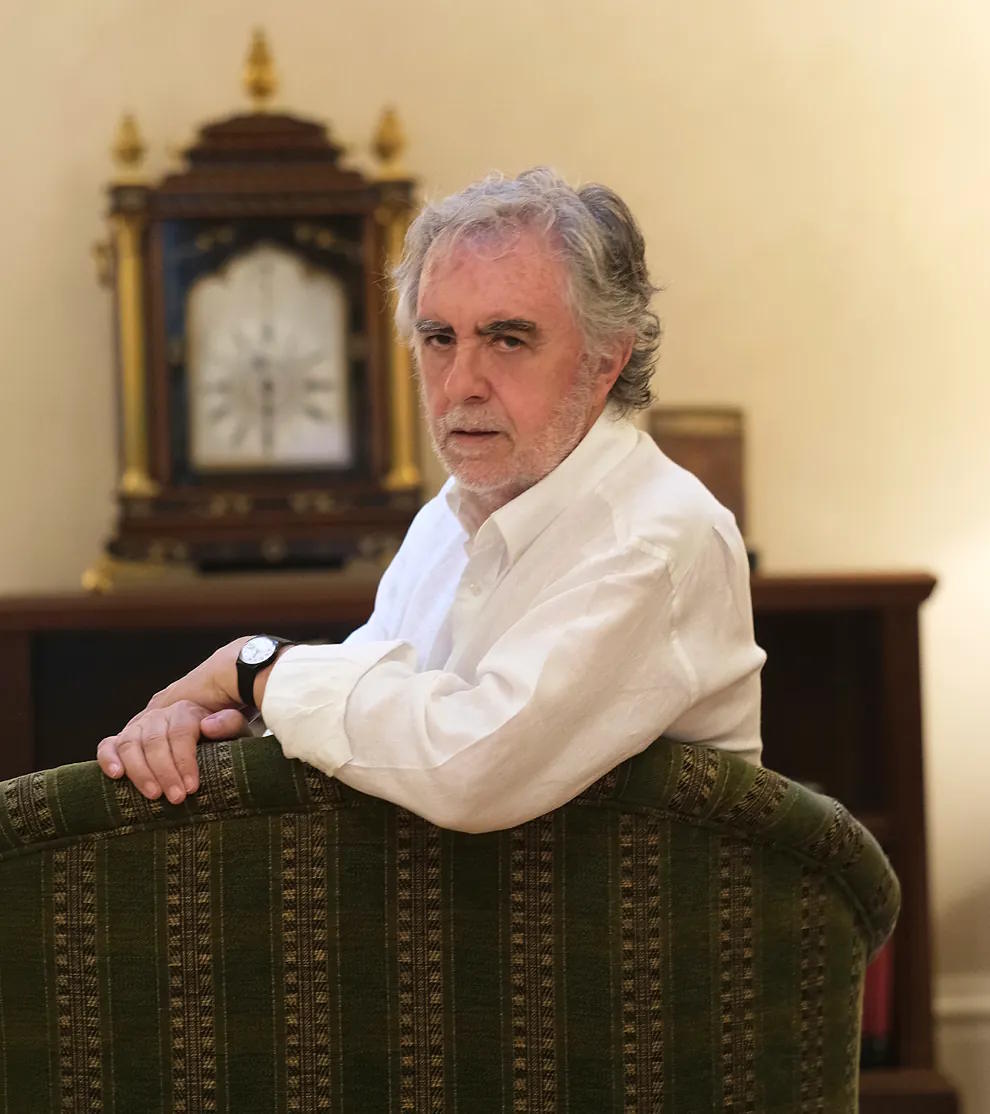
We spoke with Tomás Pérez Vejo (Caloca, Cantabria, 1954) a few hours before Felipe VI is received at the National Palace by President Claudia Sheinbaum in a meeting that could represent the definitive normalization of relations between both countries after seven years in which the left-wing governments of Mexico have demanded an apology from the Crown for the Conquest... or perhaps a new jab in historical reproach. This renowned academic, whose intellectual work has been recognized with the Order of Isabella the Catholic and the Mexican Order of the Aztec Eagle, is the ideal person to understand the relationships between both countries and the reason for that institutional animosity against the Spaniards that has become an electoral strategy on the other side of the ocean. His knowledge is not only endorsed by his various books, but by a whole life: that of someone born in Spain with 30 years of teaching in America as a History and Ethnohistory professor at the National School of Anthropology and History of Mexico.
The meeting with Pérez Vejo took place on Tuesday in Madrid, when this city competes in asphalt temperature with the Sonora desert, hours before his talk at the Rafael del Pino Foundation on memory and the construction of the narrative of Spain and Mexico.
"In today's hegemonic narrative of the past in Mexico, Spain is the enemy, the one responsible for the destruction of the nation"
What is the origin of this animosity in a country that has received so much Spanish emigration for two centuries?
There is a problem between Mexico and Spain, that is undeniable, but not from Spain towards Mexico. In reality, what happens is an internal issue related to how Mexicans narrate their own past.
And how do they narrate it?
Throughout history, there have been two ways of narrating it. One narrative states that Mexico was born with the Spanish Conquest. Here, Spain is not seen as the enemy but as the origin of the nation, to which religion and language are owed. The other narrative, which is currently dominant, considers that Mexico existed as a nation before the arrival of Hernán Cortés and died because of the Conquest only to be reborn with Independence. In this narrative, Spain, the Spanish, and Spaniards are seen as the enemies.
It's not a historical debate, it's ideological.
Yes, the first narrative tends to be, in general terms, that of conservatives and the right, while the second one was adopted by the left. However, this was not always the case. Prominent figures of the left, such as José Vasconcelos, an intellectual figure of the Revolution, or President Lázaro Cárdenas, strongly defended ties with Spain against Anglo-Saxon influence. President López Obrador's demand for an apology from the King was for domestic consumption, for his electorate, nothing more. If it had been a real foreign policy issue, it would have been pursued through the Ministry of Foreign Affairs, not through a letter to the King. The same approach was taken by the Madrid president, Isabel Díaz Ayuso, from the other side, when she visited Mexico recently, reclaiming the Spanish past of America. Her attitude was also for domestic consumption.
Do you think Sheinbaum will bring up the issue again tomorrow?
I hope not, but I don't rule it out. I hope diplomacy and hospitality prevail towards a Head of State who is their guest. However, we cannot forget that Sheinbaum is in a truly uncomfortable political situation, so much so that she did not even attend the World Cup inauguration. She feared the public's reaction, besides that, from her ideological standpoint, she has always seen football as the opium of the people. Additionally, her relationship with the United States is complicated. We are talking about the country to which you export 80% of your production and which is also asking you to extradite a former governor of your country linked to drug trafficking.If you were an advisor to the King, what would you recommend in case of a dilemma?
I would advise him not to do anything because whatever he does, he will be criticized in Mexico. If he doesn't ask for apologies, he will be criticized by those who support the government, while if he does, the other sector will feel offended.
It seems like criticizing Spain is fair game...
That's right. Mexican politicians get away with it. It is a conflict perceived as a moral drama between executioners and victims.
Many times the victims have last names like Martínez and Pérez.
It's true. I'll share a quote from a Mexican historian that I like to use because, although it sounds like a joke, it holds a lot of truth: "In Mexico, the Indians carried out the Conquest, and the Spaniards carried out the Independence." The taking of Tenochtitlán was done by an army of over 40,000 soldiers, of which only 900 were Spaniards. In other words, the vast majority were indigenous people. Looking from Spain's perspective, it's curious that the descendants of Extremaduran laborers who never saw the sea feel like direct descendants of the 16th-century conquerors when, in fact, the descendants of the conquerors are those who did not return and stayed in America. Those who centuries later gained independence and now define themselves as heirs of indigenous peoples.
One thing is certain, the independence did not break the ties between Spaniards and Mexicans.
Think about the independence of Algeria. The first thing Algerians did was expel French settlers, establish Arabic as the official language, and Islam as the religion. This is normal in such a political process. However, why didn't this happen in Spanish America? Because the independence leaders were descendants of Spaniards, spoke Spanish, and were Catholics! I'm not sure about the history taught in schools, but what is important to know is that the Spanish Monarchy consisted of American kingdoms, not colonies. Perhaps the only colony was Cuba. When discussing the crisis of the 17th century, which was undoubtedly exaggerated by the Bourbons to strengthen their own legacy over the Habsburgs, it is true that territories were lost in Europe, but not in America. Spain became more American than ever and remained a superpower throughout the 18th century. Spain was the first Euro-American power in history.
Regarding Cuba, since you mentioned it, and the affections. While in Havana, I encountered a group of schoolchildren in their uniforms. When they passed by the Spanish embassy, suddenly the teacher said to them, "That is the flag of the Motherland." I was very surprised. Such a view is unimaginable in other Latin American countries. I wanted to ask you, considering the decline of the Castro dictatorship and the pressure from the Trump Administration, do you think we will see a Cuba annexed to the US?
Although it is a remote possibility, I do not rule it out; it has never been closer. Given the economic disaster of the Cuban Revolution, where even the person selling ice cream on the beach is a government official, it is evident that Cubans are living in such desperation that they would be willing to consider any solution. As Cuba is a failed state, annexation has never been easier. It has always been a desire of the US, even before independence. I believe the first purchase offer was made in 1823, and it is worth noting that after the 1898 war, the Americans imposed a protectorate over Cuba. If Cuba withstood such pressure, it was because its political elites understood that the only way to counter US influence was through Spain. Recent statements from Miami exiles do not rule out the mission of integrating Cuba into the US. Even though they are of Cuban origin and speak Spanish, they are already Americans in reality. Look at Marco Rubio.
Peripheral nationalisms arise precisely with the loss of Cuba, when intellectuals' opinion on the nation is most depressing.
They are related. Nationalisms emerge when the image of Spain as a failure is established, leading to supremacist ideologies. Consider that the first PNV councilor appears on July 3, 1898. I maintain the thesis that Spain, unlike other American countries, has succeeded in state-building but has failed in nation-building. At least a relative failure because there is a percentage of Spaniards who do not consider themselves as such. I believe this failure originates from 1898. Previously, the Spanish national construction process was very similar to that of most European countries. It is the elites who created this perception of failure. This happened because for a century, they had been emphasizing that one of the defining traits of Spanish nationality was its imperial character. So when the last part of the empire fell, just as other powers were building theirs, it was interpreted as a failed nation.