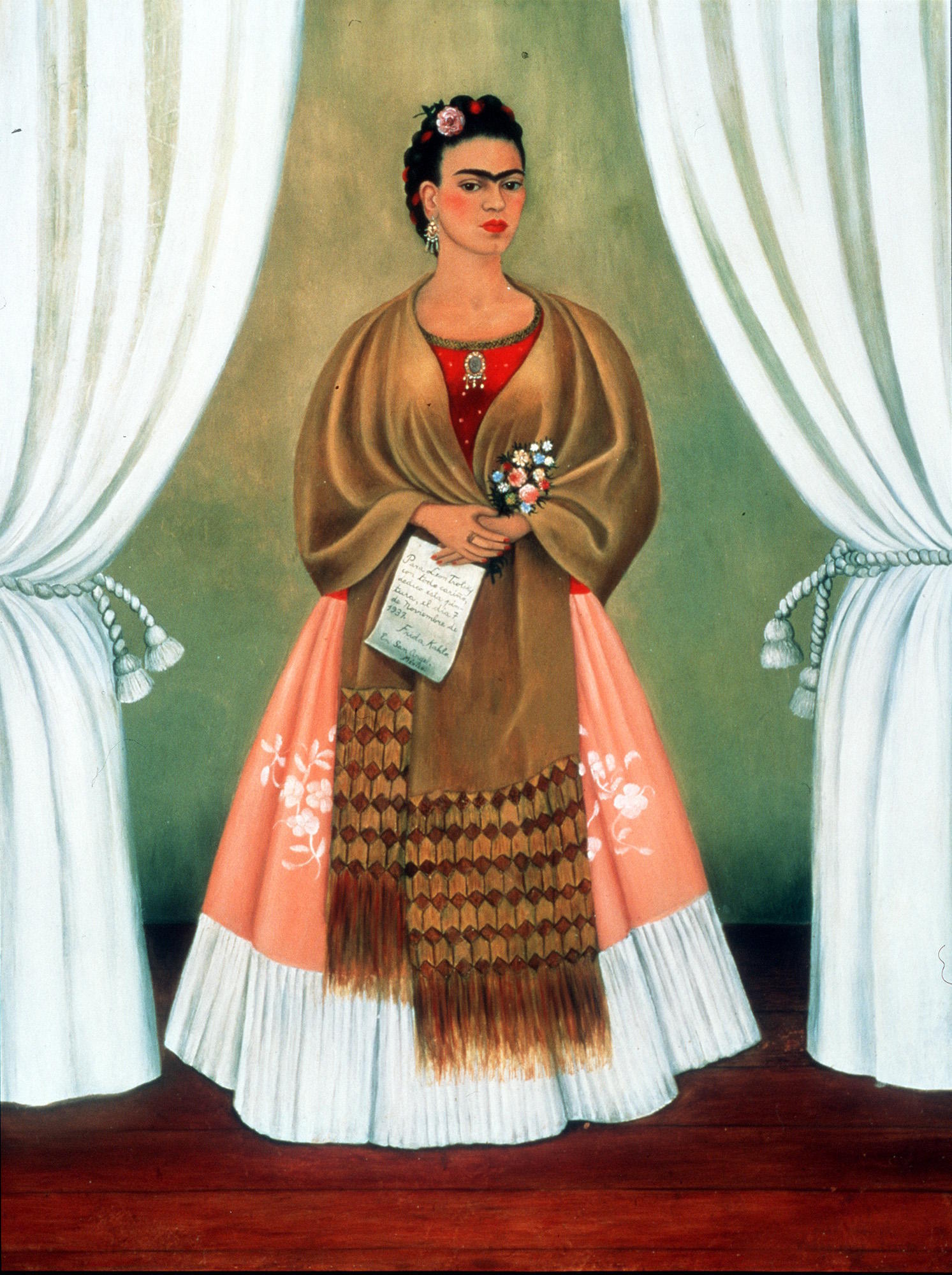
Frida Kahlo was not born an icon. Nor was she, in life, the universal artist that she seems to have been forever. For decades, she was a Mexican painter known in small circles, partly overshadowed by the monumental - also physical - figure of her husband, Diego Rivera, associated with surrealism even though she always rejected that label, as she herself said "I do not paint dreams. I paint my own reality."
When she died in 1954 - from a pulmonary embolism?; by suicide?; by voluntary or involuntary overdose of medication? - something extraordinary happened. Progressively, especially in the decades of the seventies, eighties, and nineties of the last century, Frida Kahlo ceased to be just Frida Kahlo. She became Frida. A face, emblem, flag, collective self-portrait, and global phenomenon. And, obviously, also a commodity,
So the exhibition at the Tate Modern in London, in collaboration with the Museum of Fine Arts in Houston, in the USA, about this transformation could not be called 'Frida Kahlo'. Just 'Frida'.
Frida's Ambition: The Making of an Icon' is complex: explaining how the artist ended up becoming one of the most recognizable images of the 20th century and a decisive influence for generations of artists in Mexico, the United States, Europe, and Latin America. She even changed her native Coyoacán. In 1907, when Kahlo was born, that name only referred to a town on the outskirts of what was then Mexico City.
Today, Coyoacán is part of the gigantic metropolis now called Mexico City, a hybrid between a neighborhood undergoing gentrification, a tourist attraction, and a pilgrimage center to the Blue House, the tourist magnet that the house where she was born has become, replacing as the main attraction the house of León Trotsky, where the Soviet revolutionary - and Kahlo's former lover - was assassinated on Stalin's orders by the Spaniard Ramón Mercader. Kahlo's mythology has surpassed that of Trotsky.
The Tate exhibition is the largest held in the UK in decades, offering nearly 40 works by the artist, including rarely seen self-portraits, along with photographs, dresses, personal objects, and archival materials. But the real differential twist of the exhibition lies in placing Frida Kahlo in dialogue with modern and contemporary artists from around the world. The curators of the retrospective - Tobias Ostrander and Beatriz García-Velasco - not only suggest looking at what the artist painted but also observing what others have seen in her. Some have seen an aesthetic. Others, a biography, an identity, and even a form of resistance.
The exhibition does not present these self-portraits as mere masterpieces but as personal construction operations. This is the case with Self-Portrait (in a velvet dress) and Self-Portrait with Loose Hair, from 1926 and 1938, respectively. They are accompanied by paintings of other protagonists of the so-called Mexican Renaissance, including the Portrait of Frida Kahlo by her husband Rivera, dated around 1935, and 'Dream and Premonition' by María Izquierdo, from 1947. Thus, Kahlo is framed within the Mexico in which she lived: a post-revolutionary country seeking visual reinvention, between cultural nationalism, popular traditions, mass politics, and modernity.
The core of the exhibition is Kahlo's relationship with surrealism. She rejected the label, although, at least from a more superficial point of view, the affinities are obvious: open bodies, hearts outside the chest, doubles, masks, skeletons, death symbols, interior landscapes, and scenes suspended between confession and hallucination. André Breton defined her as "a surrealist created by herself" and invited her to exhibit in Paris, where she took her self-portrait The Frame from 1938, now presented at the Tate alongside works like Diego and Frida 1929 or Memory, the Heart.
Although her name circulated in artistic circles in the USA since the thirties, Kahlo's explosion came two decades after her death when, in the late sixties, the Chicano movement in the United States adopted her as a symbol of cultural and political pride. For Mexican-origin artists and activists seeking to assert their own identity within the USA, Kahlo was Mexican, mestiza, rebellious, politically committed, and outside established cultural models.
Feminism was another driving force behind her posthumous rise. In Mexico and the USA in the seventies and eighties, the self-portraits with cropped hair, her masculine features, and scenes of physical pain directly challenged the traditional representation of women. Kahlo painted experiences outside the artistic canon, such as the non-idealized, pained female body - the painter had poor health throughout her life - and the Tate captures that vision and places it alongside artists like Kiki Smith, Judy Chicago, Yasumasa Morimura, and Ana Mendieta who, sometimes directly emulating Kahlo, continue her path in describing identity, violence, nature, body, memory, and gender.
The final section is the most ambiguous: what the Tate calls Fridamania. In other words, her transformation into a global brand. The works there consist of over 200 objects born from the mass production of merchandise with her image. T-shirts, tequila bottles, 'Barbie' dolls, perfumes, fashion items, and consumer products show to what extent Kahlo has been absorbed by the market.
This process was triggered by the publication in 1983 of Hayden Herrera's biography, which established Kahlo's image as a tragic, rebellious, and therefore fascinating artist. Then came the cinema, fashion, marketing, social media, and the cultural industry. Frida became ubiquitous. And ubiquity comes at a price: the more recognizable an image is, the more at risk it is of being emptied of content.
The exhibition leaves a question unanswered: what remains of Frida Kahlo when her face appears on millions of objects that may have nothing to do with her work? The very Anglo-Saxon Tate does not see commercialization as a betrayal. This opens up an unexpected possibility: Kahlo is not a passive victim of her own commercialization because she understood very well that identity could also be a work of art. What she perhaps did not predict was that this identity would end up being a Barbie.