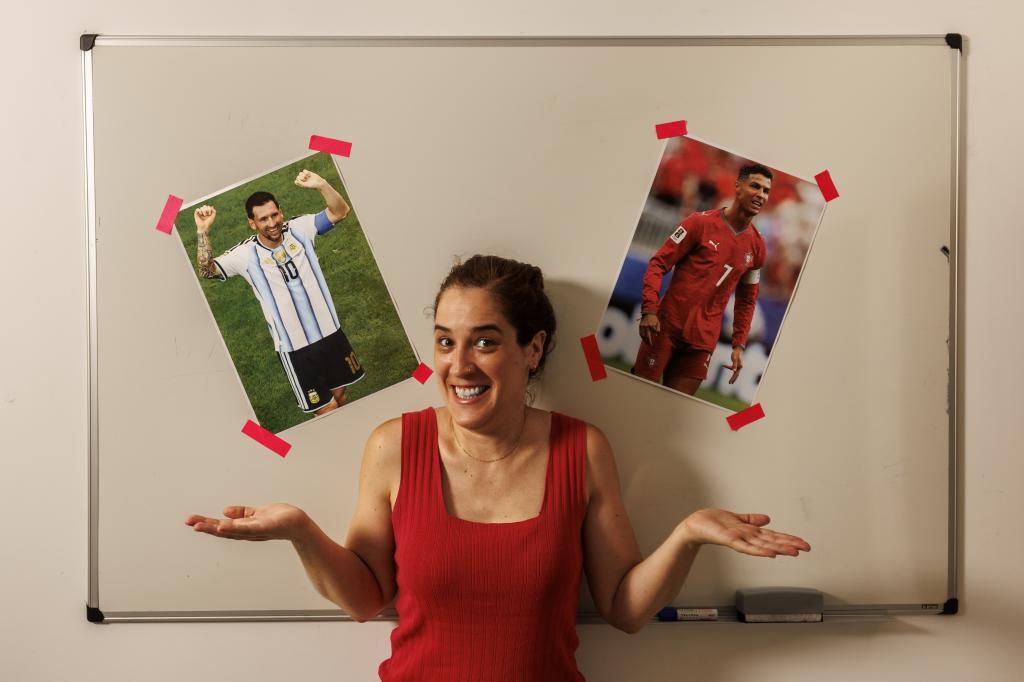
In the midst of the World Cup, with Messi and Ronaldo making history, breaking records that seemed impossible, at 39 and 41 years old respectively, a scientific sociological study has entered football and political conversations. It is a bold research titled Political Identity Beyond Politics: The Preference for Messi and Ronaldo in 26 Countries. One of its most powerful conclusions points out that "the more progressive respondents preferred Messi, while the more conservative ones preferred Ronaldo." And the debate went viral. Questions multiplied: Do I have to feel more right-wing because I support the Portuguese star? Closer to Pedro Sánchez because I like Messi? Many felt uneasy with these bar conclusions. What lies behind this?
The essay is led by prestigious doctors, colleagues, passionate about mass culture. Two relevant names: Saifuddin Ahmed, known as Saif to his close ones, and Teresa Gil-Lopez. One practicing in Singapore, the other at Carlos III University in Madrid. Both met at the University of California-Davis. Crónica contacts both to explain their publication. Saif poses with the jerseys of the Portuguese and the albiceleste. Teresa, from the Politics department and a future professor candidate for Princess Leonor, with photos of these titans who refuse to retire... It is worth noting that this stems from trying to understand an excessive passion. And the external influence on that frenzy that goes beyond club or country passions.
"The first thing I would like to say is what this study is not: a verdict on anyone's taste... What it does say is something more subtle and, I believe, more interesting: that the line between our political identity and our cultural life has become thinner than most perceive, and that the Messi-Ronaldo debate, which most experience as purely personal, turns out to be a small window into something much broader about how we see the world," says Saif, endorsed by Teresa.
Camus already spoke of football as part of the reflection of the world. Does this apply to these football geniuses? "They are a mirror, they have always been more than football... Mirrors are uncomfortable precisely because they show us things we were not looking for. Most people who prefer Ronaldo are not thinking about hierarchy, authority, or individual domination when they watch him play. They are seeing someone execute excellence at an extraordinary level... People on the more progressive side tend to find Messi's archetype more resonant. That means our values are more pervasive than we think: they reach places we assumed were free...".
In other words, the ball is not tainted by politics, but there is a relationship. "There is a broader human implication. Messi and Ronaldo have become something that very few athletes in history have become: true global cultural icons, figures on which billions project aspirations. The study works because both players are so successful that preference cannot be explained solely by performance... It is a distinctly modern phenomenon."
Do conservatives who like Messi and progressives who like Ronaldo have anything to fear? "The most important human message, however, is that none of this is deterministic. These are trends that emerge at a population level, visible patterns when thousands of people in dozens of countries are observed, not rules that govern individuals. Many conservatives are passionate Messi admirers. Many progressives have Ronaldo posters on their walls. The finding does not predict any individual's preference. What it does reveal is something about the currents running beneath our choices, currents that most of us did not know were there."
Spaniards gave Messi an average score of 4.68 out of 7. Ronaldo received a 4.34 out of 7. Spain was the fourth most "pro-Messi" country among the 26 analyzed, only behind: South Korea, Argentina, and Finland...
"Spain is the only country in the world where the Messi-Ronaldo rivalry is directly projected onto deep cultural and regional fault lines. Barcelona against Real Madrid is not just a football match: it carries a historical, linguistic, and political weight that is unique... Spain is both the most complicated country in our data set and the most interesting."
It is worth noting that in most of the countries analyzed, the Real Madrid legend prevails... "The broader finding of our study, that within each country people who position themselves to the left of their compatriots tend to prefer Messi, while those on the right tend to prefer Ronaldo, applies in Spain just like in the other 25 countries in our sample. Spain's polarized political landscape makes this particularly resonant... The Messi-Ronaldo debate in Spain is not just a football conversation but also a conversation about values, whether its protagonists realize it or not."
Personally, Teresa leans towards Messi. Out of nostalgia for having lived in Andorra, a Catalan-speaking country. Life, of course. Saif, for Ronaldo... "There is something almost irrational in his refusal to accept limits that fascinates me. It is an extraordinary human story regardless of what you think of his personality. One can be the greatest artist. Ronaldo is the one whose story speaks to me of something internal. Now comes the uncomfortable part, and I say this as the one who designed and directed this study. I am not immune to the phenomenon I discovered. There is something slightly unsettling about admitting it here, knowing what our data shows. I genuinely wonder how much of that preference was my own, and how much was silently constructed over years of media exposure, by algorithms I did not choose, by cultural signals I absorbed unknowingly. I built the mirror. And then I looked into it."