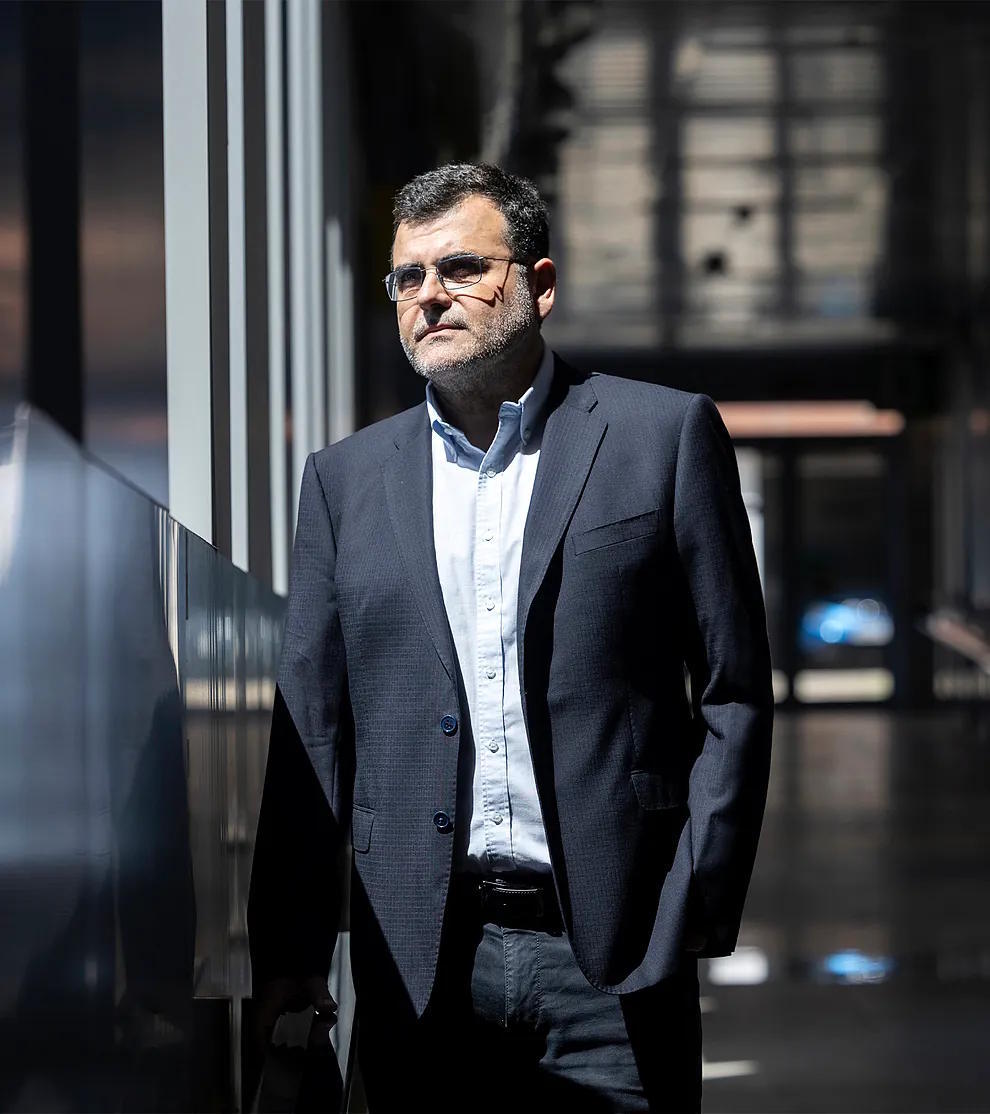
As a child, Eduard Batlle (Barcelona, 1970) wanted to be a soccer player. Like many other children, he dreamed of one day emulating the soccer idols he admired every Sunday from the stands of Camp Nou. Until one day, watching TV, he realized that it wasn't Schuster or Maradona the stars he wanted to follow. "I remember sitting watching the series Cosmos, by Carl Sagan, when I was about 12 years old and feeling the spark that this was what I wanted to do. I experienced that passion for Science at a fairly early age." And it's clear that he still retains it.
Batlle, head of the Colorectal Cancer Laboratory at IRB Barcelona, ICREA researcher, and scientist at CIBERONC, is an international reference in cancer research. Not only for discovering unknown mechanisms about the biology and progression of colorectal cancer but also for being one of the pioneers of a promising and innovative anti-tumor therapy: petosemtamab.
'Peto', as Batlle calls it, has achieved, in combination with immunotherapy, complete remission of cancer in six people with head and neck tumors. Trials on the drug's effectiveness are ongoing, but the FDA, the agency that regulates medications in the US, has already designated the treatment as innovative therapy, expediting its development and highlighting its potential to change standard clinical practice.
"The data so far is extraordinary, and if all goes well, it could be approved initially for head and neck tumors in first, second, or third-line treatment. But, in addition, there are also hopeful preliminary data in other indications," explains Batlle, who, however, quickly points out that "until we reach the end of the road, we won't know if it will become part of the standard treatment for patients. We still have to wait." The researcher is cautious yet optimistic about the future of the experimental therapy he designed with Hans Clever and Ton Logtenberg, from the Dutch biotechnology company Merus, which the company Genmab acquired for 8 billion dollars at the end of 2025.
"The dream of any researcher working on cancer is to find a treatment that helps patients. But it's such a long road, with so many ups and downs and so many hypotheses that fail after a lot of work that it's incredible and unexpected to feel that this treatment is so close to approval," he confesses.
"Giant steps are being taken to treat and make many tumors that are currently incurable chronic"
The therapy, a bispecific antibody, is based on an innovative line of action that Batlle details carefully: "Our antibodies, those that all mammals naturally produce, are monovalent; that is, in their case, both arms of the antibody bind to the same antigen, to a single marker on the cell they have to identify and neutralize."
However, 'peto' has been designed so that one of its arms binds to the marker of cancer stem cells LGR5, and the other to the EGFR receptor, which promotes their proliferation, thus having a dual antitumor function without affecting healthy tissue.
"Additionally, we have also found that the antibody not only inhibits the activation of EGFR in cancer stem cells but degrades that receptor, destroys it. It's an unexpected activity that contributes to its action," points out Batlle.
The drug was designed to be used against colon cancer, the most common tumor in Spain, with 44,132 new cases expected for this year, according to estimates from the Spanish Society of Medical Oncology (SEOM). However, trials conducted on patients who had already undergone previous treatments did not yield the expected results.
Both the company responsible for the product and Batlle himself believe that the key to this lack of response lies in the timing of drug administration, applied to patients with colorectal tumors already adapted to several previous treatments.
"There is currently a phase 1 trial in patients who are given the drug with chemotherapy as a first-line treatment, and the initial data is quite promising," notes the researcher, who has been dedicated to confronting colon cancer for over three decades.
"The Government should double or triple the funding allocated to science because resources are key"
He recently received an ERC Advanced Grant, a prestigious European grant of 2.5 million euros that will allow him to continue advancing in his fight against colon cancer.
With this new project, he reveals, he wants to study how to reduce the ability of these tumors to adapt to changes and become resistant to treatments and how to find ways to combat it. This is the fourth time in his career that he has received this type of funding, a support that few scientists have managed to accumulate four times.
As Batlle explains, one of the main challenges that Medicine faces when addressing advanced colorectal cancer is the ability of tumor cells to adapt to almost any condition, reprogram themselves, and ultimately become resistant to treatments.
"This mechanism, called cellular plasticity, allows tumor cells to rapidly change their genetic program and adapt based on what they encounter in their tumor microenvironment," says the scientist, who clarifies that, as if it were a disguise, cells have the ability to camouflage themselves under different states, so that within the same tumor, very different cell populations can coexist.
"And this hinders the success of therapies. For example, some cells may be sensitive to chemotherapy, but, due to that disguise, others survive, evolve, and escape," he explains.
What his group aims to do is to thoroughly study that cellular plasticity and heterogeneity to find ways to combat it.
"If we understand this mechanism well, it is possible that we can find a way to homogenize tumors, get all cells to adopt a specific genetic program to make them respond to targeted therapy," he clarifies.
He is convinced that this cellular plasticity "is responsible for the fact that there have been very few therapeutic advances in colorectal cancer in recent decades despite it being one of the main targets of the pharmaceutical industry," although he also believes that the short-term horizon is going to change.
"I think very important steps are being taken in cancer research, that many tumors that are currently incurable will be treatable and chronic. The entire industry and research centers are making significant contributions, taking real giant steps against issues like metastasis, which continue to pose a significant challenge but are not viewed from the same perspective as they were a few years ago," he points out.
But for Spanish research to be at the forefront of these advances, he emphasizes, resources are needed. "European grants like the ERC's are very important in Spain; they allow for competitive Science. In other countries, like Germany, these projects bring a lot of prestige if you achieve them, but they are not essential for research because the State has a national funding system that is as large or even better than this. Unfortunately, in Spain, it is not the case. The Government should double or triple the funding allocated to Science because resources are key. You can have good researchers, good teams, and good ideas, but if you don't have resources, it's very difficult to generate frontier discoveries that have a real impact."
"Increasing the money dedicated to Science would bring a huge change to the system. In the total budget of a State, it would mean very little, but it would bring great benefits," which would also enhance creativity, he assures, because "when you have to spend a lot of time applying for grants or thinking about how to maintain projects and team salaries, it's more complicated to think of new ideas. Ferran Adrià once told me that 'while you're in production, it's impossible to create.' And I totally agree. The most creative moments happen when you're more relaxed, when stress gives you a break to think, and ideas emerge more spontaneously."