In 1932, Robert Bruce Lockhart told one of his best friends a phrase that could well apply to any respectable spy, from his contemporary Mata Hari to Edward Snowden, the man who revealed the NSA's obscene computer tracking curiosity to the world: "My whole life is a lie, in fact, that is the best definition that can be made of it."
Any life requires a clearing of forgetfulness, exaggerations, and inaccuracies by the one who investigates it. In Lockhart's case (1887-1970), the task is monumental. We are talking about a spy who was original and exuberant, a master of manipulation and a central figure in the major political and ideological conflicts of the 20th century. His art of deception was so modern that if he were alive today, it would not be surprising to see him recruiting bots for fake news in internet forums dedicated to the wars in Ukraine and Iran and crowned as a poisonous influencer in X. However, always with impeccable manners, those of the gentleman he always was.
Lockhart told his version of the story in the first person in 1932, in his Memoirs of a British Agent, a bestseller with its corresponding film adaptation, but, as he warned in the declaration of the first paragraph, it should be read with caution.
Therefore, it is necessary to start by giving a general profile of his talents. Lockhart has been defined with many adjectives. Charismatic. Rogue. Drinker. Self-destructive. Charming. Intelligent. Hesitant. Nocturnal. And one even more fascinating must be added: omnipresent. He gained the trust of Vladimir Lenin, witnessed the birth of the Red Army, shared bread with Leon Trotsky, and experienced the dampness of the Cheka's cells, the first Soviet intelligence organization dedicated to the persecution of "counter-revolutionaries." Lockhart also experienced the other side of evil: Nazism. He was a visionary regarding Adolf Hitler and the personification of Heinrich Himmler's nightmares, the leader of the SS and the German Police, during World War II.
To bring some order to Lockhart's web of lies, it is best to turn to James Crossland, author of A Spy in Moscow (Ed. Crítica), a biography dedicated to him that has just been published in Spain. It is a well-documented thriller that begins with this Scotsman - our protagonist had not a drop of English blood - in the most tumultuous Russia, that of the 1917 Revolution, where he had been sent to establish contact with the revolutionaries. His talent for public relations quickly earned him the trust of the Bolshevik leaders.
"What fascinates me about him is that he is a nonconformist, he can shake hands with a communist as well as an anarchist or a count. He enjoys any environment, whether in a grand salon or going out to dance and drink with gypsies until dawn," says James Crossland. "His behavior is unconventional for someone of his class, much more interesting than any posh boy of his time."
Lockhart did not fit the profile of the typical young man from a good family, proud of the empire and its pomp and circumstance, who worked at the Foreign Office after studying at Eton and then at Oxford or Cambridge. He was a convinced European, very open and from a wealthy family - the Scotch whisky business paid for his studies - but not classist, unlike his peers. At only 24 years old, he joined the Foreign Service and showed himself as the only embassy employee in Moscow interested in studying and mastering the Russian language.
By the time the Bolsheviks seized power, Lockhart's reputation in London was extraordinary. "Due to the wisdom of his reports, I expected to see a distinguished old man with a gray beard," said Prime Minister Lloyd George of him, impressed by his intelligence work.
More challenging than recounting his life is linking Lockhart to any of his contemporaries. We propose to Crossland the figure of T. E. Lawrence, the Lawrence of Arabia who became mainstream thanks to David Lean's film. He accepts the comparison. "Both are writers, poetic souls, privileged, adventurers, very self-assured because they feel capable of solving any problem," says the academic. "One in the Middle East and the other in Bolshevik Russia."
The new Russian regime that emerged from the fall of the czar and the provisional government in a few hectic months is here to stay. Thanks to Lockhart's reports, London realizes that it must reconcile with the Bolsheviks to prevent them from abandoning, as they have promised, the war against Germany and its allies.
But Lockhart's intrigues are not enough. On March 3, 1918, Trotsky signs the Treaty of Brest-Litovsk, which reflects a disorderly Russian withdrawal from World War I. The Revolution has other concerns, such as the civil war that pits it against an opposition made up of tsarists, liberals, conservatives, and various disenchanted individuals. New orders from Britain are clear: the next objective is to provoke the collapse of the communists.
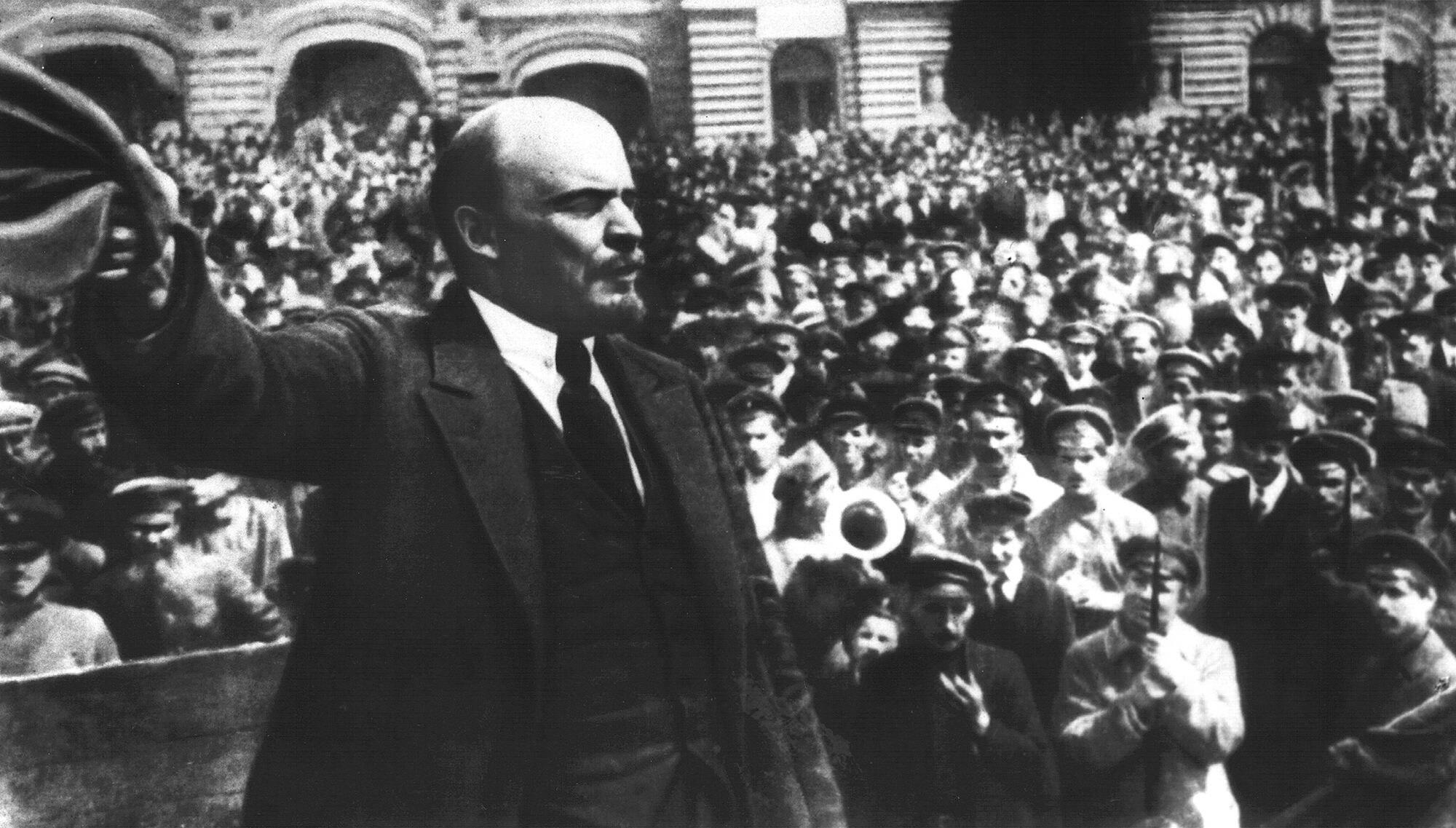
On August 30, 1918, Moscow is a chaotic city. The power of the soviets hangs by a thread due to the lack of food and streets controlled by criminal gangs. The presence of a state is practically non-existent. That day, not only Russia's history but the world's is about to change. During his speech at a weapons factory, booed by the workers, Lenin is shot. The revolutionary leader is critically wounded. Two bullets have hit his neck and lung. Those attending doubt his survival.
This assassination attempt is known to historians as the Lockhart Conspiracy and seems to be a plan attributed to a triumvirate of British, French, and American diplomats with the collaboration of nationalists and Russian spies.
Lenin survives and begins hunting down the suspects. A leak leads to Lockhart being arrested as the head of the conspiracy and taken to the Kremlin. He seems destined to be shot against a wall.
"The Russians publicize his arrest greatly," says the biographer. "He writes in his memoirs that he had nothing to do with it, but he lies shamelessly." The other main instigator of the assassination attempt is Sidney Reilly, the prominent - as astute as shady - figure of MI6 history, who alongside Lockhart would inspire Ian Fleming's literary James Bond. Reilly, beyond the myth and more than a good spy, was a psychopath. A con artist who fomented a mutiny within the Red Army to overthrow Lenin."
However, something inexplicable happens. Lockhart is treated well during his captivity. So much so that he is allowed visits from his Russian lover. Months later, he is released. London exchanges him for a Russian diplomat. He is considered very important by his government.
A small clarification is necessary: in 1918, espionage was much more of an amateur activity. More about observation and amateurish gatherings than spectacular operations. The great professionalization will come later with the Cold War; however, Lockhart proves to be ahead of his time.
However, Lenin's survival and the survival of the communist Russia penalize his career. He is no longer the pampered super spy. Lockhart is sent to Prague to fight against the Soviet influence looming over the Czechs. He fades into just another bureaucrat until, once again, his time comes. Something that will not last long. Lockhart wanders during the interwar period through consular offices without much attention. He quickly realizes that fascism is replacing communism as the seductive charm for the youth. Lockhart studies the Italian invasion of Abyssinia, the annexation of Austria, and the Spanish Civil War and warns his superiors of the threat posed by Nazi Germany. He fears a war and a British defeat. He advocates for his country's rearmament.
"Being so pro-European, he saw things in Vienna and Prague that his colleagues did not perceive," says James Crossland. "He fears fascism because he already knows very well, from his experience in Russia, how an authoritarian state operates."
But Lockhart grows tired. He resigns from his position as a civil servant and takes a career path advised against by anyone with common sense: he becomes a reporter for a newspaper. All until one day Hitler decides to start devouring beings and territories.
"He feared fascism from the beginning, because during his time in Russia he had seen what an authoritarian state is like."
Great Britain seems to be heading towards disaster and places its destiny in the hands of a man who, like Lockhart, had failed in the most important mission of the First World War: Winston Churchill. The new Prime Minister remembers the veteran spy and recommends him to the King for a role that seems essential in the fight against Germany: propaganda.
Crossland describes Lockhart's new job as follows: "In 1942, he becomes the head of psychological warfare and the spreading of rumors aimed at undermining the morale of the Germans. It is incredible that, without today's technology, he was able to run such imaginative campaigns. He even spread a lie in Germany about how an entire battalion of Wehrmacht soldiers had been annihilated on the Eastern Front by dysentery. We are talking about hundreds of fake news stories to distress the civilian population in the rear."
Surely Lockhart's masterpiece was Churchill's popular V for victory, which became a symbol of British morale during the toughest moments of the German bombings. His propaganda department worked to make the enemy believe that the symbol actually referred to a hidden military force in occupied Europe, the V army, which could rise up at any moment.
"It instilled genuine fear," Crossland continues. "It was so terrifying that Himmler sent SS troops to search for the leaders of that phantom army. Another example of a talent little studied by historians. Lockhart failed to stop communism in the First World War, but he was successful in combating fascism."
As had happened before, after the war he was forgotten and never became part of Britain's pantheon of heroes. He entered the last phase of his life giving conflicting versions of what had happened in Russia in 1918 in his lectures. With his meagre savings and cerebral sclerosis, he retired to a nursing home. His final public appearance was a talk at his old school, Fettes College. In his speech, Lockhart urged the new generations of teenagers to be "adventurers" and to "respond to the appeal of the unknown".
When the nursing home staff found that Lockhart did not wake up from bed on the morning of February 28, 1970, he was 82 years old. Thirteen months later, a letter arrived from Hungary addressed to him. It was from the Hungarian writer Paul Einzig. In it, the sender reminded Lockhart that his name had been on the list of those to be executed by the Gestapo in case of a German invasion in 1940. He invited him to a commemorative dinner to celebrate the thirtieth anniversary of that fateful sentence and apologized for years of blindly searching for him. Another adventure of the spy who was always there. This time posthumously.