We walk through the darkness, take a few steps in total darkness. We pull back a heavy velvet curtain and amidst underwater and electronic sounds emerges the voice of Patti Smith, rough, deep, shamanic. More than reciting, she whispers mysterious verses and ancient stories guiding us through a garden with blue herons among the reeds, thyme and rosemary flowers: the same Mediterranean vegetation outside, that of Camargue, which reminds her of the wetlands of New Jersey. "People think it's close to New York, but it's two hours away and it's another world. I feel very at home here, the terrain is similar: the fields, the clayey sand, the crickets, the mosquitoes... When I was a child, we lived in houses built on swamps for poor soldiers and their families. It was Indian land, inhabited by Native Americans and Quakers. Everything was a bit backward but magical, strange, and mystical at the same time," Smith recounts, giving us the key - the landscape and spirituality - to delve into her plastic work, Correspondences, which she has been developing for 10 years with the Soundwalk collective.
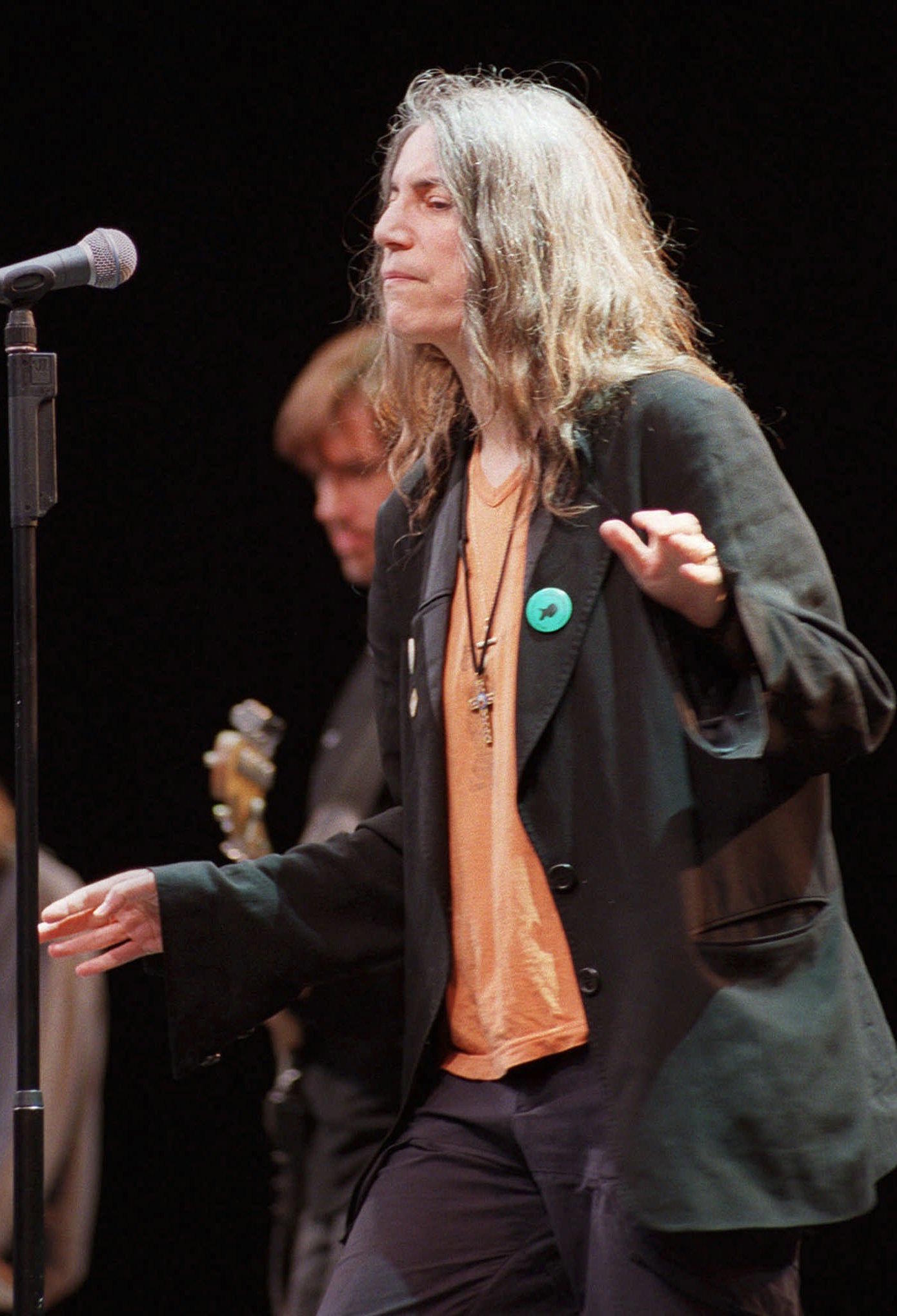
To find Smith, you have to head towards the light of five immense screens arranged like a cross, plus another one acting as a front or main altar. In the center of the nave is she, seated like a modern priestess, with her silver-gray hair falling whimsically disordered, brown boots, fisherman-style jeans, and a fine black blazer over her white blouse. She wears a silver pendant that shines in the dim light of this industrial cathedral, a former iron foundry built on a Roman necropolis, now transformed into a modern center of contemporary art. The LUMA museum in Arles, crowned by a tall tower by Frank Gehry - like a twisted vertical Guggenheim - inaugurates the grand presentation in Europe of Correspondences, a project that has been gradually revealed, with exhibitions in Tokyo and Medellín, with performances in Chile and Buenos Aires. For the first time, she presents her entire artistic corpus: 10 videos (two new for the occasion) that last about two hours.
Poet with a Beat and French spirit (Rimbaud and Baudelaire intertwine irretrievably with Kerouac and Reed), godmother of punk and rock star, writer of herself and of an entire era, Patti Smith doesn't stop there. Although her role as a visual artist is the least known, everything resonates in her: her shiny Princess of Asturias Award in the Arts fits her like a glove. "In the US, they wouldn't give me an award like this. I'm very excited," she confesses. Her face truly lights up.
After several days of setup, she rests on a bench next to her colleague Stéphan Crasneanscki, the sound artist and founder of the Soundwalk collective. They met on a plane and have been creating an artistic collage for over a decade that never ends. To simplify: he records a sound (from melting glaciers, the seabed, the desert, the Chernobyl exclusion zone...), she adds lyrics and voice. Then come the images.
"You know? This morning while having coffee, we were talking about Spain," says Smith. And she recounts her Friday morning: "I listened to Pope Leo XIV [referring to his speech in Philadelphia upon receiving the Liberty Medal] and also to Pedro Sánchez. And I saw that Spain had won the match [against Austria]! So I wrote a message to Rosalía. Today is my Spanish day," she smiles playfully. But then she becomes serious. "Currently, it seems to me the most interesting place in Europe, politically speaking," she admits on the eve of July 4th, the national day commemorating the 250th anniversary of the United States, which Donald Trump has turned into a celebration of himself. "The atmosphere we live in the US is terrible. It embarrasses me, it makes me more angry and sad than I can express. I'm not a nationalist, I'm a global person. If I want to listen to someone intelligent and compassionate, I listen to the President of Spain or Pope Leo." She doesn't even want to mention Trump's name. "At least Pedro Sánchez is brave and stands up to countries with so much power, money, and fanaticism. That gives me hope," she emphasizes.
Continuing with the Spanish day: when Smith was about 12 years old, her father took her and her siblings to the Philadelphia Museum of Art, one of their rare family outings. "The harlequins and Picasso's cubism took my breath away," she confesses. What she composes with Soundwalk would be a sonic cubism, a collage of melodies, noises, phrases, and difficult-to-decipher snippets, where echoes of nature merge with Pasolini's Medea (the immortal Maria Callas) or even Mary Magdalene herself. "I've always been fascinated by Mary Magdalene. Jesus elevates her as the thirteenth apostle. I have studied the New Testament a lot, and when I wrote Dancing Barefoot (1979), the song starts by saying: "She is benediction / She is addicted to thee." It was a nod to their relationship. She is blessed, and her great addiction is not drugs or sex: it's him, the Messiah."
A little over a hundred kilometers from Arles, in the crypt of the Sainte-Baume church, Mary Magdalene's skull is preserved in a sumptuous reliquary of gold and crystal, as if it were a mummy statue. Although Smith has not made a pilgrimage there, Crasneanscki has: "The most interesting thing is that Mary Magdalene ended up in France fleeing persecution in Palestine, during the Roman Empire. She settled in a cave on the edge of a cliff and lived the rest of her life in seclusion. The Vatican took the skull out of the display case for the first time in a thousand years to scan and study it. And they gave us access to their research," he explains. In their new video Le Mistral, they reconstruct in 3D the skull and face of Mary Magdalene, with data provided by the Vatican to which Smith adds an ode that sounds like a prayer.
In parallel, she has been imprinting a phrase that repeats like a mantra in different places of the exhibition: The earth is a skull that refuses to explain itself. When she writes it in rough capitals, with a skull drawing included, it looks like graffiti on a punk bar's bathroom door, but when she writes it in her elegant, almost Arabic calligraphy-like handwriting, it truly becomes elegant. On a one-meter paper, she has written the phrase over and over, forming a filigree that creates an oval, creating a kind of portal. "Masterpieces do not need to be explained, they don't need to. They exist, and therefore their power is undeniable. A film like Roma by Federico Fellini or Andrei Rublev by Andrei Tarkovsky. Or a painting by Caravaggio! The Earth exists. It doesn't have to explain why a volcano erupts or why there are certain atmospheric changes," Patti Smith compares.
That skull-verse almost becomes the metaphor for the Arles exhibition. "It's the magic of poetry or song lyrics, like I am the walrus, you are the eggman [I am the walrus, you are the eggman, from a Beatles song]. What does it mean? It doesn't matter, somehow it connects dots of light... We need mystery in life." Points of light that she and Soundwalk scatter on two long tables almost like those of a forensic or police investigation (they have something of that): they display images of Greek sculptures, poems and texts by Smith herself, discarded frames from Tarkovsky or Jean-Luc Godard (in addition to some notes from her notebooks), a sepia photo of Pasolini's corpse, a Roman statuette from the 1st century, miniature animal skulls...
Around them, the blue of the Mediterranean floods the five screens: Roman amphorae submerged in the seabed, brutal rocks that almost look like meteorites, dizzying tracking shots over the waves... After a few minutes, the screens blaze with uncontrolled fires: trees devoured by flames, a Dantean hell that ravages mountains and fields. "I was born in Chicago in 1946. Stéphan has searched for archival material of the forest fires that have occurred throughout my life. In 80 years, which I will turn this December, millions and millions of hectares have burned. Almost all fires have been caused by humans, by arsonists or negligence. We also review all the animal species that have become extinct in this time...," Smith sighs for the forests of Las Landas and the sequoias of California, for the Asian cheetah or the Pallas's cormorant. And she quickly adds: "But in each piece, there is, I hope, a spiritual element. We are not documentarians. And nature, essentially, is spiritual. When you are young, they tell you: God is everywhere. Nature is that too."
To end her Spanish day, Smith promises to travel to Oviedo in October to receive the Princess of Asturias Award, she is even thinking about an artistic project in Madrid for 2027, but she considers it too early to reveal details. And she says goodbye like this, with a warm smile and a generic message to the Spanish people: "I know that you love me a lot in Spain, I love you too."