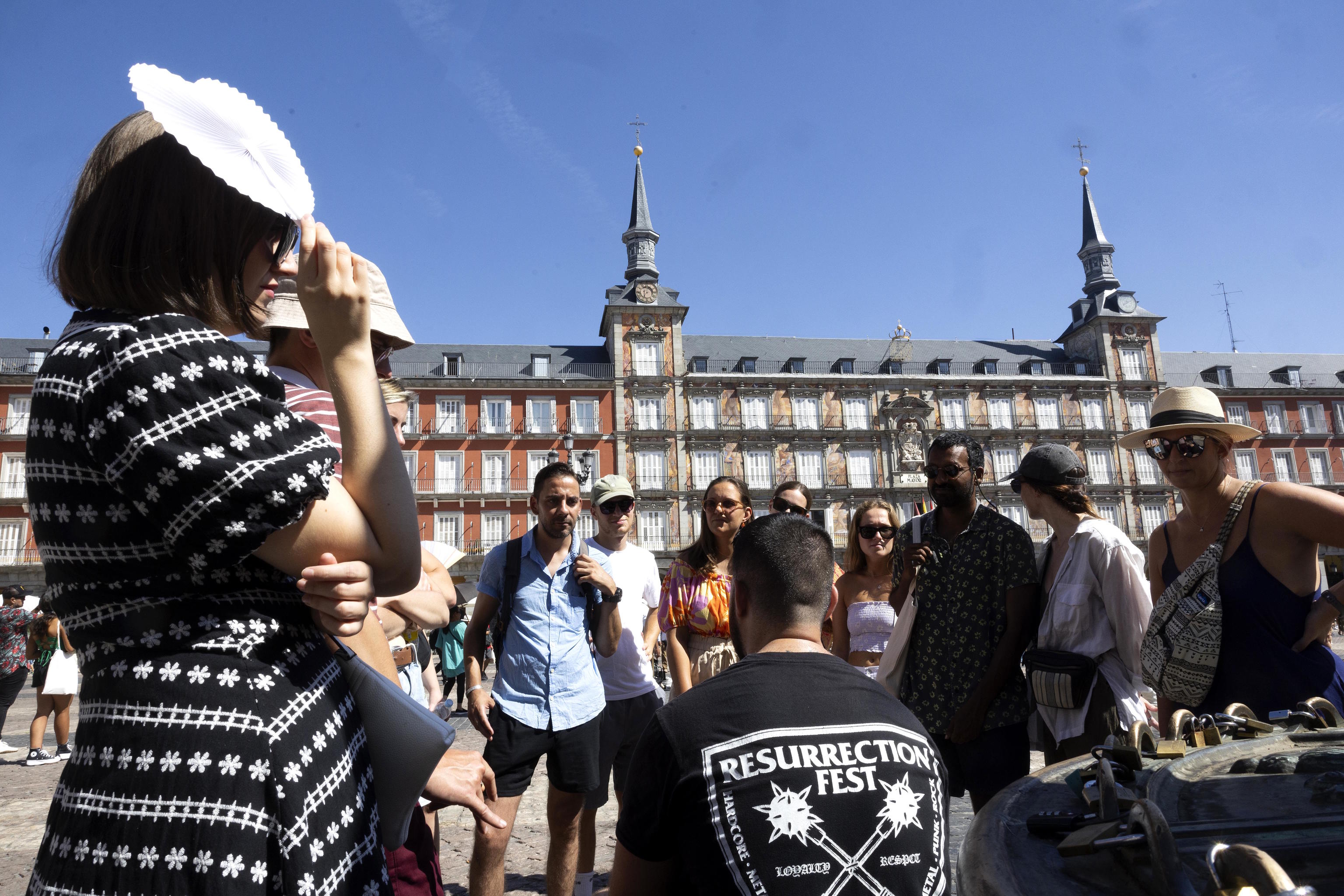
Spain has a dusty unused sign stored away that reads 'Full capacity'. Until now, it had not needed to display it, but on the brink of summer and close to reaching the record of 100 million international tourists, some wonder if the time has come to unearth it.
Spain is torn between the option of 'dying of success' -such a volume of tourists entails negative externalities- or trying to limit one of its greatest sources of wealth -that of a sector that contributes more than one in every ten euros to the Gross Domestic Product. Both options have supporters and detractors, but beyond personal opinions, data point to a ceiling that should not be far off.
The Satellite Tourism Account in Spain, compiled by the National Institute of Statistics, shows that tourism activity in 2024 - the last year for which data is available - accounted for 12.6% of GDP and 12.3% of total employment, with over 2.7 million jobs. For this year, the sector's business association, Exceltur, has forecasted that the contribution to the economy will increase to 12.8% of GDP, indicating that tourism is gaining weight as the number of travelers grows: in 2025, 96.80 million foreign visitors came to Spain - with a significant influx of British, French, and German tourists - and this year we could surpass that figure, especially considering that the conflict in the Middle East could redirect part of the global tourist flow towards Spain.
"The conflict zone and its area of influence in the Eastern Mediterranean represent a significant tourist destination, which was visited by 181 million tourists in 2025, of which 46.9 million came from European markets. In a context of insecurity and the predominance of nearby destinations, it is expected that some of these trips will be redirected to other destinations, especially in the holiday segment, family tourism, and during the summer months, in which Spain has a high competitive position along with other destinations in southern Europe," the business association points out.
In April, hotel bookings for the summer were already at 100%, so this redirection could be more noticeable in other types of accommodation - such as tourist rentals - in cities that are not traditionally summer destinations, or even in the months of September and October.
This dynamism in tourism in the country has consequences. Positive ones, such as economic growth and employment, the establishment of businesses in destination locations, and wealth accumulation; but also negative ones, such as a tendency to create low value-added jobs, added pressure on prices, strain on the housing market - due to the temptation to convert residential offerings into tourist apartments that are more profitable than regular housing -, overcrowding and displacement of residents and national tourists, transformation of city centers into a sort of theme park for tourists, and strain on resources consumption, for example, water resources.
"The most notable characteristic of this tourism sector is its difficulty in increasing productivity and its extraordinary capacity to absorb low-skilled employment. This reflects a business structure of small companies, where it is difficult to achieve economies of scale and, above all, a sector in which a large part of the activities are stagnant, meaning those in which it is inherently difficult to increase productivity. Thus, the vigor of recent years has come at the expense of extraordinary employment growth. This would be one of the clear limitations to consider that tourist demand: creates jobs, generates foreign exchange, drives business dynamism, but, in a way, contributes to the general stagnation of productivity and, therefore, of per capita income," analyzed Funcas recently in one of its Economic Notebooks.
While this effect on productivity is more intangible, those that are tangible - such as the mentioned impact on inflation, housing, or overcrowding - are causing a certain weariness among the local population due to the influx of tourists, especially in high season, and straining the seams of a country that at certain times and places no longer has the capacity to accommodate more people.
"What we are seeing is a moderation in tourism growth, although it continues to increase above GDP. There are several elements justifying why each quarter we are expecting a more intense slowdown," explains Miguel Cardoso, Chief Economist for Spain and Portugal at BBVA Research. The first of these is the evolution of hotel occupancy rates in the country, which, although at levels 5% to 10% higher than the 2017-2019 period, have not shown significant changes in the last two years despite the increase in the number of visitors.
The second is the issuance of new building permits for tourist use buildings, which have increased in places like the Community of Madrid or Valencia but have not risen in tourist destinations like the Balearic or Canary Islands, where there have been "intense falls," up to 100% in the Mediterranean islands. "There are destinations, like these, where hotels are not being built, and there will be difficulties in receiving tourists. The restrictions that municipalities and autonomous communities are imposing regarding the number of properties that can be used for tourism make it seem that the quantity-based model is nearing its end, especially in destinations that seem overwhelmed," he points out.
So, where are we heading? Not so much towards receiving more and more visitors but towards trying to make them spend more: a more expensive, higher-quality tourism that could contribute more to GDP without necessarily increasing the influx. Cardoso explains that it will depend on whether price increases are simply because companies take advantage of the demand to raise prices, expand their profit margins, and discriminate among tourists, or if there is a real improvement in quality behind it.
"Much will depend on how much has been invested and can continue to be invested to increase the added value of the sector, for example, by upgrading 3-star hotels to 5-star hotels and optimizing restaurants. Much of the future growth may have no limit if these investments are made, and this price increase is accompanied by more added value. Meanwhile, price increases without improving quality have numbered days. This is something we will see in the long term because without quality improvement, Spain will end up being less competitive, and demand will decrease," he explains.
What could happen is that the number of international visitors continues to grow - albeit more moderately - at the expense of the national tourist, who ends up being displaced, resulting in an overall stagnation in growth via quantity. "Congestion and prices are starting to displace the national tourist, who prefers to go to less expensive destinations within Spain with more space, especially in the north or northwest, or opts for foreign destinations," Cardoso points out.
In this shift in preferences, coolcations or holidays in cooler climates are emerging, whether in another country or in the Cantabrian coast. This is one of the trends identified by OBS Business School in one of its recent sector analyses, explaining that "the rise in temperatures experienced in the Mediterranean in recent summers is leading northern tourists (Northern Europe and America) to be interested in milder and more benign destinations. The concept of coolcations is beginning to be a significant well-being strategy during travel. In 2025, countries like Finland and Norway saw significant increases in arrivals compared to 2025 (+14.1% and +12.9%, respectively), with a significant boost from English, French, and Canadian tourists, who in the past might have chosen more southern destinations," something that is starting to be replicated within our borders in favor of mountain or northern destinations.
Alongside this change, there is also a certain de-seasonalization, meaning a transfer of travelers from high season to low season to avoid summer overcrowding, presenting an opportunity for sector businesses in inland destinations, whether provincial capitals or rural areas. The European Travel Commission (ETC) has noted a higher demand in the months close to the high season than in the summer itself. For example, the volume of passenger-kilometers transported (RPK) by airlines increased by 6.7% in October and 7.1% in November 2025, a figure higher than the 4.4% growth in July and 6.0% in August.
These changes represent an opportunity for destinations away from the spotlight, but what can the tourist magnets do? The effectiveness of tourist taxes, for example, has been shown to be limited in those destinations when it comes to regulating the flow of tourists, while other ideas such as charging for regulated access to saturated natural spaces have been more effective in preserving the environment.
There are no magic formulas to achieve sustainable tourism that is environmentally friendly, has no negative social impact, and on which we do not overly depend. However, the sector is already exploring alternative ways to grow - in other places or times - and continue contributing to the economy more for quality than quantity.