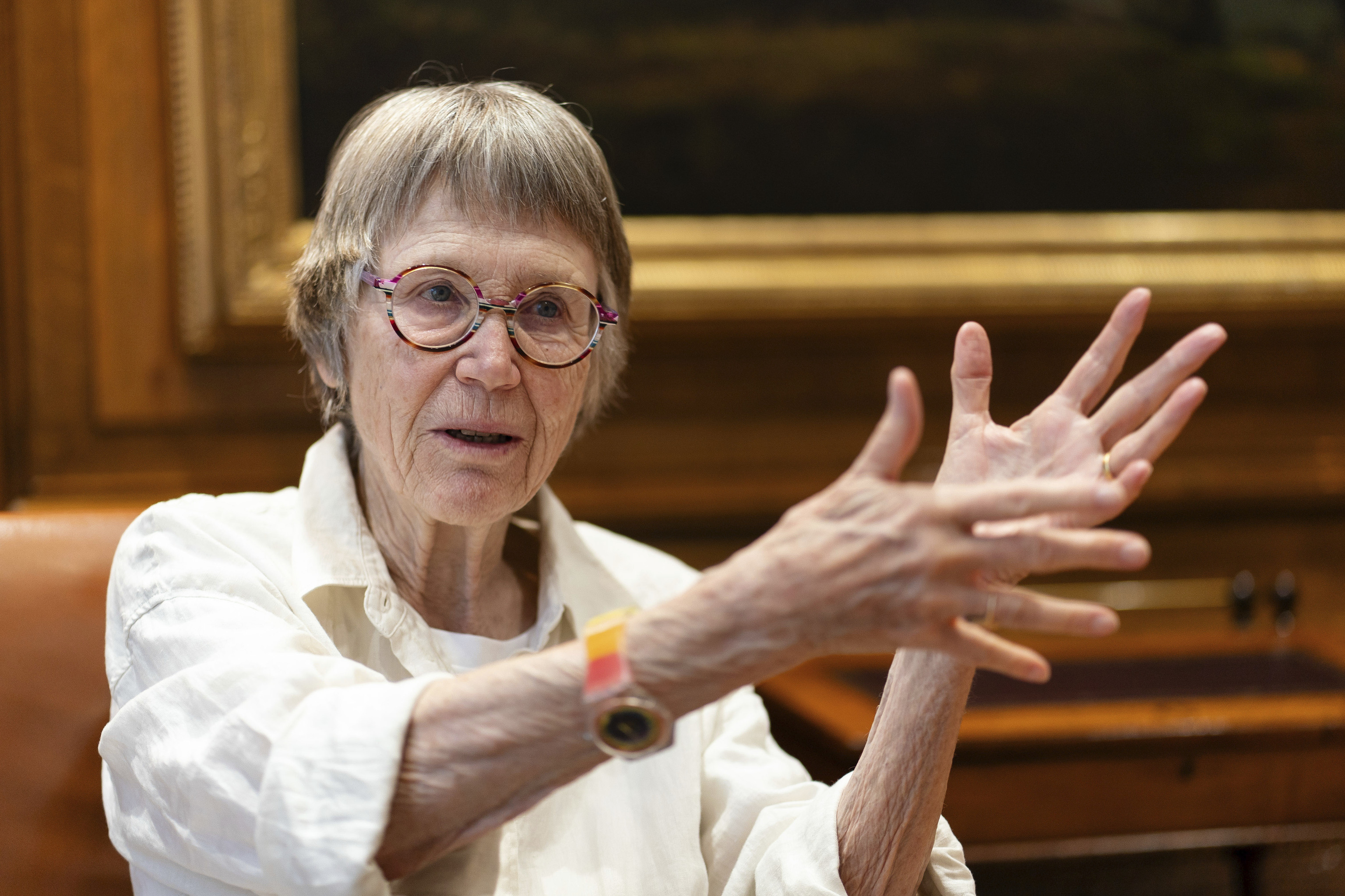
Something unusual happens to Nancy Cartwright (New Castle, Pennsylvania, United States, 1944) in the academic world, where she distrusts a phrase that everyone else repeats constantly and with some relief: "It's what science says". To her, that formula not only does not reassure her, but it seems like a dangerous simplification, almost an elegant way to stop thinking. And not because she doubts science, but because she has spent her life within it and knows its margins and its cracks.
Trained as a mathematician and a philosopher of science by intellectual profession, Cartwright has spent decades dismantling the image of science as a solid block of truths destined to order the world. Her idea is that science does not advance as a unified system, but as a set of different tools, sometimes incompatible with each other, that work in specific contexts and, above all, fail in others. There is not a single science in progress, she argues, but many overlapping scientific practices that rarely fit together completely.
This perspective has made her one of the most influential - and most uncomfortable - voices in contemporary philosophy of science. Not so much for what she denies, but for what she complicates. In a time when science has left the laboratories to settle in the center of public decisions - pandemics, climate crisis, economy, artificial intelligence - that confusion is no longer just philosophical, but political. The models do not stay in books but enter governments, headlines, and urgencies. And suddenly the question is not what we know, but what we do with what we believe we know when there is no time to be sure.
Cartwright, professor in the Department of Philosophy at the University of Durham and Distinguished Professor at the University of California, San Diego, has dedicated much of her career to studying that intermediate territory, where knowledge ceases to be theory and becomes a decision under pressure. A work that has earned her this year the Frontiers of Knowledge Award in Humanities from the BBVA Foundation in its XVIII edition. An acknowledgment of the idea that science does not lose value for being incomplete, but when it pretends not to be.
Science is present in all major political decisions in our world: pandemics, climate change, economy. Are we abusing it as an unquestionable authority?
No authority should be unquestionable. If we believe that science works that way, we would be mistaken. It is different to expand the knowledge, methods, and scientific techniques we already have to apply them to new areas and obtain useful results. Perhaps not with absolute certainty, but with valuable information to make better decisions. It seems like a good idea and, in fact, it is something that science has been doing for a long time.
For a long time, the philosophy of science focused mainly on theories and experiments. What do you think your work contributed to that debate?
When I started, much of the philosophy of science was focused on very abstract issues: how theories relate to each other, what a scientific explanation means, or how certain fundamental concepts should be interpreted. These are important questions, but I wanted to look at science from a different perspective. I was interested in science when it moves from paper and begins to operate in the world. How different disciplines collaborate, how instruments are built, how different knowledge is combined, and how decisions are made when the available information is never complete. I believe that part of the influence of my work has been to contribute to shifting the focus towards science as it is actually practiced. Because science is not just a set of elegant theories. It is also a complex human activity, full of adjustments, corrections, negotiations, and practical learning.
How did you start thinking that the official image of science did not quite match reality?
When I arrived at Stanford. I came from the philosophy of physics, which was very abstract at the time: equations, fundamental theories, the relationship between relativity and quantum mechanics... But I was interested in something more practical: how we use all of that to build real things. I wanted to understand how lasers were made. I started visiting the Physics department and discovered something curious, that physicists were directing me to engineers. I had learned a story according to which one starts from fundamental equations and, through some steps, arrives at a practical application. But it doesn't work like that. Building a laser requires many different types of knowledge. Physics is an important part, but so is engineering. That made me understand that real science is much more complex than the idealized image we usually portray. I am interested in science not only to understand the world but to change the world.
You insist that scientific models are not reality. What does that mean exactly?
It means that models are tools, not mirrors of the world. They work very well in controlled contexts, but they simplify reality. And the problem is not that they simplify, that is inevitable, but that we forget that they do. The laws of physics, for example, do not work as universal statements that apply everywhere without further ado. They are adjusted, corrected, combined with other types of knowledge, and sometimes even contradict each other depending on the context. It's not that they lie in a literal sense, but they operate in idealized conditions. And yet they are extremely useful. In fact, science would not progress without them. But we would not progress either if we believed that they describe the world as it is in all its complexity. They are extremely useful and, in many cases, indispensable. No model captures all of reality. The problem arises when we think that simply introducing more variables into an equation will capture everything that happens. Many times it is not the case. There are factors that do not easily fit into the model and that require looking at other sources of information as well. Models guide us, but they do not replace judgment or understanding of the context.
One of your most well-known books is titled How the Laws of Physics Lie. What did you mean by such a provocative statement?
The title is provocative, but the idea is not a criticism of science. It is an attempt to understand how it really works. The laws of physics are extraordinarily powerful, but they often operate in idealized contexts. They are not false, but they are not complete descriptions of reality either. They work very well in models and controlled experiments, but the real world is much more complex. They are powerful tools, not perfect mirrors of the world. My argument is that if we want to use science to intervene in the world, to build devices, to design technologies, we need to understand how the laws work when they are correct, but also when they fail. Because in practice, we do not work with pure laws, but with combinations of theories, with approximations, with experience, and with judgment.
During COVID, we saw epidemiological models influencing real-time political decisions. Was that experience an example of good science or an excessive reliance on computer-generated models?
The models were the best we had at that time. The problem was that we did not have all the necessary information. There were important factors that we did not know and that emerged over time. That is why the models had to be continuously modified. Additionally, what could work in England might not work in South Africa. The populations are different, social behaviors are different, and circumstances are also different. It is very difficult to incorporate all that information into a model from the beginning. The models were useful, but they had to be constantly updated and complemented with other types of knowledge.
For years, causality was seen as a problematic concept in the philosophy of science. Why did you decide to bring it back?
Because at that time, both positivism and behaviorism considered talking about causality as not rigorous, almost an illusion of language. However, in scientific and social practice, we cannot do without it. We need to know what causes what, under what conditions, and with what reliability. Not only in physics but also in medicine, economics, or public policies. It is not a philosophical abstraction: it is an attempt to make causality operational, useful, verifiable.
What role should science play in political decisions?
A very important role, but not an exclusive one. Science can help us know if a policy has a chance of working, but that is not the only relevant question. We must also ask ourselves what the objectives of that policy are, what secondary effects it may have, what are its costs and benefits in a broad sense, not just economic, or if certain measures are acceptable culturally or morally. During the Ebola outbreak, for example, there were strategies supported by scientific evidence that could save lives. But it was also necessary to consider the customs and values of the affected communities. It is not simply about imposing a measure because it works technically.
So, what concerns you more today: scientific denialism or overconfidence in science?
Both can be dangerous. It depends on what is denied, who denies it, and what kind of confidence we are talking about. Life is about navigating risks. However, what does seem crazy to me is not using science and all that we know to try to figure out what we should do. That knowledge can come from scientific research or accumulated experience. The important thing is to use it intelligently.
Should science be more explicit about what it does not know?
Science cannot solve all our problems, and we should acknowledge that. Additionally, there is always uncertainty. When we make a decision based on scientific evidence, we should also ask ourselves what will happen if we are wrong. We must plan for failure. If we believe that a measure will work, we should also think about the potential harm it could cause if it fails and how to correct course. Uncertainty is an inevitable part of decision-making. The fascinating thing is not that science has all the answers, but that, despite its limits, it remains one of the best tools we have invented to understand and change the world.
Do you think society is ready to live with that uncertainty?
We have no choice. As humans, we live with uncertainty every day. I grew up in a Calvinist community in Pennsylvania. There, I was taught that one day I would wake up and be face to face with God, with all the answers. When I stopped believing in that, I had to learn to live with uncertainty. We all do. We have children, loved ones, projects. The phone can ring, and we can receive good news or bad news. We do not know what will happen tomorrow, but we keep getting up every day. That is the human condition.
Artificial intelligence is often presented as an inevitable consequence of scientific progress. Does that discourse concern you?
I do not know. And I think that is a perfectly valid answer. I have learned something over the years: I do not have to have an opinion on absolutely everything. I read about artificial intelligence like anyone else, but I do not know enough about the topic to make an informed judgment. I have colleagues who work in artificial intelligence and study very specific issues, such as its use in medical diagnostics. I prefer to listen to them. We live in a time when it seems obligatory to have an immediate opinion on any matter, and I am not convinced that this is a good idea. I read the same newspapers as you, and on this topic, my reaction is simple: I do not have enough knowledge to form an opinion. An important part of rigorous thinking is precisely recognizing when we do not know enough to speak out. Admitting the limits of our knowledge is not a weakness; it is a condition for learning.
It is often said that science advances by correcting itself. Is that so?
Yes, but scientific self-correction does not happen overnight. It is a long and demanding process. I have seen projects at Stanford that took 20 years of work to complete. Science corrects itself through a vast network of knowledge, methods, experiments, and people who continuously review the results. That's why I think it's important not to confuse this slow and rigorous self-correction with hasty changes. Science progresses because it tests its own ideas over and over again. That is precisely one of its greatest strengths. It is not simply about imposing an idea today and replacing it with a different one tomorrow; it is more complex than all of that.
Are you concerned that politicians may choose only studies or experts that support their positions?
I believe that has always happened. When delving into the details of public policy, there are often different ways to measure results and different scientific approaches. Some may be more suitable for certain objectives than others. The problem arises when only the evidence that is most politically convenient is selected. This leads to a broader social and political issue. There is always a risk of using knowledge for self-interest. Politicians have always chosen the scientific version that suits them best, and that is a social and political problem. Corruption is always possible, and we have to confront it.
What role can philosophy play in evidence-based policies?
An important one, but never in isolation. Philosophy can help us think about how we understand objectivity or what it means for a policy to work. However, these ideas cannot be directly translated into practice alone. Real progress occurs when philosophy is combined with scientific knowledge and the experience of those working in each specific field. That is what we have tried to do in various interdisciplinary teams: education, public health, child protection, development economics, or criminology. In all these cases, the issue is not to impose a theory but to decide what counts as relevant evidence in each situation. That's why I believe interdisciplinarity is not a supplement but a basic requirement for useful knowledge. No discipline works in isolation. Neither philosophy, physics, nor medicine. Reliable results - a technology, a medical intervention, or a public policy - are always the product of many forms of knowledge working together.