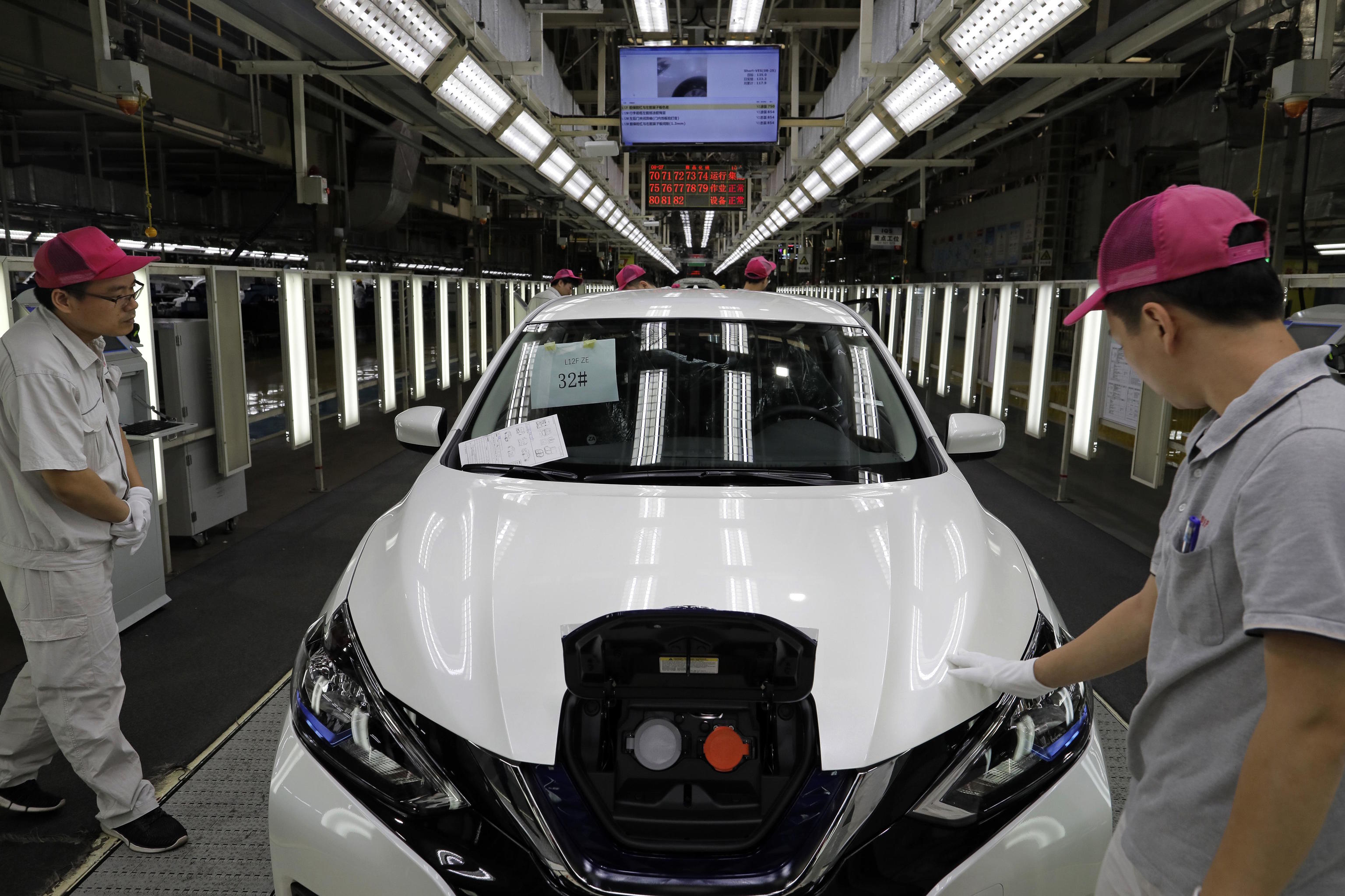
There is something that puzzles almost all foreigners the first time they walk through Shanghai. It's not the skyscrapers that seem to never end or the elevated highways where thousands of vehicles circulate at all hours. What's strange is the silence. In a city of almost 30 million inhabitants, where traffic is incessant, the roar of engines is barely heard. Cars and buses move as if floating on the asphalt. Only the impatient honking and the tinkling of shared bicycles break a calmness unfitting for one of the largest megacities on the planet.
Just spending a few minutes at any intersection in the financial district of Pudong is enough to understand that this silence is much more than an acoustic curiosity. It is also the sound of the shift in power in the global automotive industry. While pedestrians cross staring at their mobile screens and delivery drivers zigzag between electric cars, the logos passing by tell a completely different story than just a decade ago.
Volkswagen, Toyota, or General Motors, which for years symbolized the success of foreign manufacturers in China, no longer dominate the streets. Now, unknown names to most Europeans prevail. And most strikingly, many belong to companies that until very recently manufactured mobile phones, vacuum robots, batteries, drones, or household appliances.
The most well-known example is Xiaomi. The company that revolutionized the smartphone market with cheap and powerful devices surprised when it announced in 2021 that it would enter the automotive business. Now, its electric sports car SU7 is one of the trendy cars in major Chinese cities. Its success has convinced dozens of entrepreneurs that manufacturing cars is no longer a territory reserved for traditional brands.
Dreame, known for its robotic vacuum cleaners, is now preparing to launch its first electric vehicles. Rox Motor, specialized in SUVs, was founded by the creator of another popular cleaning robot brand. Huawei, although avoiding manufacturing cars under its own emblem, supplies intelligent systems, software, and technological platforms to several brands. Even drone manufacturers and many AI companies are already participating in an ecosystem where the boundaries between the technology and automotive industries have completely blurred.
All this transformation is hard to imagine in Europe. It would be as if Balay decided to manufacture electric cars to compete with BMW or Philips decided to rival Mercedes. In China, however, the electric car is currently one of the country's biggest technological showcases.
Last year, vehicles were commercialized under at least 143 different brands. According to the consultancy AlixPartners, 46 of them did not reach 1,000 registrations, but another 23 new ones were born while only nine disappeared.
Many brands belong to large industrial conglomerates that multiply their brands to cover all possible segments. Geely, one of the largest Chinese manufacturers, controls a true galaxy that includes Zeekr, Lynk & Co, Polestar, Volvo, or Lotus. Chery does the same with Omoda, Jaecoo, Exeed, and Jetour. The Chinese consumer can choose from dozens of brands that, in many cases, share platforms, batteries, assembly lines, and even shareholders.
Only a handful of companies managed to sell over a million vehicles in 2025 and, although they dominate the vast majority of the market, new contenders continue to emerge convinced that there is still a niche to conquer. But since 2023, the sector has been immersed in a price war that has minimized profit margins. The Chinese government itself has had to intervene to demand an end to a spiral it deems unsustainable.
Beijing fears that excessive competition will end up destroying the profitability of a strategic industry. The first victims have already begun to appear. Hozon Auto, manufacturer of the Neta brand, is on the brink of collapse after failing to pay salaries.
"Just two decades ago, developing a car required decades of industrial experience and mastering thousands of mechanical components. Today, for a technology company, manufacturing a car has ceased to be a leap into the void to become a natural evolution of its business," argues Michael Dunne, one of the leading experts in the Chinese automotive industry. The same idea is shared by Bill Russo, founder of the consultancy Automobility. "The electric car should no longer be understood solely as an industrial product, but as a technological platform," he explains.
While the Chinese market begins to show signs of saturation, manufacturers are looking outward. Europe has become the major escape valve for an industry that needs to continue growing and absorb a huge excess of production capacity. Chinese vehicle exports continue to rise and Spain is increasingly prominent in that strategy.
MG, owned by the state giant SAIC, has become the best-selling Chinese brand in the Spanish market thanks to a combination of aggressive prices and abundant equipment, while considering developing production in Galicia. Chery has reactivated the former Nissan plant in Barcelona together with Ebro. BYD is considering building a factory in Tarragona. Changan has set up one of its main European headquarters in Madrid and is considering locating its first production plant in Spain on the continent. Leapmotor will manufacture Chinese models alongside Stellantis.
Following them are Dongfeng, Great Wall, BAIC, XPeng, NIO, and a long list of names that just a few years ago were practically unknown outside of Asia and now aspire to compete in the European market with manufacturers that dominated the world's roads for decades.