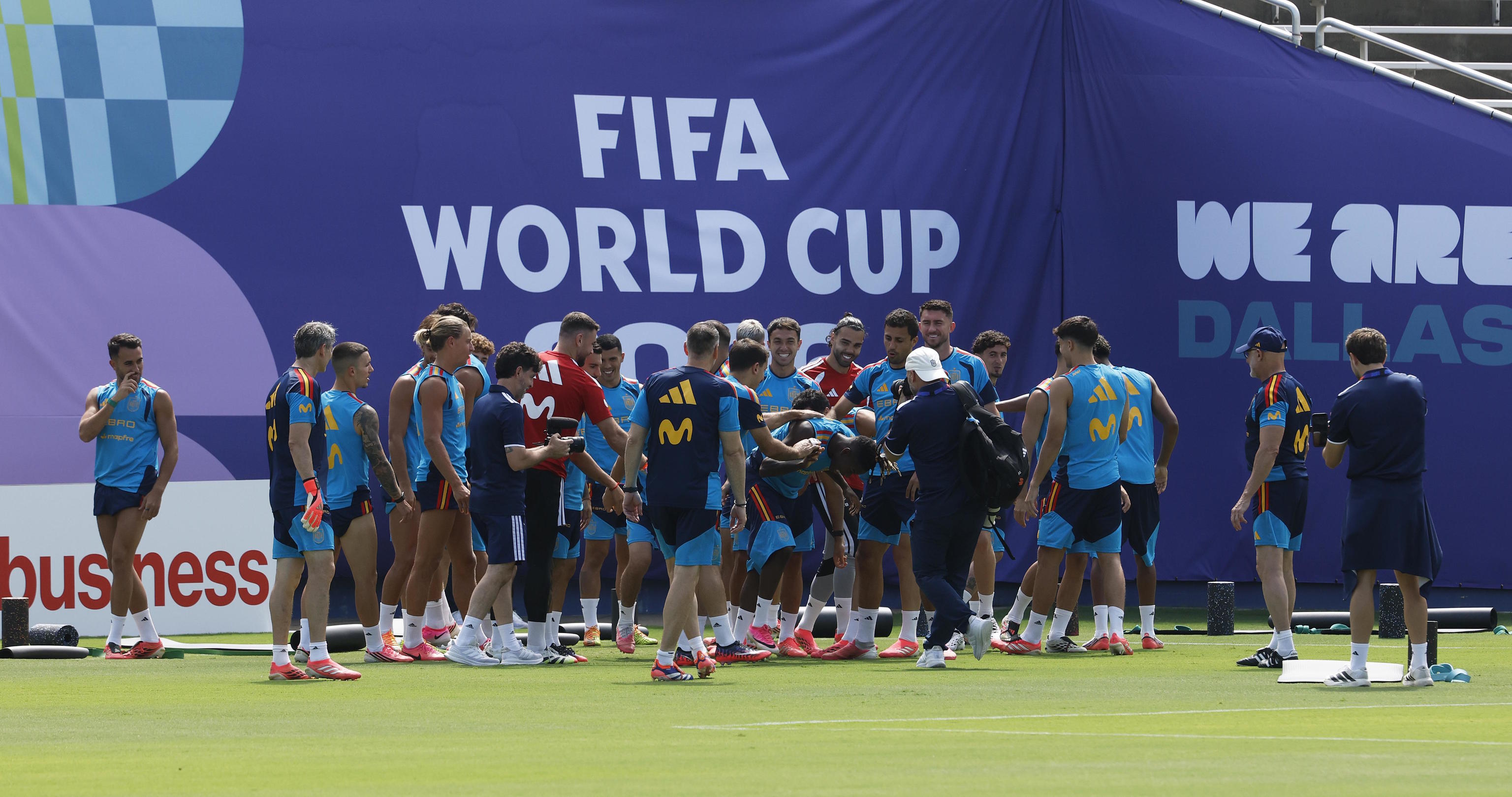
The World Cup is also played in hotels, on roads, and in airplanes. In the kilometers and flight hours that the footballers have had to complete to play each of the matches. And there exists an invisible yet significant difference between Spain and France. When both teams take to the field at the AT&T Stadium in Dallas next Tuesday, Luis de la Fuente's team will have traveled 9,000 kilometers more and will have spent 16 more flight hours than the French team. Three times the time spent just to reach the venues.
Between Chattanooga, Atlanta, Guadalajara (Mexico), Los Angeles, and Dallas, Spain has covered 14,605 kilometers in 26 and a half hours of transportation, with six flights totaling 18 and a half hours in the air and four bus journeys totaling eight hours on the road. 26 hours of transportation. An odyssey. They have stepped foot in two countries and, including their base camp, four different states in the geographically distant United States. From the southern part of the country, where Atlanta or Dallas are located, to the West Coast and the sun of Los Angeles. A tedious journey that forced them to leave their base camp in Chattanooga before the round of 16 and be itinerant since then, with all that entails: packing and unpacking, security checks, hotel changes, different beds, and the difficulty in establishing a stable routine for rest, nutrition, recovery, and training. "It's not something that will influence us. We had planned the trips and have taken care of schedules, food, and rest to minimize the impact. We are not worried," says a member of the Spanish technical staff.
The French delegation has had it more comfortable, obsessed from the start of the competition with finishing top of their group to repeat similar travels in the knockout stages. The French have been in Boston for over a month, where they have set up their base camp and hardly moved from there. They have traveled 5,595 kilometers, all by plane and on short flights, of barely an hour each, and only now, on the trip to Dallas for the semifinal, will they have to spend over three hours seated on a plane, the longest journey of the entire tournament.
"Didier wants us to finish first because the logistics are different, due to schedule, temperatures, the cities not being geographically in our same zone...", stated Guy Stephan in the press conference before the third match of the tournament against Norway, crucial in determining the knockout stage opponents. "If we finish first, we will have fewer trips. If we finish second, we will have to travel much more. So we want to win," declared Tchouaméni at that time, acknowledging the obsession of the coaching staff and the team with that victory. Norway fielded their substitutes, Haaland didn't even play, France won convincingly and secured their stay in Boston.
However, the stadiums in Boston, Philadelphia, and New Jersey are open-air, without a roof, unlike those in Dallas, Los Angeles, or Atlanta, where Spain has played: "Some teams had longer trips and others had the advantage of playing in covered stadiums. In the last match, with a temperature of 40 degrees, the players were pushed to their limits. Freshness is crucial in a competition," explained Deschamps after defeating Morocco.
Mbappé, Olise, Dembélé, and company traveled from Boston to New Jersey for the opening match and the round of 16, spending an hour each way; they flew to Philadelphia, also just over an hour, for the second match and the round of 16; and stayed in Boston, at the New England Patriots' stadium, for the third match and the quarterfinals. In total, nine flights and just under 11 hours of travel, 16 hours less than Spain.
The difference is particularly relevant at this stage of the tournament. The World Cup semifinal will be the seventh match in just over a month for both teams, with the consequent accumulation of minutes, knocks, and fatigue from the matches. Every hour of recovery, sleep, and rest matters, and that's where the travels come into play.
While France has been able to make Boston their home for the entire month, Spain has spent the second half of the tournament hopping between hotels and flights between Los Angeles and Dallas. This case reflects one of the major peculiarities of this World Cup. Never before has a World Cup had such a vast territorial extension: three countries, 16 cities, and distances that turn even the shortest trips into true airborne journeys.