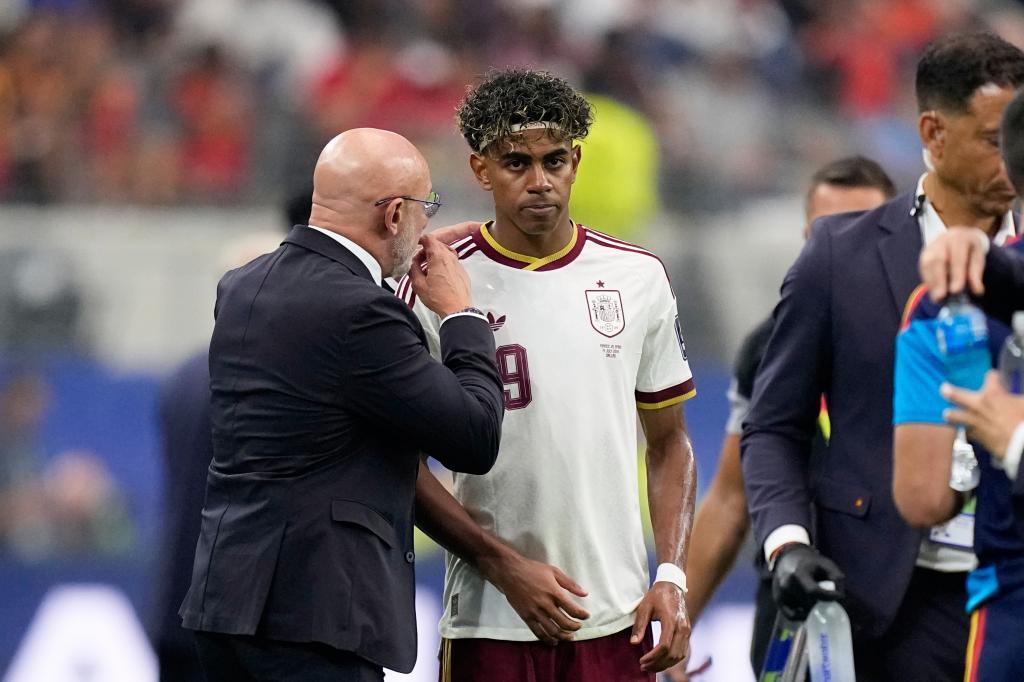
"Hey, hey, this one played with Lamine," shouts a kid with all the looks of a kid -mullet, vaper, knee-length shorts, and Yeezy sneakers- upon seeing a journalist who looks like a journalist (I suppose). "And I did too," repeats a friend, joined by another, all with stories of impossible verification, in the little field of Anselm Turmeda square in Rocafonda, where there is now a graffiti of Lamine Yamal and the memory of some great goal he scored there as a child. They all witnessed the impossible.
"Lamine is ours, he is from here, from Mataró, from the neighborhood," assumes Buba Camara at the end, standing as a spokesperson. "He grew up here and is Spanish. Lamine is Spanish," he proclaims excitedly, asked about the controversy before the Spain-France semifinals which, here, in Parc Central de Mataró, next to Rocafonda, while almost 5,000 people follow the match, loses its meaning.
If they are here, it's to cheer for Spain, no matter where their parents came from. "We came two years ago to the Euro final and it brought us luck. It's a great place, everyone is cheering," adds Bernat Muñoz, a neighbor of Rocafonda, who did a project on Lamine after finishing high school and ended up meeting him. "Now it's hard to see him around the neighborhood because he's heavily protected and the streets would fill up if he appeared, but I know he has come to visit his grandmother, or his uncle's house," he says just before his former neighbor causes the penalty for Mikel Oyarzabal's goal.
Until the semifinals, with no big screens in the city, one of the meeting spots for Yamal's longtime neighbors was the LY 304 bar, owned by Abdul, the player's uncle, but this week it's closed. "There's no one here. They're all over there, in the United States, to watch the games. The whole family, even the grandmother, Fátima. Until the World Cup is over," points out Amel, a friend of the player's family, who also recalls the kids' memories. She also recounts a legendary goal by the young Lamine Yamal in the square.
At halftime of the semifinals, precisely in that little field, soccer doesn't stop: some teenagers play a little game before going back to their phones. At halftime of the semifinals, in that little field, they stand up for something. "During the day, you can't play here, there's not even a shadow," complains one of the players.
"We've been asking the City Council for a cover for years and nothing," denounces Marc Jiménez, president of the Rocafonda Neighborhood Association. "The neighborhood was created in the 60s for those who came from other parts of Spain to live here. Narrow streets, small apartments; it wasn't even expected that these workers would have cars. Since then, there have been many deficiencies, and that hasn't changed in recent years."
Rocafonda is proud of Lamine -the Spanish national team jerseys with the number 19 (the white one, of course) or the Barcelona jerseys with the number 10 are repeated-, but it remains "the abandoned neighborhood" as always, as Jiménez admits.
In fact, the Association is currently collecting signatures to demand more presence from the Local Police and garbage service from the City Council, in order to prevent conflicts among neighbors due to "nighttime noise, cleanliness issues, and acts of vandalism like burning dumpsters."
"In the neighborhood, there are several spots where young people from here and other parts of the city gather, and there is growing discontent, a breeding ground for the far right. With their inaction, the PSOE [the ruling party in the city] is leaving the door open for Vox and Aliança Catalana," analyzes Jiménez, pointing out that the World Cup is not the problem -"it's once every four years"-, although the late games are not helping to maintain calm on summer nights.
Approximately 11,500 people live in Rocafonda, and around 35% have foreign nationality, but if we count Spaniards born abroad or children of migrants, the foreign-born population far exceeds half. The Moroccan community is the largest, ahead of the Senegalese or Gambian communities, and that's why the Moroccan national team games have been followed with intensity. "Morocco has been closely followed, but Lamine is Lamine. Until a few days ago, there was some division between Morocco and Spain on the streets, but most people have a special feeling towards him," says Muñoz, although within that "most," there is also a reality.
"The Moroccan neighbors are divided. Many have bought the Spain jersey because of him, with the number 19 on the back, but others don't like that he doesn't play for Morocco," concludes Jiménez before the final whistle of the match and the start of the celebration, which will last for hours.