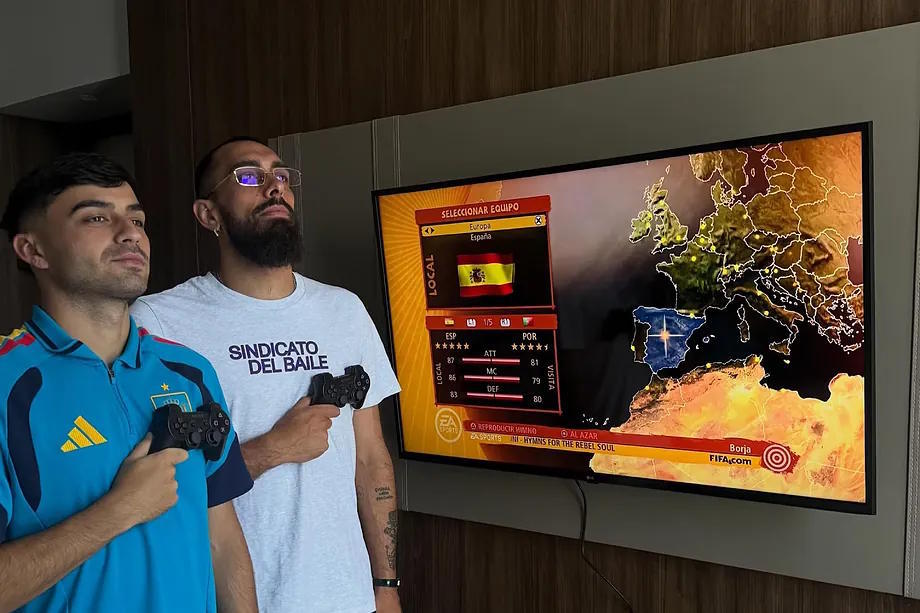
They are a reflection of a society that has also changed its way of interacting. The 'TikTok Generation' spends time between handheld consoles, online games, and social media. They laugh, tease each other, compete, and talk, but with a screen in between. The result? Another World Cup final.
Former player Capdevila's room was the central stage for the "pocha" tournaments, the famous card game that the internationals played in South Africa, always with Casillas and Villa as main participants. Sergio Ramos played the music while Puyol kept track of the results in an Excel sheet for the World Cup pool. These weeks in the United States, the reality has been somewhat different. There is no pool, the music continues, and the cards have been replaced by screens.
From Durban to Dallas, from Gelsenkirchen to Kiev: a journey through the legendary matches of the Spanish national team
The team has been living together for 48 days since they gathered in Las Rozas on May 30. Enclosed between hotels, planes, and buses without a single internal conflict, with technology, when used well, and with the leniency of Luis de la Fuente as their main allies. There is a scene that has been repeated these weeks. A plane trip and most players with a Nintendo Switch console in their hands sharing the same game, each looking at their screen. Borja Iglesias, Porro, Cucurella, Unai Simón, Olmo, Fabián... They talk, shout, argue, and laugh while competing in Mario Kart, the car racing video game. Think of your young cousins or nephews during a family gathering. The team is a reflection of society.
Borja Iglesias' premonition with the 2010 video game
And do not be mistaken. They do not use the console to isolate themselves but to socialize. "I'm taking the Nintendo to play Mario Kart with the others," Borja announced before traveling to the World Cup. In addition to that, the Celta forward also brought with him to the United States the PlayStation 3, an old console from 20 years ago, but which serves the internationals for a curiosity: playing the official video game of the 2010 World Cup in the common rooms of the hotels during this tournament. A sort of premonition that has worked out well for the Galician striker and the team, who gather almost every day to play some virtual matches with Xavi, Iniesta, Ramos, or Villa, idols from their childhood. "It helps to interact with teammates, we play a lot. I hardly ever play alone," admits Dani Olmo.
Not only video games fill the team's free time. The classic board game "parchís" remains one of the games that hooks the internationals, with Olmo and Unai Simón almost always among the participants. However, forget about the wooden board, that is a thing of the past. Now "parchís" is played on a tablet, the dice are rolled by tapping with a finger, and the pieces move automatically, no cheating possible. On screens, some also play chess online, others watch viral series like the anime "Jujutsu Kaisen," to which Nico Williams or David Raya are hooked, and others have become fans of iconic series like "Game of Thrones," in the case of Ferran. The coach, meanwhile, switches to airplane mode to review Belgian classics like '300' and then entertains himself in the hotel room or lounge reading Marco Aurelio. A matter of generations.
Social media is also a key point of gathering, teasing, and coexistence. Like in most current teams, players turn to them after each game, in their free time, or during bus trips. They watch videos, leave comments on each other's posts even if they are sitting next to each other, or tease each other, like the videos posted by Lamine and Nico Williams about one's naps and the other's flip-flops. They communicate. Like a school or a university, they do not seek anything out of the ordinary in people who are quite normal.
This interest in social media has also been transferred to the Federation, much more attentive to its TikTok account than in previous tournaments. It has nearly 8 million followers, and from there, a new wave of young people very attached to the national team and especially to stars like Lamine Yamal, very active on the platform, is emerging. Hence, his jersey is the best-selling among teenage audiences. The RFEF posts videos on the plane, quick questionnaires, jokes between players... Fast-consumption content that is multiplying views and followers on the team's social networks, turning TikTok into another window of the concentration. In fact, several influencers have been invited to the tournament by adidas, one of the main sponsors, as well as by the RFEF to further publicize the daily life of the team on their profiles.
Outside the screens, Gavi and Fabián are very competitive in ping-pong, while others like Llorente, Pubill, or Ferran Torres take advantage of downtime to soak up the sun, a routine started by the Atletico player and adopted by the rest of the group before training sessions. Others, occasionally, but less frequently, spend their free time playing pool or darts, although the participation rate is much lower than in online games.
And as mentioned before, Luis de la Fuente's leniency is also explained in a detail: the coaching staff has given free time in the afternoon before matches and throughout the day after the games. For example, on the afternoon before the quarterfinals against Belgium in Los Angeles, several internationals spent a good time swimming in the hotel pool with their families. Laporte and Oyarzabal were there. In a long World Cup, with many trips and downtime, De la Fuente has understood the importance of relaxation, both technological and vital and family-related, to perform well on the field.
The screens could be used to communicate with families, but that is not necessary here. They have them nearby, like Olmo with his father, brother, and girlfriend; or Lamine, accompanied by his mother, brother, girlfriend, two friends, a manager, and a photographer. Even those with young children, like Merino and Oyarzabal, have had their entire families join them during the knockout stages.
This concentration is far from those of several decades ago, without the internet and sometimes without television. And different from that of 2010. Let's hope that this Sunday in New York, the result is the same.