There are still 30 minutes left before the Accademia Gallery opens its doors. But on Via Ricasoli, it's hard to walk due to the lines of visitors eager to see Michelangelo's David and the paintings that local artists display on the street. The scene, common in the eternal Florentine summer, repeats itself in front of all the greatest hits of the cradle of the Renaissance. There are no tickets available to climb the Duomo all week, nor to visit the Uffizi Gallery. It's difficult to move along the narrow sidewalks leading to the Ponte Vecchio. And yet, just three strict minutes from the Accademia, the Convent of San Marco welcomes the visitor discreetly, without crowds, from 8:15 in the morning.
The romantic Florence discovered by Grand Tour travelers can now only be read in books. But even today, the city of Brunelleschi, Donatello, and Ghirlandaio, of Dante and Machiavelli, of Gucci and Ferragamo continues to dazzle in palaces, churches, libraries, and corners that can be visited without having to jostle with all the souls dispatched by mass tourism. Any secret? Yes, the oldest in the world: get up early.
As we mentioned, it's 8-something in the morning, and on the steps of the Convent of San Marco, where Fra Angelico's Annunciation appears at the top, there is no one. It seems like a miracle. Suddenly, we are in the year 1450, and outside, in the flourishing city of the Medici, Santa Maria del Fiore already boasts a huge brick dome designed by Brunelleschi. But inside this convent, built from 1437 with the support of Cosimo de Medici, a small revolution is also taking place: the blessed Angelico, in addition to painting the San Marco Altarpiece, is creating wonderful frescoes in each of the cells of the Dominican friars. For such a humble and severe order, that must have been quite a commotion.
Today, it still overwhelms. And these days, even more so. Because the convent is one of the venues for the summer's major exhibition in the city: Rothko in Firenze, a show of the great American abstract painter organized by the Fondazione Palazzo Strozzi (until August 23) that reveals an unexpected and uncrowded Florence. Mark Rothko's paintings (1903-1970) occupy five of the convent cells. Each one is hung next to a fresco by Fra Angelico, establishing a brilliant dialogue between two masters and two eras.
Rothko traveled to Florence in 1950 and, according to his own testimony, he was captivated by San Marco, but also by another nearby monument: the Laurentian Library, built in the cloister of the Basilica of San Lorenzo. Here we find another satellite venue for the Rothko exhibition. It was Pope Clement VII de Medici who commissioned Michelangelo to design this library, which still houses the valuable collection of manuscripts gathered by the family with the help of some of the most famous humanists of the time. In the vestibule, two additional works by Rothko appear, although they are only fully appreciated when descending from the Reading Room, the crown jewel of the library.
The bulk of this major exhibition, with over 60 works by the expressionist painter, awaits in a more conventional space, if such a term can be used for an imposing Renaissance palace like the Palazzo Strozzi, in the city center. There are no queues at this essential museum for contemporary art lovers, responsible for organizing ambitious retrospectives of great international artists. Rothko in Firenze covers his entire career from his early figurative works to the famous colorful abstract paintings of the 50s and 60s that made him a phenomenon.
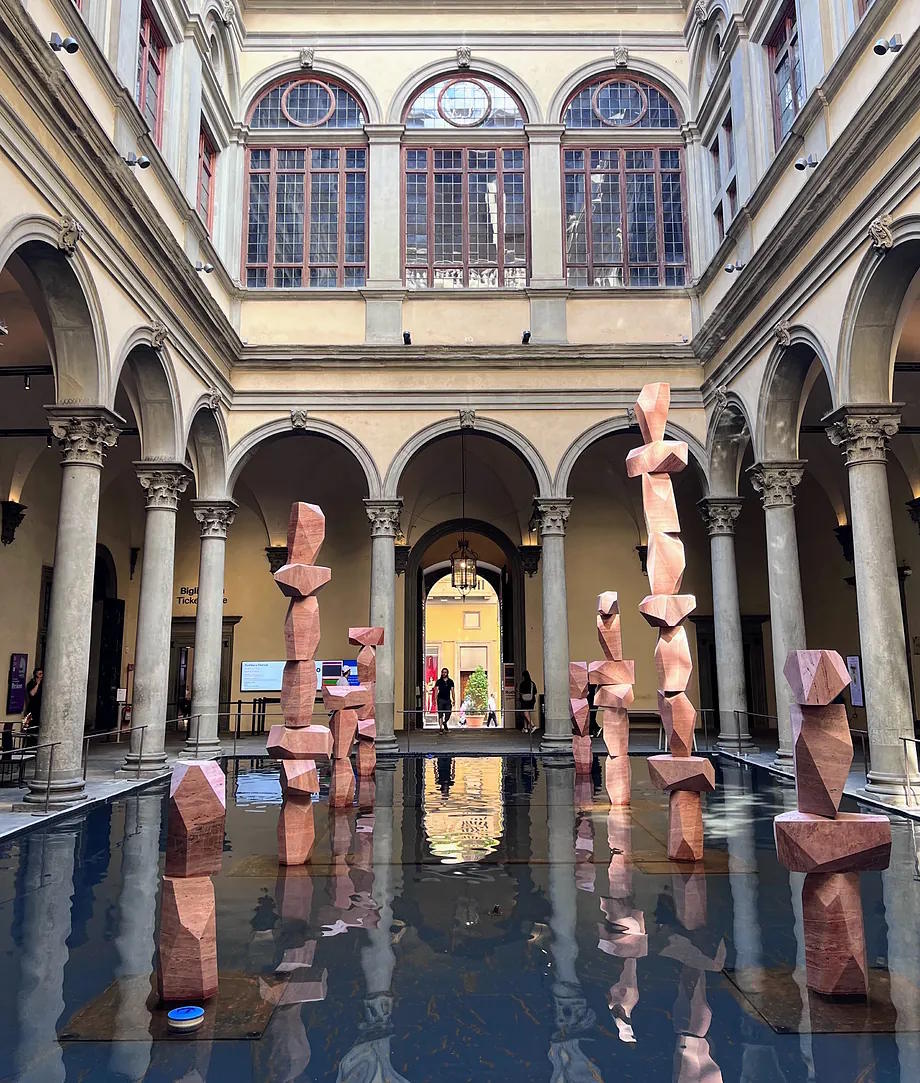
Needless to say, the Strozzi is a perfect refuge from the tourist frenzy of Florence. With Rothko or without him, sitting down for a coffee in the museum's courtyard, intervened by the Danish collective Superflex, is ideal for recharging your batteries. But if you need a nap, perhaps the Giunti Odeon is even more enticing. This former cinema around the corner is now a fantastic bookstore, but it still retains its boxes and several rows of seats facing the big screen. Even Stendhal would have liked to take a break here from so much beauty, from so much Florence.