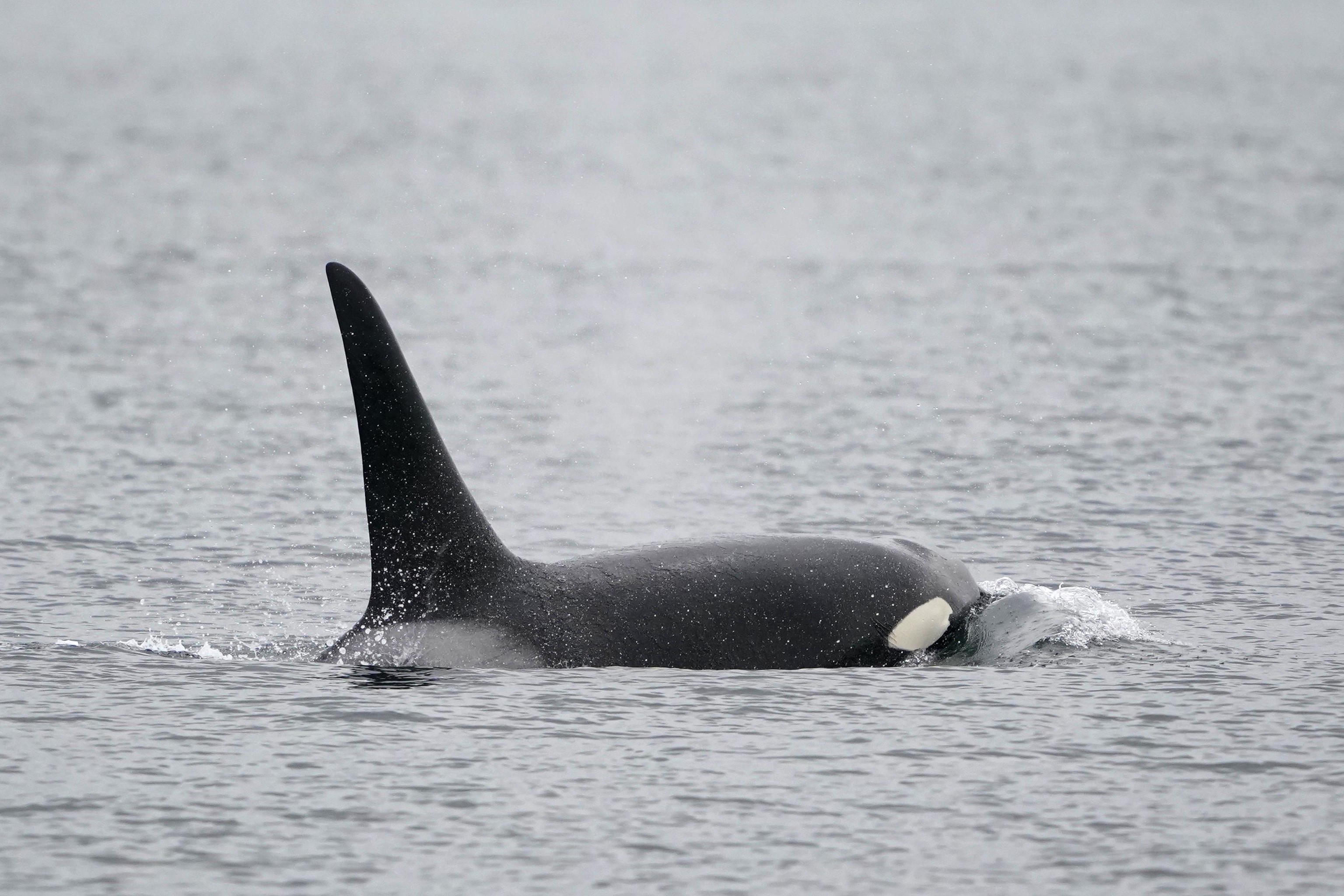
The behavior of orcas (Orcinus orca) never ceases to amaze scientists. These large ocean predators have no natural enemies and are known for their skillful techniques to capture, kill, and process their prey. Now, a team of researchers has recorded in the Gulf of California two shocking scenes that have revealed a hunting strategy that had not been observed until now.
Intelligent and 'ruthless', orcas are capable of capturing a wide variety of prey, including whales larger than themselves. In the scenes described in the journal Frontiers in Ethology on Thursday, the victims were sharp-tailed moonfish (Masturus lanceolatus), one of the heaviest known fish.
This species can reach up to three meters in length and weigh 2,000 kilograms. They move at different depths but come to the surface to rest, regulate their body temperature, or remove parasites. When they are in these surface waters, they are more vulnerable to predators. According to this study, in the Gulf of California, they are one of the species that orcas hunt and consume most frequently.
"We documented how an orca holds the moonfish and releases it just before another one hits it at high speed, causing its tissues to disintegrate into thousands of fragments," explained Kathryn Ayres, the study's lead author, in a statement. "We believe this could help young orcas feed more easily or simply could be done for fun. Orcas are known to play with their food," details this scientist, who is part of the organization Beneath The Waves, dedicated to promoting ocean conservation.
Observations of this brutal behavior are based on two independent hunting episodes that occurred just over a year apart. The first took place in July 2024 when Kathryn Ayres observed how a group of orcas, including a juvenile individual, interacted with a dead sharp-tailed moonfish they had previously hunted. A female held the fish by its large caudal fin, a very effective grip point, while a male accelerated and swam directly towards both. Moments before the impact, the female released the fish. The blow caused the moonfish's tissues to fragment and scatter in the water.
The juvenile individual then began to feed on the small fragments, while the adults consumed the main remains of the body, leaving the smaller pieces intact.
In September 2025, a very similar episode was recorded, filmed by Héctor Franz, which showed the same behavior of holding, ramming, and subsequently eating the fragments. The strong impact caused a considerable disintegration of the prey's tissues.
Until now, the use of ramming as a predation strategy had never been described in orcas, according to scientists, but its characteristics do match their behavior.
Thus, both episodes suggest that the orcas followed a coordinated and cooperative strategy: one stabilized the carcass while the other hit it more accurately. Since the fish were already dead in both cases, the researchers consider that the rams constitute a technique to process the prey and not a method to kill it.
According to the researchers, fragmenting the carcass into more manageable portions for the offspring aligns with other behaviors previously observed in orcas. "Orcas often tear apart their prey and share them with other members of the group, including newborns and juveniles," Ayres explained.
However, this does not mean that the interaction could not also serve a social function: it could simply be a game for the orcas.
It is still unclear whether the same orcas participated in both episodes. As Ayres highlights, this underscores the need to obtain more high-quality recordings, especially of the dorsal fins and eye patches, to be able to identify individuals. "Collecting good identification photographs whenever possible is essential," she assures.