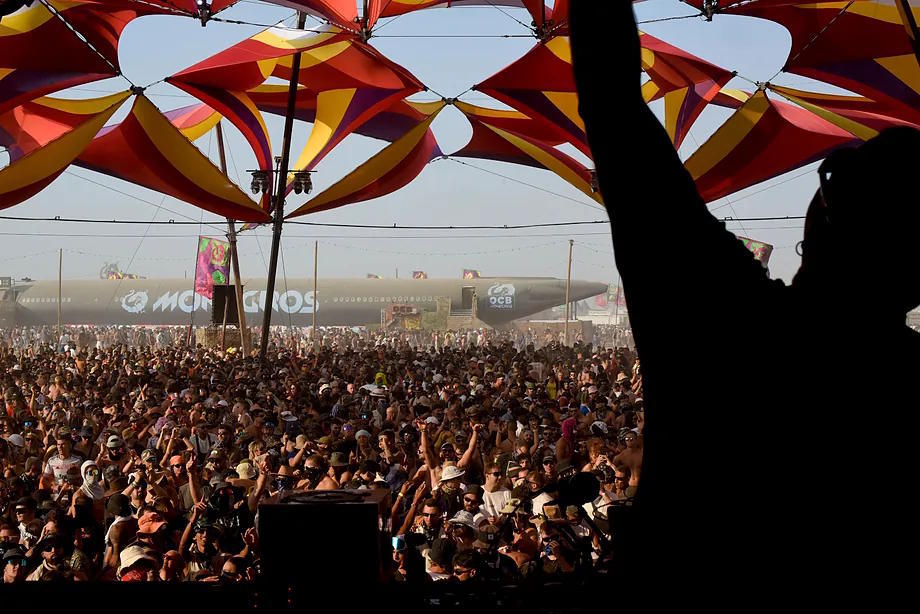
"I cross a desert and its secret/ nameless desolation". This is the first verse of the first poem in the first book published by José Ángel Valente. It was 1954. That desert could be this one, but the one here has a name: Monegros, in the Ebro Valley, between Zaragoza and Huesca. And we cross it under a punishing sun at 2:00 p.m. on Saturday, with no desolation at all, as everything that happens here is fervor, scattered community, a craving for trance, bodies waiting for the sound blast that inaugurates one of the biggest techno parties in Europe, a hypnotic atoll unfolded in an old familiar era where the Arnau family, with their base since their great-great-grandparents in Fraga (Huesca), established the Monegros Desert Festival over 33 years ago following the fierce raves of Northern Europe.
That experiment that originally attracted a hundred people is now a feverish ceremony against time, an essential stop in the electronic music circuit of this part of the world, where 60,000 individuals wind up for 22 straight hours (from Saturday at 2:00 p.m. to Sunday at 12:00 p.m.) to the beat of 120 DJs spread across 10 stages. The gathering covers 120,000 square meters (about 24 football fields). And a single goal: to enjoy, dance, be amazed, endure.
At 2:00 p.m., with exquisite punctuality, DJ and producer Indira Paganotto kicks off the 2026 edition. The power goes up, the speakers start pulsating in the Techno Cathedral, a legendary stage, a forest of raised arms takes over the space, dance is the only religion, the sole ideology of this place. And the people who entered the venue hours ago walking through a dry dirt track and enduring the heat across the vast plain of the Monegros Desert Festival, parallel to the N-II, start pulsating forming an unnamed ritual assembly, with t-shirts and without, with scarves against the dust or mouths open, drinking water eagerly, some unleashed by euphoria. Paganotto unfolds her psy-techno rocked by cosmic sounds while the sun high above is a hydrogen bomb. It's 38º Celsius. The way to engage in battle is this: invoke ecstasy as if nothing while outside life becomes rarefied and burns.
There is no time ahead. And if there is, it's to ward it off. With a horizon of languid lands, the crowd sheds any protocol as they pilgrimage from one stage to another. People from over 90 nationalities with a common purpose: excess and hedonism. "That's the key," says Juan Arnau, the founder of this event.
"Here, people come to enjoy techno and leave their routines aside for a while. Everyone has fun as they please, and at the Monegros Desert Festival, there are many ways to do so. By day one way, by night another. This started as a very small bet. Spain lacked a big festival of this kind, so I visited over 30 raves throughout Europe to find out what was happening in them. They were tough raves, the kind the police could shut down at any moment. I studied them in detail and in the end, we chose this format. Something that offers a radical experience but within a safe space." He anticipated this in a confessional book, Dancing in the Desert (Grijalbo), published in 2023. The story of himself and a family saga (the Arnau family, which now spans five generations in the entertainment business), from Josep Satorres' dream in the 19th century to Juan's dilemma in 2013 about whether to sell the festival. "I'm retired now, my children manage it, but I like to come, be here, observe, see how people continue to have fun. It's what I've done all my life: observe." The patriarch has his oasis in the artist's VIP room.
In this cosmic grand party, laser beams cross the sky and a pack of rhythms at supernatural decibels create a strange harmony in a rugged landscape. As the sun sets, the dozens of speakers at the new stage of this edition, the Outworld, roar, an immersive 360º setting with a capacity for 20,000 people. Ten arms of light and sound embrace a central tower of 28 meters where DJ KlangKuenstler plays, with a hard and nostalgic 90s sound. This set makes sense at dusk and dawn, but during the rest of the day, it's a bothersome repeater of very pale sound loops for some.
A few steps away, the scene is different: "This is paradise", says Yukio, a 28-year-old Japanese. "I study in Barcelona, and it's the second year I come to Monegros. This time with two friends from Tokyo whom I lost a while ago. But we'll meet at some point, who knows. Meanwhile, I dance." He dances alone, swaying a bit in the middle of a dirt circle where thousands of attendees float in rhythm. In the distance, they might seem like dangerous beasts, but here everyone minds their own business, more or less disheveled depending on the time.
Choices must be made, like in amusement parks. It's not possible to ride all the Ferris wheels, but once you've chosen your own, it's hard to escape its turns. In some, you get trapped, amidst thousands of beings magnetized by sounds that envelop or shake. Music and experimental proposals that are already part of the sparkling darkness as the desert cools down. The temperature suddenly drops by nine degrees. At 11:30 p.m., the attire changes in favor of some warmth. Another anthropological aspect to highlight is the wardrobe repertoire, the extravagance, and the somewhat costume-like appearance of some attendees: from normality to sensuality passing through delirium and absurdity.
Around techno grows a culture, a devotional culture like jazz has, as flamenco adds. A brotherhood that navigates through festivals across Europe. "Although I wouldn't call it culture," Juan Arnau interjects. "It's true that it brings happiness and people together around the same thing, but... Maybe it's another form of culture, yes. Look at this turnout. We've broken attendance records in the history of the Monegros Desert Festival. That means something." Perhaps it means that there is a culture around it. A code. An aesthetic. A purpose. A way of wanting to be here. A frenzy. A certain insurgency. A certainty that things happen in this music. An advocacy that reason alone is not enough. Perhaps that's what we call culture: another way of not accepting the inevitable.
At 6:30 a.m., the sun begins to rise in the east. With no trees in sight, the horizon is vast and clear. The light disintegrates a bit and at the same time fosters a brief renewed energy. There are still six more hours of relentless festival ahead. Bodies serve as resonating chambers. In some places, the first casualties of the night are seen. Those who no longer distinguish the light that emerges anew in the morning from the one that died in the evening. This new sun also illuminates the definitive defeats that the suspended dance gilds for those who tested their strength.