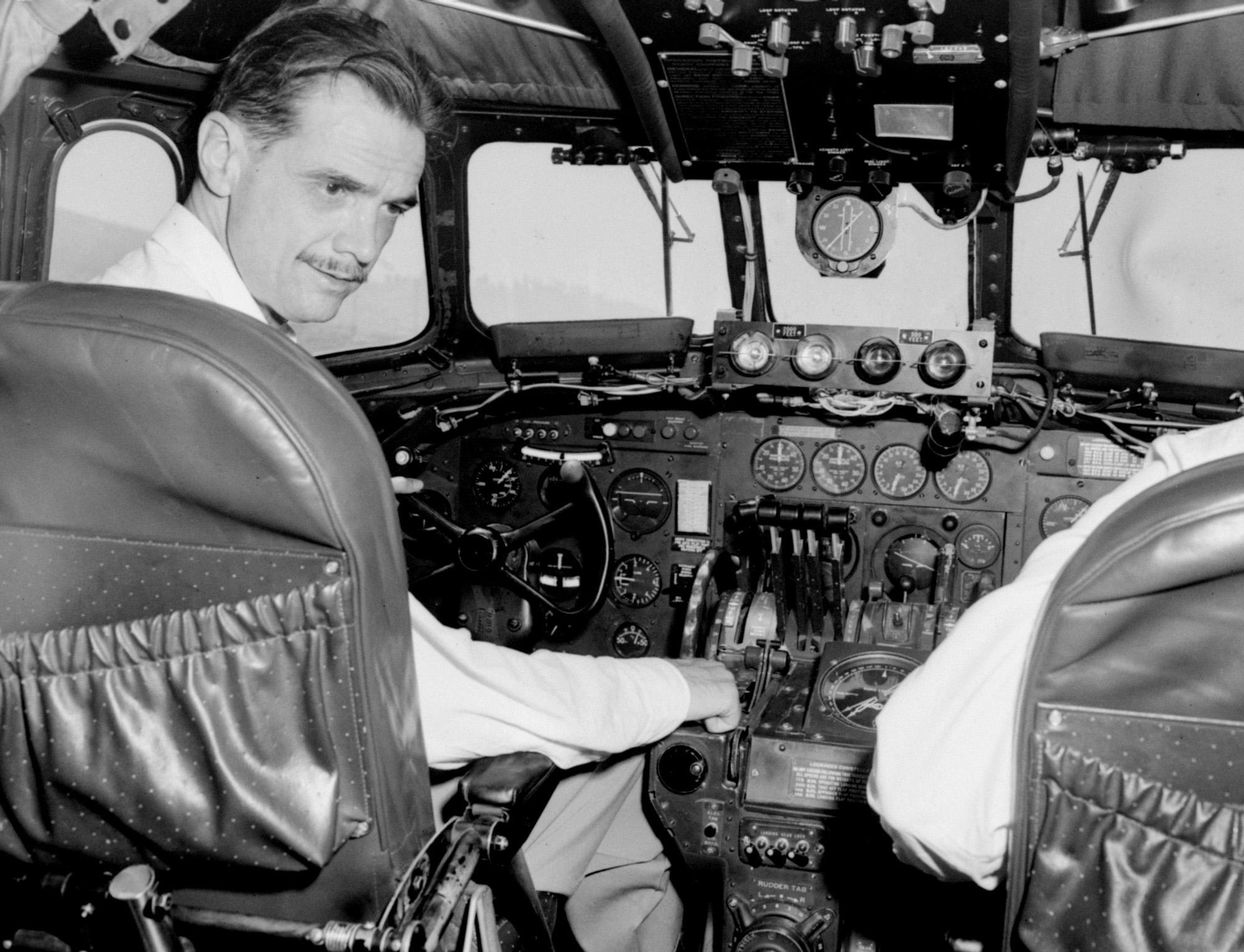
At 25, Howard Hughes announced to one of his assistants the purpose that would become a lifelong pursuit: "I will be the most complete aviator in the world, the greatest film producer, and the richest man on Earth." He managed to fulfill all three prophecies a few years later. Born in 1905 in a town in Texas, the son of an industrialist who patented the tricone drill bit for drilling oil wells in previously impossible terrain, and an Englishwoman, Alene Gano Hughes, with Victorian manners who suffered from mysophobia (intense, irrational, and pathological fear of dirt, germs, bacteria, and contamination). The child Hughes was raised under the shadow of his parent's paranoia: he checked the state of his bowel movements daily, made him shower with bleach soap, inspected every inch of his body at night... Thus grew this only child, assisted from birth by a melee of doctors from all specialties, who by 18 was already a golden orphan.
Hughes learned to manage his father's business, dropped out of college, and settled in Los Angeles, where one of his uncles, Rupert, worked as a screenwriter, director, and producer. A few weeks after arriving in the promised land, he realized he could also apply his ambition in Hollywood. He arrived married (to Ella Rice) and within months was already divorced for being unbearable. Capable of handling oil business and taking on the film industry without breaking a sweat, he became a fashionable millionaire and played the role of a playboy, presenting himself at parties as if he were an always unattainable horizon. By then, he already had the accounting savvy of Noah Dietrich, his best henchman. He confided in him some ideas from his instruction manual: "I can buy all the men in the world". And this one: "Everyone has a price." Together, they embodied a mountain of unscrupulousness.
But what truly fascinated Howard Hughes was flying. In 1932, he founded his first airline company, Hughes Aircraft. He set the speed record for a flight between Burbank (Los Angeles) and Newark (New Jersey). It took him seven hours, 28 minutes, and 25 seconds. It was 1937, and he achieved this piloting his own model, the Hughes H-1 Racer. He devoted millions of dollars to improving airplanes until he embarked on another stellar adventure: completing a round-the-world flight in three days, nine hours, and 17 minutes, breaking the previous record by four days. This was Hughes, unable to accept limits.
He lived to fly and make tremendous deals. The sky was the only space that no one had conquered, and he turned it into his playground. He had several accidents that almost took him out of this world, but he managed to recover each time. He designed his own hospital beds. He was the first man in the U.S. to amass $1 billion. In the 1930s, he also acquired Trans World Airlines (TWA) and turned it into the second-largest airline in the country, behind Pan Am. His life became increasingly bizarre. He thrived at the same speed he created black holes in his wake. Tyranny was the hallmark of his home: he forbade his closest team from eating cheese or garlic, looking him in the eyes, speaking to him, touching him. He had an employee with a full-time contract to scare away flies and insects. He urinated in glass bottles that he ordered to be kept in a room prepared for that bizarre obsession. He had the gift of making money and turning everything into more money and madness. Howard Hughes was a top-notch lunatic.
Allergic to paying taxes, he chose a nomadic life in the best hotels. He settled in Las Vegas and bought the Desert Inn so that no one would occupy his room during his absences. Later, he acquired several others: Castaways, Frontier, Sands, Silver Slipper, and Landmark. He had fewer and fewer people around him. He suffered several nervous breakdowns, and his phobias grew. In the mid-1960s, he decided to retreat from the world. Hardly anyone had access to the impetuous Hughes anymore. When he left the suite at the Desert Inn, only a handful of Mormons from his dwindling circle of trust had seen him for years.
In 1970, he embarked on a tour of hotels in the Bahamas, Nicaragua, Canada, England, and Mexico. Increasingly confined to dark sumptuous rooms, addicted to drugs to alleviate the pains from a plane crash he had in 1946. He had invested another fortune in creating a network of isolation. It is said that some nights he would look up with crazed eyes at the dark sky, seeking the part of the universe that belonged exclusively to him. He ended up becoming a creature of fiction from his own dark legend. He was an exaggerated and decrepit rich man surviving in a phobic soap bubble. In this wretched life, he only truly enjoyed a few dazzling flights and a few youthful parties where the orchestra stopped in admiration as he crossed the room in impeccable tuxedo with a dry martini in hand.
The last stop of his life was in Acapulco. He weighed 40 kilos, had let his goatee grow like a Valle-Inclán, stopped cutting his nails, and his hands were already a terrifying mess. He died on the flight from Mexico to the Methodist Hospital in Houston. It was April 5, 1976. Two days later, he was buried in the family mausoleum at the historic Glenwood Cemetery in Houston, next to his parents. Six people, including the two gravediggers, formed the funeral procession. After so much, all for nothing.