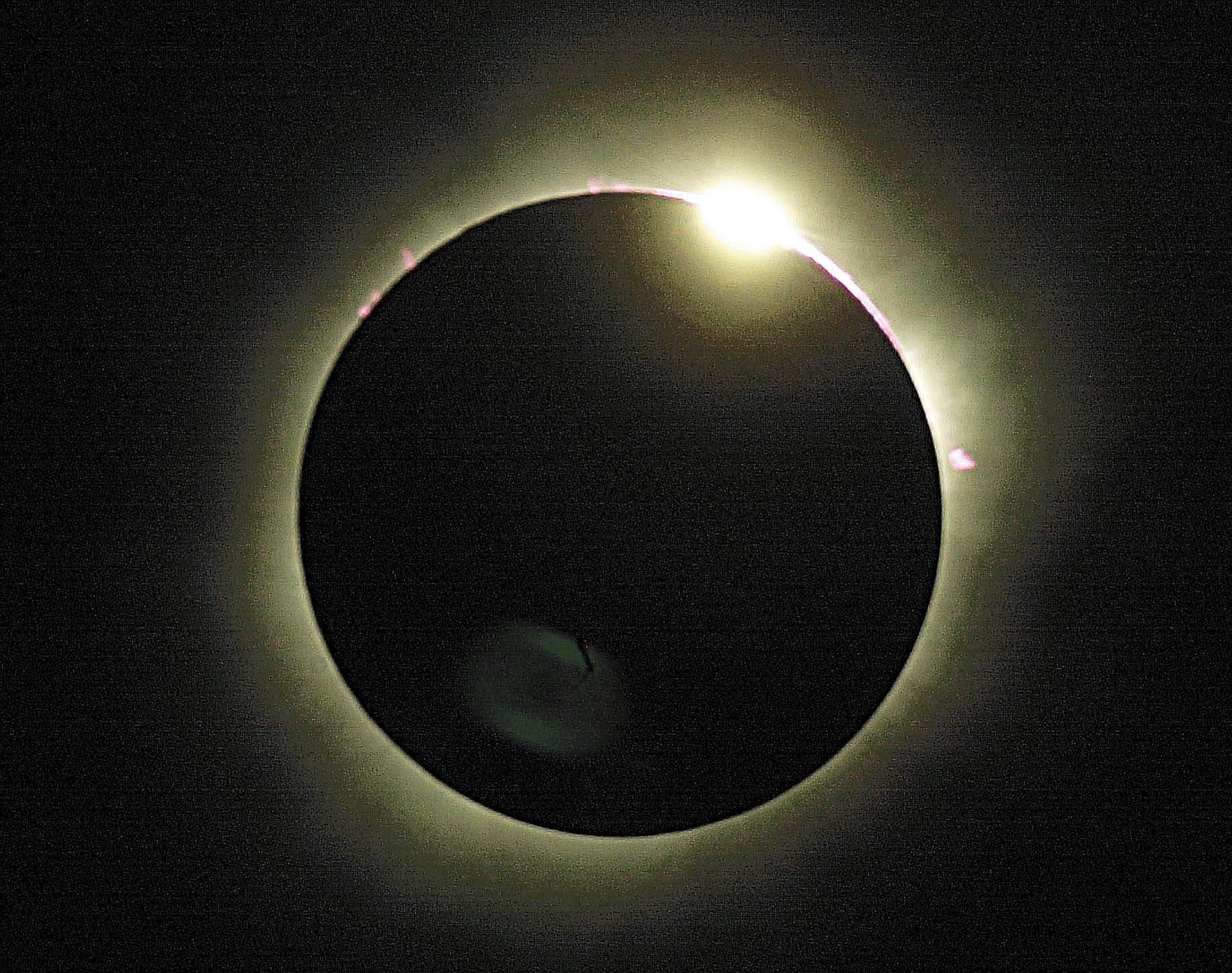
Current scientific knowledge allows us to know, unlike ancient civilizations, that eclipses are not bad omens or manifestations of angry gods or monsters that devour the Sun or the Moon. It is a unique spectacle - although it is a frequent and mathematically regular phenomenon - because being able to see it from specific points on the globe is something exceptional. Thus, seeing a total Solar eclipse from an exact geographical point only happens once every 375 or 400 years, on average.
In the Iberian Peninsula, one has not been witnessed since 1912, but now luck (or the manifestation of content gods) has allowed us to experience several in a row: the total eclipse on August 12, another total one on August 2, 2027, and an annular one on January 26, 2028. Specifically, the one next Wednesday will be seen as total in almost the entire northern half of the peninsula (from west to east through the northern part of the peninsula, leaving cities like Madrid or Barcelona out of that strip), while in the southern half, it will be seen as partial.
This circumstance should be taken advantage of to observe the phenomenon, but it must be done with the appropriate protection to avoid irreversible eye injuries. In fact, there are multiple documented cases of eye injuries after eclipses throughout history (the first clinical case of solar retinopathy was reported as early as the 17th century). Many times people associate that decrease in brightness that occurs during an eclipse with low sun risk, but solar radiation remains intense enough to damage the retina. "Precisely that false sense of security can lead to prolonged staring and cause irreversible damage to the retina," explains the president of the General Council of Opticians-Optometrists (CGCOO), Andrés Gené Sampedro.
The damage to the eyes occurs at the moment of looking at the sun, but symptoms may take hours or days to manifest, and there is no specific treatment to reverse these injuries, so the best way to protect the eyes is through prevention. Here are (almost) all the possible doubts regarding the eclipse.
Will we be able to observe the sun at any time without protection?
Until the Sun is completely covered by the Moon and darkness falls, about 55 minutes will pass. "But it will be of very short duration: in the central zone, totality barely reaches two minutes (one minute 49 seconds), while in the north and south of the central totality strip, the viewing time will be shorter," says Mª Ángela del Castillo Alarcos, director and owner of the School of Sciences-Astronomical Observatory of Titaguas (Valencia) to Science Media Centre (SMC) Spain.
Could we look at the Sun without protection at any of those moments? "The sun emits dangerous radiation even when partially covered by the moon. At that moment, high-energy radiation is especially intense and can directly affect the eye structures. The only safe way to observe the total or partial eclipse is to use approved glasses," emphasizes Jesús Merayo, director of the Fernández-Vega University Institute.
What can happen if you observe the sun without protection? What are the consequences?
"Exposure to the sun can cause a burn and destroy the exposed tissue. This is known for exposure to other tissues such as the skin, but the eye also has a focusing system (cornea and lens) that concentrates the sun's energy at the point where we are looking and multiplies the thermal effect and the risk of permanent and irreversible damage," argues the director of the Fernández-Vega University Institute.
Direct observation of the sun can permanently damage the retina and even cause solar retinopathy, an injury caused by the photochemical and thermal damage of solar radiation on the macula (where the majority of cells that see color or allow us to read are located), which can cause total vision loss. "This risk exists whether you look at the sun with the naked eye or use inappropriate methods," adds Merayo.
Which parts of the eye are most affected when looking at the eclipse without protection?
The damage to the retina is the most common if the eyes are not properly protected. It affects a very small but important part of the retina, which is the macula. This damage may go unnoticed at the time of exposure because the retina "barely has pain receptors, which means that many do not relate the symptoms to the eclipse exposure," points out Merayo.
Other injuries from sun exposure can damage eye tissues such as the eyelid skin, cornea, and conjunctiva, which also require prevention and treatment. For example, it can cause photokeratitis, a corneal burn that manifests hours later with pain, stinging, itching, redness, tearing, and a lot of discomfort with light.
Can the eclipse be observed through telescopes, binoculars, cameras, or mobile phones?
According to Marcos Pérez Maldonado, director of the Coruñeses Scientific Museums, one should avoid using telescopes or binoculars "unless you have the necessary filters and experience in solar observation," in statements to SMC Spain. For this reason, Merayo does not recommend it initially, "since we are not aware that cameras, mobile phones, or optical instruments have suitable filters for sun exposure. To avoid damage to the sensor, photography or astronomy enthusiasts are accustomed to protecting these optical instruments, including their lenses, with filters and protectors. But this is not the case for the general population. Therefore, the best recommendation is to protect the eyes with approved glasses."
What type of glasses are recommended?
The only safe way to observe the total or partial eclipse is to use approved glasses that comply with the ISO 12312-2:2015 standard. Some common mistakes that can cause irreversible retina damage should be avoided, such as using regular sunglasses; homemade methods like x-rays, photographic negatives, CDs or DVDs, ski goggles, smoked glasses, or improvised filters; "or using optical instruments using only eclipse glasses, as these are not designed to withstand the light concentrated by magnification systems," indicates the director of the Fernández-Vega University Institute. The specialist emphasizes that many of these methods "reduce glare and create a false sense of security, but do not block the radiation that can cause permanent damage to the retina."
The specialist recommends checking that the filter does not have scratches, perforations, or any other damage. "In the case of children, the observation of the eclipse should always be done under adult supervision to ensure the correct use of approved glasses," he stresses.
Is there a recommended time to observe the phenomenon?
"Observing the phenomenon should be brief, in segments not exceeding 30 seconds, alternating them with breaks," advises Merayo. While many astronomy or astrophysics specialists recommend looking at the Sun without protection during the seconds of the eclipse's totality phase (remember, not throughout Spain), ophthalmologists advise against it because it is only a few seconds and not feeling pain in the retina may prolong the observation time, causing damage that we may not perceive. "Although theoretically during the total eclipse period when it is all dark, the glasses could be removed, it is not recommended to do so since they would have to be put back on when the first bright edge appears. If we have children in our care, we must ensure that they have the protection properly worn at all times," adds Merayo.
How can you tell if the retina has been damaged? What would you notice if that happens?
After following the protection recommendations, damage to the retina should not occur, considers Merayo, who points out that damage in patients with solar retinopathy generally may go unnoticed at the time of exposure because the retina barely has pain receptors, and many do not relate the symptoms to sun exposure.
The most common symptoms are blurred vision, the appearance of a central spot (like a dark or blurry spot in the center of vision), distorted lines (seeing waves), and difficulty reading, distinguishing colors, or focusing on details. "In the presence of any of these symptoms, it is recommended to see an ophthalmologist as soon as possible for a better evaluation. In any case, prevention is the best option, as the damage can be irreversible," concludes Merayo.
What other recommendations should be followed?
Aside from the visual aspect, there are other precautions to take when viewing the eclipse. The Spanish Society of Emergency Medicine (Semes) recommends choosing a safe location, "away from hard-to-reach areas, cliffs, or fire-prone areas"; not stopping the vehicle on shoulders or unauthorized areas to observe the eclipse; and paying attention to driving and avoiding distractions related to observing the phenomenon.
Furthermore, the Ministry of Health issued a document in May about various risks, also considering respiratory and vaccine-preventable diseases (whose transmission is favored in mass events), vector-borne diseases (mosquitoes and ticks), sexually transmitted infections, alcohol consumption, tobacco, and psychoactive substances/drugs, food safety, and sun exposure with rising temperatures.
Regarding the latter, Semes recommends maintaining adequate hydration throughout the day; wearing a cap or hat, light clothing, and sunscreen if staying outdoors for several hours; seeking shade whenever possible during the wait; paying special attention to children, the elderly, pregnant women, and individuals with chronic illnesses; and seeking medical assistance for symptoms consistent with heatstroke, such as severe dizziness, disorientation, loss of consciousness, or high body temperature.