There is a sound I did not expect to hear upon arriving at a five-star hotel in Mallorca in the middle of the second week of July: the sound of a spoon clinking against a coffee cup.
Not a child crying because they don't want to put on sunscreen. Not a parent negotiating one last swim before lunch. Not a ball landing on a neighbor's towel. Not a lifeguard asking not to run along the pool edge. Not even that suspicious silence that any parent recognizes instantly because it usually announces mischief.
Just a spoon slowly stirring a coffee.
It takes me a few seconds to understand what is happening. It's not that the sounds here change. It's that all the sounds I have been associating with summer since I can remember and since I became a mother - almost 15 years ago - are missing. There are no children.
And suddenly, silence stops being an absence to become a luxury.
I confess that I arrived at the Secrets Mallorca Villamil Resort & Spa, in Peguera, with a certain prejudice. I thought that an adults-only was simply a hotel that does not admit guests under 16 years old. An idea of marketing aimed at couples with high purchasing power, a refuge for newlyweds and spa lovers. A place where nothing is designed for children, but where pets are allowed. Curious, but everything will be understood. Time will tell. Two days later, I discovered that I was wrong. An adults-only does not sell rooms. It does not even sell tranquility. What it markets is something much harder to find: time.
We live in a time where resting has become an activity almost as demanding as working. We take our email to the beach, answer messages from the hammock, listen to WhatsApp audios at double speed, and end vacations more concerned about the phone battery than the color of the sea. Disconnecting is no longer about turning off the computer. It's about making it stop mattering to us for a few hours.
Perhaps that's why this type of hotels is experiencing its golden age. They were born decades ago in the Caribbean, designed for honeymoons, and today they have become one of the fastest-growing segments in Spanish tourism. It's curious because, from the outside, the whole debate revolves around the absence of children. From the inside, no one talks about that. No one. Legislation does not allow the entry of children to be prohibited - really, no one based on age or sex - and they are not prohibited, but it is warned: "If you want to come with your children, you will not find anything for them here". Adults-only, the word says it all.
Conversations revolve around wines, restaurants, books, excursions, children - yes, also about children - and how much they needed to disappear for a few days. But never about the absence of minors there. As if, once inside, the matter automatically ceases to be important.
The hotel director, Alejandro Garrido, tries to summarize the concept in four words.
-Relax, romance, luxury... and entertainment.
The phrase might seem like a catalog slogan if one had not been observing what is happening around for barely half an hour. Angie Comte, Sales Executive of the hotel, is the one who keeps her eyes on each of the clients. She is the one who tells you how to learn to enjoy yourself and your partner, the one who sets the steps for the experience of an adults-only to be real, not what those who do not know what it is tell.
No one is running. There are no lines at reception. There are no sun loungers occupied by a towel since seven in the morning. There is no music trying to impose itself on the sea. There are couples reading. Others have breakfast for an hour and a half.
A woman is deeply asleep under an umbrella with an open book on her chest. Her husband flips through pages without making the slightest effort to wake her. A few meters away, a German couple spends almost half an hour looking at the Mediterranean without exchanging a single word. It does not seem like an uncomfortable silence. On the contrary. It has the intimacy of those who no longer need to constantly prove they have conversation.
I start to think that the real luxury of this place is not in the infinity pool or the sea-view suites. It is that no one is in a hurry.
The hotel's real business is to bring back a version of ourselves that we had forgotten
Outside the hotel, Peguera lives the usual summer. Floatie shops, families looking for a table to eat, teenagers carrying giant inflatable mattresses, and music escaping from the bars. Inside, it seems that time flows at a different pace.
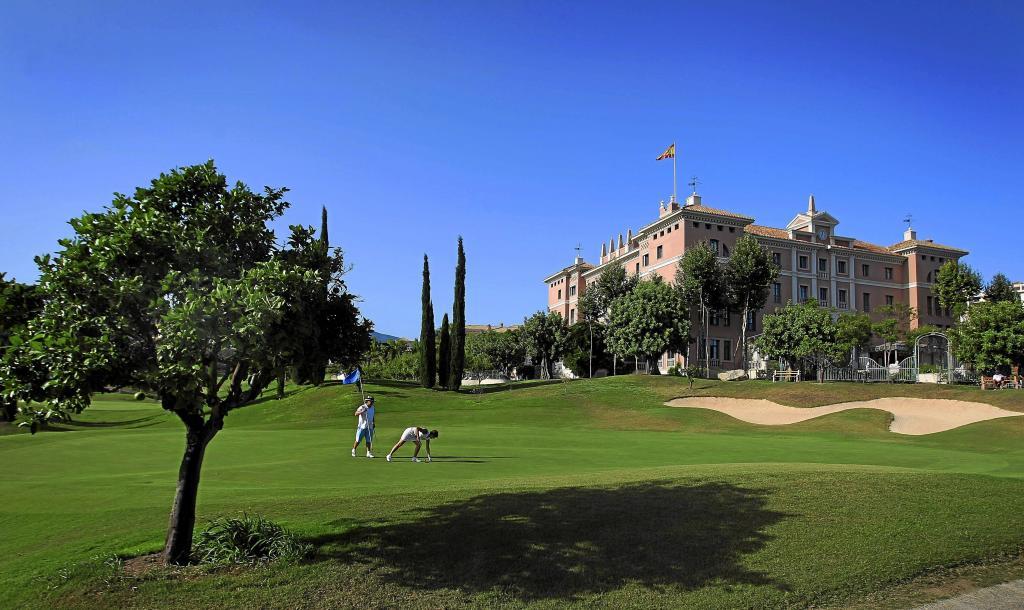
The building has been overlooking the Mediterranean for over 70 years and retains the elegance of those grand hotels where vacations still meant stopping the clock. Here, almost all tables are for two. The Balinese beds too. The terraces, the corners facing the sea, the small sofas where the evening falls... Everything seems to remind you that, before being a parent, boss, self-employed, or slave to notifications, you were simply a couple.
And perhaps that is the real business of the hotel: to bring back a version of ourselves that we had forgotten for 48 hours.
There is a woman who summarizes better than any advertising campaign what an adults-only means. Her name is Marta. She carries a tablet in her hand, walks fast - she is almost the only person in the hotel who does - and her official title is Guest Experience. Translated: the one responsible for making sure you don't have to worry about anything at all. The curious thing is that she never seems to be watching you. She just appears.
I am lying on a Balinese bed facing the sea - each one is named after an island and mine is called Menorca; I love it! - trying to decide if I want a coffee, a beer, or to keep looking at the horizon when Marta appears out of nowhere.
Five minutes later, she passes by again.
10 minutes later, I look up at the bar. I don't even make a gesture. She is already walking towards me.
-Can I bring you something? We have a freshly made mango slushie.
I start to suspect that Marta has a sixth sense to detect thirst even before it appears. For two days, I see her repeat the same ritual with almost every guest. She knows who is celebrating an anniversary, who has just arrived, who wants shade after four in the afternoon, and who has been returning every summer for twenty years. She never talks about clients. She talks about people. It may seem like a minor detail, but it is not.
In luxury hotels, anyone can learn a protocol. The difficult part is to make the service seem spontaneous. To make one feel that things happen because they do, not because there is a perfectly oiled machinery behind it.
As Marta moves from one sun lounger to another, I start to notice scenes that, outside of here, would probably go unnoticed.
A British couple has been having breakfast for over an hour. Between the two of them, they have barely spoken a dozen sentences. They do not look at their phones. He finishes the newspaper. She watches the sea. When they look up, they smile. Nothing more. And yet, they convey a complicity that is hard to find in many restaurants full of conversations.
A French man is reading a crime novel. His wife is fast asleep with her head resting on his shoulder. He shifts his position several times so as not to wake her.
Two Portuguese women toast with white wine before lunch. They don't take a single photo of the table. Nor of the scenery. It surprises me because the Mediterranean, from this terrace, looks like it was designed for Instagram. Here, however, it seems as though memory has once again taken precedence over the phone's camera roll.
The cell phone still exists, of course. We all carry it with us. But it's no longer the star of the show. It's strange to realize how that automatic urge to unlock the screen every few minutes fades almost without you noticing. By the second day, I find myself leaving my phone in the room for hours. Not because I've decided to. Simply because I forget. And that, right in the middle of 2026, almost deserves a commemorative plaque.
Then there's the spa. Liseth speaks so slowly that you lower your voice to match her. No whale music or wellness speeches are needed. All it takes is dim lighting, warm towels, and hands that know exactly where we've stored the stress of the last 11 months.
Twenty minutes later, I walk out feeling like I've taken a three-hour nap. The first thing I do is check the clock. The second is to laugh. Only 20 minutes have passed.
Outside, everything remains exactly the same. The sea continues to crash against the shore with that elegant indifference unique to the Mediterranean. The same couples are still on their lounge chairs. The same waiter is serving a glass of cava. The same German couple continues to gaze at the horizon.
And then I realize something much more revealing. I've been here for more than 24 hours. I still haven't thought about work. Not even once. For someone who's constantly glued to the news, that's starting to feel like a real luxury treatment. But on top of that, I've forgotten to call my kids and my husband. I'd use the emoji of the woman slapping her forehead.
At lunchtime, I'm once again wary of the buffet. Buffets and I have never gotten along particularly well. I associate them with lines, empty trays, scrambling to find a table, and tourists convinced that a vacation starts by filling up three plates. Here, it's exactly the opposite. There's no waiting. The chefs prepare many dishes fresh to order. No one seems to be in a hurry to leave.
Another thing you learn at an adults-only hotel is that doing nothing takes practice.
I order a very cold beer. It arrives with some olives. Next come some sobrasada croquettes that pull off a feat almost impossible in Mallorca: for a few minutes, I stop looking at the sea to focus exclusively on my plate.
No one around me is talking very loudly. No one is telling a child to finish their vegetables. No one is cutting a steak while negotiating that, after dessert, there will be one more scoop of ice cream.
Suddenly I realize that the silence an "adults only" resort boasts so much about isn't just the absence of shouting. It's, above all, the absence of interruptions.
As evening falls, the hotel transforms once again. Not because there's been too much activity during the day, but because the calm takes on a different hue. The light turns golden, the Mediterranean sheds the electric blue of the early hours, and a gentle breeze prompts guests to swap their swimsuits for a linen shirt or a light dress. No one seems to have agreed on this. It simply happens. As if the hotel itself were setting the pace.
At the piano bar, the tables begin to fill up. Each one has a candle. There's no loud music or a singer trying to drown out the conversations. In the background, classics play almost in a whisper.
The couples speak little. It surprises me.
We live convinced that a good relationship is measured by how much we have to tell each other. Here I discover just the opposite. There are married couples who spend half an hour gazing at the horizon without exchanging a word. They don't seem bored. Nor do they seem angry. They seem at peace. Perhaps silence is also a form of intimacy that only emerges when all other distractions fade away.
That night, Spain is playing Portugal in the World Cup round of 16. At any beach hotel, there would be giant screens, national team jerseys, waiters dodging fans, and applause every time someone got close to the goal area. Here, too, they've set up a room for those who want to watch it, but it barely disrupts the routine. Some people go in. Others don't even remember there's a soccer game. Most continue to dine by the sea as the sun finishes sinking behind the coast.
For the first time, I get the feeling that the most important event on the planet has taken a back seat to a sunset. Dinner confirms that here, everything revolves around a word we hardly ever use the rest of the year: after-dinner conversation.
At the Pintxos restaurant, almost all the tables are once again set for two. There are no seatings. No one waits impatiently for you to finish. No one checks their watch. Mushroom croquettes with gorgonzola arrive, along with a shrimp salad with quail eggs, a tuna tartare brioche, and an Iberian pork taco with kimchi. Dishes meant for sharing, for tasting a bite of each other's food, for saying "try this" without any rush.
At the next table, a French couple is toasting with white wine.
I ask them what they were looking for when they booked this hotel. The answer takes barely a few seconds.
-Time.
They don't say "luxury." They don't say "exclusivity." They don't say "five stars." They say "time." And suddenly, it all makes sense.
For years, we've believed that luxury is about accumulating things. More square meters. More pools. More restaurants. More activities. More experiences. However, after 48 hours here, I'm starting to think that true luxury works exactly the opposite way.
It's about subtracting. Subtracting notifications. Subtracting noise. Subtracting schedules. Subtracting the rush. Subtracting that constant obligation to be producing, responding, organizing, or deciding something.
Even subtracting the guilt we often feel when we're simply doing nothing or just want to do "grown-up" things. Because that's another thing you learn here: doing nothing takes practice. The first hour, you look for your phone. The second, you think about everything you should be doing. The third, you start looking at the sea.
The next day, you realize you've been watching the waves for half an hour without thinking about anything at all. And that produces a strange sensation. Almost like vertigo.
Before leaving, I take one last stroll through the garden that connects the hotel to the beach. There are hardly any guests still awake. A couple walks barefoot along the sand. Another sits facing the sea in complete darkness. No one speaks. No one is looking at a screen. All you can hear is the ebb and flow of the water crashing against the rocks. Then I step out of the hotel. And summer comes rushing back all at once.
A boy runs after a ball that ends up under a table. Another complains because he wants to go on the "horses." A mother chases after her son with napkins in hand so the chocolate ice cream he's eating doesn't end up on his T-shirt. A father takes on the "hassle" of heading back from the beach at the last minute.
I smile. Not because they bother me. On the contrary. They are summer. The summer of a lifetime. Then I realize that for two days I'd been looking for the wrong explanation.
Adults-only hotels don't exist because there are too many children. They exist because we lack silence. Because we lack time. Because we lack conversation. Because we're so used to someone constantly demanding our attention that 48 hours without anyone asking us for anything have ended up becoming a five-star luxury.
As I leave, I remember that little spoon clinking against a coffee cup as soon as I arrived. I thought it was the sound of silence. Now I know it was something else. It was the sound of time. And there's probably nothing more exclusive than that today.