John Valenti, better known as Johnny Blaze, was an Irish tennis player who spent over a decade fighting to compete with the best: he slept and traveled in a converted school bus, used recycled vegetable oil as fuel for the vehicle, clipped coupons to save on purchases, and tightened his belt in all aspects, including stringing his rackets. He debuted in 2002 and retired in 2017 after playing countless Futures tournaments and only one ATP match, in the first round of Newport, where he lost with a double 6-0.
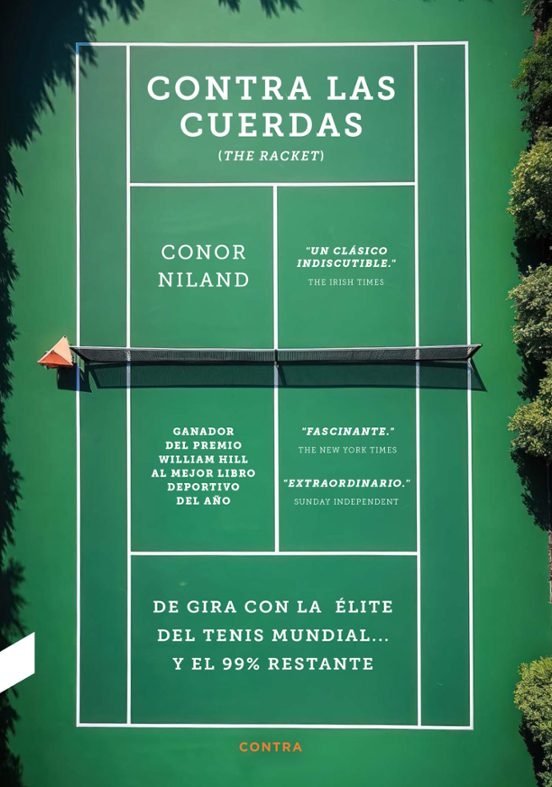
"There are players who grow up as the best in their country, but then get stuck in the world ranking, which is insufficient to be competitive in the early stages of Grand Slams, but enough to keep the tennis dream alive," recounts Conor Niland in his book The Racket, now published in Spain under the title Against the Ropes (Editorial Contra). A narrative about invisible tennis, tennis away from cameras and spotlights, tennis without an audience, and at the same time an autobiography.
Because Niland was a fighter between 1999 and 2012, the best player in Ireland, ranked 129th in the world, the opponent of Novak Djokovic in the first round of the 2011 US Open. But he grew tired of the hardships and now, after humorously recounting them in the book, he works as a real estate agent in Dublin.
"There were things that I considered part of tennis, part of my growth. If I had to play for three weeks in India, or in Uzbekistan, that was my life," he recalls in a video call with EL MUNDO from his kitchen, where he remembers anecdotes like when he precisely crossed Uzbekistan in a taxi, "seven hours at full speed, without a seatbelt and with luggage on top," only to end up losing in the first round of the Bukhara Challenger against a veteran Japanese player who hit his forehand with both hands.
The match against Djokovic
Question: With the book, he won the 2024 William Hill Sports Book of the Year award and received $30,000. He confessed that it was the biggest check of his life, more than he earned in any tournament. What does that say about the distribution of prize money in tennis?
Answer: My biggest prize as a player was $14,000 for winning a Challenger in Salzburg in 2010. In recent months, players have been protesting about prize money, and it's true that it has improved since I retired, but the cost of living has also become much higher: travel, hotels, meals. The real problem is that the circuit needs about 300 men and 300 women to be able to make a decent living from tennis, and that's not happening. If you only take care of the top 15, there's no talent pool, no new names. There are hundreds of players in the world who don't even try because they know they won't be able to make a living from it. And that makes the level of tennis lower than it could be.
During Niland's career, there were many matches without an audience in distant countries, many lonely flights, many cheap hotels, but there were also a couple of glorious nights, both in 2011. After a decade of struggle, he reached the Grand Slams, debuting at Wimbledon and the US Open, and the memories of both are "bittersweet."
At the All England Club, he came very close to beating the Frenchman Adrian Mannarino and facing his idol, Roger Federer, in the second round, but he lost in the fifth set. "I thought about that match every day for years. I could have played against Federer on the center court of Wimbledon in prime time in Ireland," he says. And at Flushing Meadows, against Djokovic, he went out to play on Arthur Ashe, but had to retire in the second set. "I was happy and excited to play on a big Grand Slam court against Djokovic. I knew I was going to lose, but I wanted to enjoy it. And then I got food poisoning the day before. I couldn't enjoy it, I was just trying to survive." The sports result was bad, but the story, he admits with laughter, "is much more interesting than if I had lost quietly 6-1, 6-1, and 6-2."
Betting, doping, and the loneliness of the circuit
The book also addresses the shadows of the circuit: betting and match-fixing in the lower levels of tennis. "I don't justify it, but I understand the problem. You can bet on any Futures tournament, and those players are earning 100 euros for losing in the first round, while betting companies advertise those matches as professional. There is a huge mismatch. I understand it in the main circuit, but at the lower levels, betting should not be allowed." The most exposed, he points out, are usually not the aspiring elite, but players who combine tennis lessons with occasional competitions: "for someone who wants to make it to the top, the risk is too great."
In addition to all that, there is also loneliness. "It's a solitary sport, even for the best. When I traveled, there were hardly any other Irish players. I saw the Spaniards, the French, traveling in groups, and that surely made them enjoy it more."
Question: Any advice for a young talent who wants to try it?
Answer: Surround yourself with a team early on, even if it's expensive. As I said, tennis is a very solitary sport, and having people around makes it more bearable. Also, you have to go all in to break into the world's top 100. The worst thing is to stay between 150 and 500, because you make sacrifices and receive no reward.