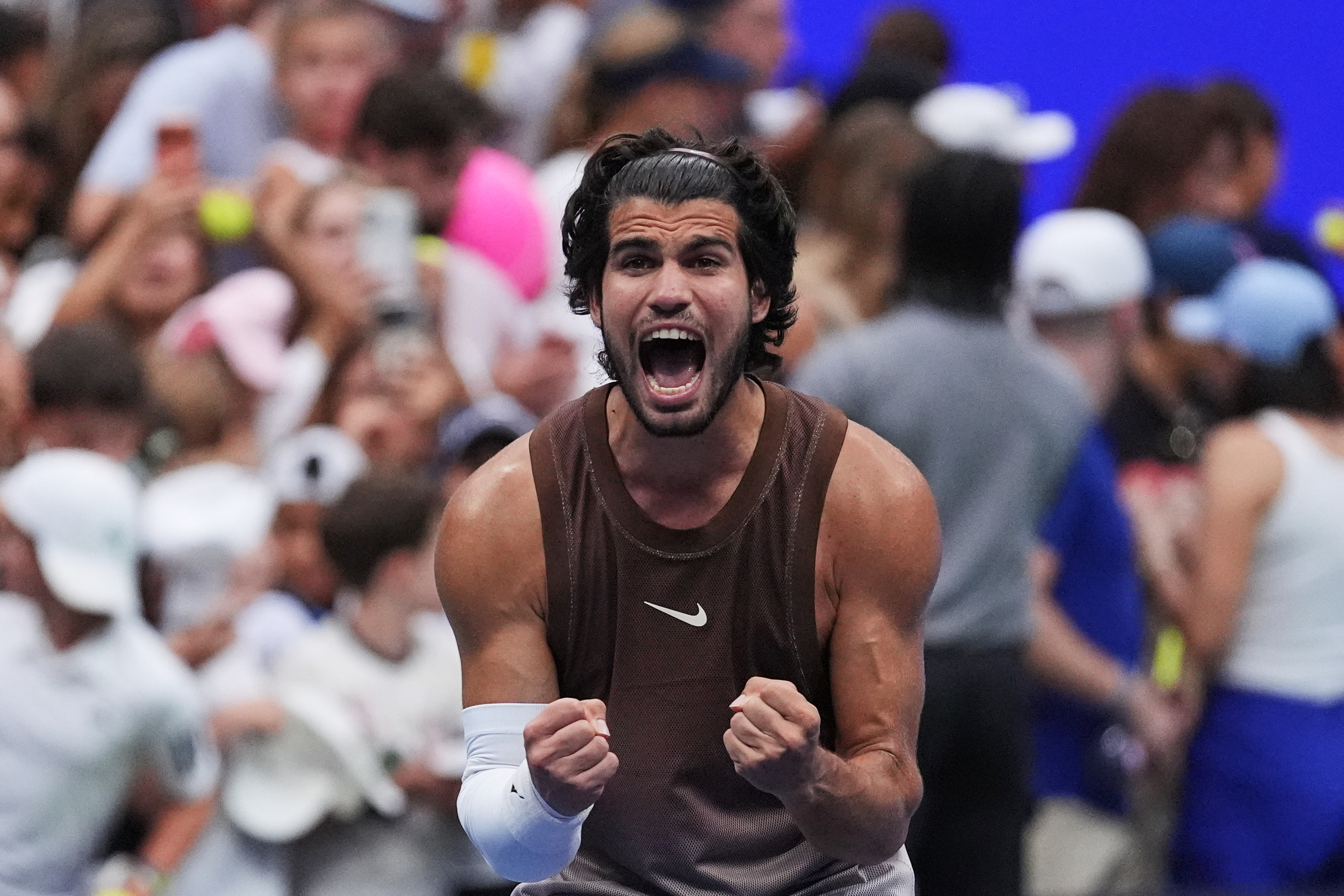
Carlos Alcaraz couldn't remember anything. What did he do before the matches? What did he do after? His routines, those movements that he had executed for years without thinking, had disappeared during his four-month break. When he woke up on Monday at the Lotte New York Palace in Manhattan, he only knew that he had to play a match a few hours later, the first round of the US Open, but he barely remembered everything that entailed.
"It has been a difficult day, to be honest. A beautiful day, but difficult. I woke up very nervous, much more than usual. I thought that I was finally going to do it, that I was going to compete again. But I had forgotten how it feels, I didn't know what was going to happen. In fact, I started warming up and didn't remember what to do in the warm-up," he admitted in the halls of Arthur Ashe after his victory against the Russian Roman Safiullin, with a triple 6-4 and with another display of his lack of practice.
In recent years, after matches, he always did the same: 15 minutes on the bike, a chat with his team, a shower, and then, already dressed and more relaxed, his appearance before the media. This Monday, however, he went straight from the court to the press conference, still in his game tracksuit, without even time to unwind. "I need to regain my competitive rhythm. For me, that is the most important thing. I have played at a good level, but I have to deal with everything again, to control everything. That will make me improve my tennis," he acknowledged.
Because the return for Alcaraz is not only about hitting a ball again after four months. It also means recovering all those small automatisms that accompany a tennis player from the moment he wakes up until the end of a match. Remembering what to do before, during, and after. Competing again without having to think about how to compete.
Against Safiullin, it was clear that the pain in his right wrist has disappeared - "I don't feel anything, I am completely pain-free" - but also that he still has to recover his best version. While his forehand is already powerful and his backhand is still strong, his serve is far from what it used to be. During his long break, he has lost about 20 kilometers per hour in speed and he will need them in his upcoming matches, starting from the second round against the Portuguese Jaime Faria on Wednesday.
"It is the stroke that is causing me the most trouble. Sometimes speed is not so important because some opponents struggle to return slower shots, I can be more tactical, but I have to improve. I will try to do it, but I know I will struggle with that stroke," Alcaraz admitted, while also acknowledging that he continues to play with his right wrist bandaged "as a precaution." Then he puts on a protective sleeve and a wristband, but the bandage is underneath and will remain there throughout his time at the US Open. Caution remains a priority, but freed from the nerves of the return and growing every day, who knows how far Alcaraz can go.