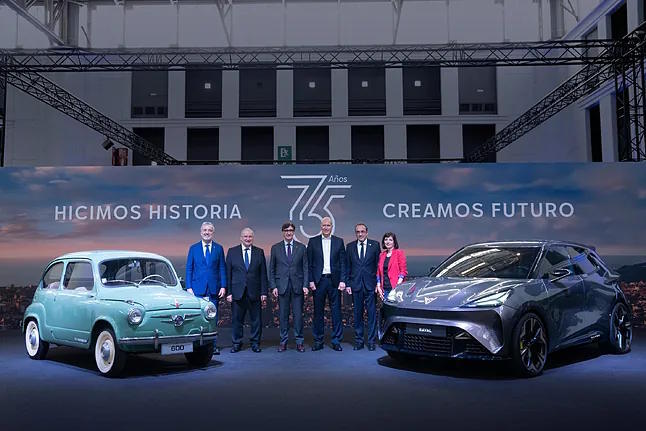
The German automotive group Volkswagen intends to phase out the Spanish brand Seat by 2029 to focus on Cupra, the second brand of SEAT SA, according to the German economic weekly WirtschaftsWoche, which has had access to a confidential restructuring plan developed by the group's management. The document, titled Report on the conceptual decision of the Supervisory Board of September 3 and 4, 2026, establishes that "the Seat brand will be phased out in an orderly manner and with optimized costs by the end of 2029 at the latest." However, Volkswagen would continue to provide service to customers and fulfill existing obligations.
In any case, the restructuring plan, spanning 147 pages, will have to be voted on and approved by the Volkswagen supervisory board this Friday. According to the same, Seat - which turns 76 this year and was instrumental in Spain's motorization - would no longer be part of the Volkswagen group's strategic vision for 2030. Its gradual elimination would reduce complexity and investment burden within the group, which is proposing a severe global adjustment plan with up to 100,000 job cuts (half of them outside Germany), the closure of up to four factories (Zwickau, Emden, Hannover, and the Audi plant in Neckarsulm), a halving of the model range (from 150 to 75), and a 75% simplification of the configurations and equipment of these vehicles.
The decision would never imply the closure of Seat SA or the Martorell factory. Volkswagen plans to progressively transfer to Cupra the products and commercial and production structures of Seat that it deems profitable and, in fact, has set a target of between 500,000 and 600,000 vehicles annually for the second brand, making the brand the cornerstone of the Spanish subsidiary's future.
Cupra started in 1996 as the designation for the most sporty and racing versions of Seat models, starting with an Ibiza. It remained so until 2018 when, under Luca de Meo's leadership, it was decided to turn it into an independent brand. Cupra is now the main source of income and profitability for the company. "To make the same profit as with a Cupra Formentor, I have to sell four Seat Ibizas," said Wayne Griffiths, former CEO until April 2025. Last year, it delivered 328,800 units (32.5% more than in 2024), surpassing Seat's annual volume for the first time, which sold 257,400 units (-17%). Both Griffiths and Markus Haupt, as well as Thomas Schäfer, the top executive in the VW group for the CORE brands (Seat, Cupra, Volkswagen, and Skoda), have repeatedly emphasized that "the future of SEAT SA lies with Cupra."
The Martorell factory and electric vehicles
Currently, including both brands and all activities, the company employs around 13,000 people after the adjustments made in recent years. The vast majority (around 10,000) are employed in Martorell. Therefore, they should not be affected as long as the group guarantees sufficient workload once Seat models cease production by the end. Last year, the Catalan plant produced 470,347 units (2.4% less) including the Seat Arona, Ibiza, and Leon models, as well as the Cupra Formentor and Leon, and the Audi A1, although the latter is no longer assembled.
However, this year, two of the four electric vehicles assembled by the VW Group in Spain have been added to this portfolio: the Cupra Raval and the VW ID. Polo. Furthermore, on the horizon is the allocation of a second platform for larger electric cars with higher added value. The German consortium has not ruled out this project, which is considered vital by the unions.
The Seat/Cupra duo had been reasonably successful until now. In 2024, they achieved their best results ever, with an operating profit of 633 million and revenues of 14,530 million euros. However, in 2025, those profits were reduced to just one million, although the turnover increased (15,272 million) mainly due to the impact of tariffs on electric vehicles from China and, in this specific case, those applied to the Cupra Tavascan.
In the first half of this year, with these tariffs minimized thanks to an agreement with the EU and other cost-saving measures, Seat SA achieved an operating profit of 122 million (almost three times more than the previous year) and generated 7,695 million euros in revenue.
Opposition in Germany to the global plan
"The Volkswagen Group is working on a transformation plan for all its activities to strengthen its competitiveness and efficiency. The goal is to make both the consortium as a whole and its respective entities more efficient and agile, as well as systematically leverage the potential of technological synergies. No decision has been made to date. We will inform at the appropriate time about any strategic decision affecting SEAT SA." is the official response given by the company in Spain.
Workers' representatives, the union IG Metall, and the state of Lower Saxony, which holds a 20% stake in the group, have expressed opposition to the plans of CEO Oliver Blume. The Volkswagen Group is facing a challenging situation due to increased competition from Chinese manufacturers, a decline in sales in China, and US tariffs.