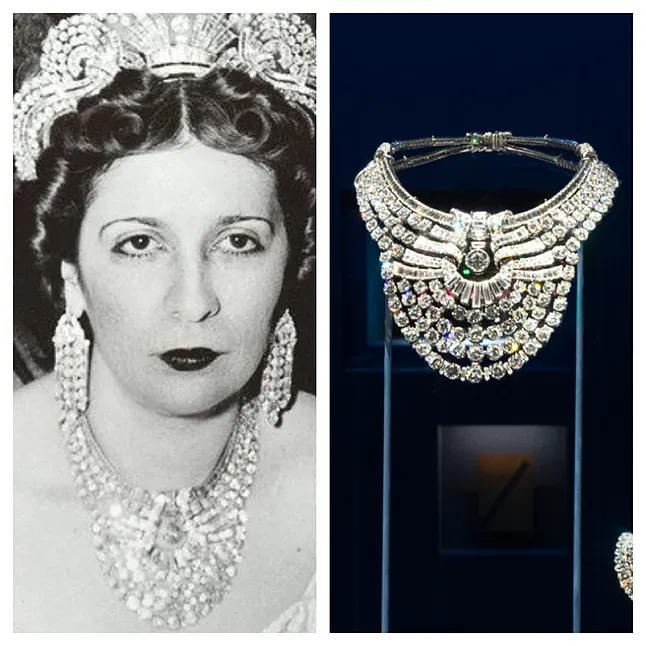
Their lives were a fairy tale that practically ended in tragedy. King Farouk of Egypt was not wrong when he predicted in 1952 that the golden age of monarchies would end, stating that "soon there will be five kings: the four of the deck and the Queen of England." He himself was a victim when he had to go into exile in the Rome of the Dolce Vita due to Nasser's government.
The Egyptian royal family is in the news because on August 27th, the fabulous Art Deco platinum choker set with 673 diamonds of different sizes weighing over 200 carats was stolen from the Museum of Applied Arts in Vienna (MAK). This exclusive piece from Van Cleef & Arpels belonged to Queen Nazli, Farouk's mother, who became the first queen consort of modern Egypt after the country achieved its first independence in 1922 following her marriage to King Fuad I.
The monarch wore the jewel on the day her daughter, Princess Fawzia, married the future Shah of Persia in 1939. Along with that commission to the iconic jewelers, there was another, an enormous tiara with over 700 diamonds. In the last auction at Sotheby's in 2014, the choker reached 4.3 million dollars.
Born in Alexandria in 1894, Nazli Abdel Rehim Sabry grew up surrounded by privileges as her family belonged to the Franco-Turkish aristocracy. She received an exquisite education at the Lycée de la Mère de Dieu in Cairo and later at Notre Dame de Sion in Alexandria. But when her mother passed away when she was 21, her father sent her to Paris, where she stayed for two years.
Upon her return to the land of the pharaohs, her father once again controlled her fate, forcing her to marry Khalil Sabri, a Turkish cousin from whom she separated eleven months after the wedding. Feeling sad and oppressed because she felt she did not enjoy full freedom, she sought the protection of
Safiya Zaghloul, who was an intimate friend of her mother and the wife of Egypt's former Prime Minister, Saad Zaghloul, had to go into exile in 1919 due to the revolution along with her nephew Saeed Zaghloul, who had a romance with Nazli. That same year, she met Sultan Ahmed Fouad at the opera, who was impressed by her dazzling beauty.
Only 12 days passed before they married in a dreamlike ceremony at the Bustan Palace in Cairo. Instead of moving to the royal palace, the newlyweds settled in the haramlek of the Azafran Palace in Abbasiya, where Ahmed Fouad was born, which soon became a gilded cage for the young woman, whom her husband doubled in age.
The sultan's top priority was to have a male heir, so he pressured his wife to make his wishes come true, or else she would be relegated to the harem. Fortunately, her first childbirth was a boy, whom they named Farouk (1920). Subsequently, her sisters Fawzia (1921), Faiza (1923), Faiga (1926), and Fathiya (1930) were born.
Life in the palace was not as ideal as one might think because once he became king, Fuad exerted excessive machismo over her, keeping her locked in her suite, allowing her to see her son only one hour a day, rarely attending public events, and rumors circulated that she was mistreated. Misfortune struck the family when the monarch passed away in 1936, and Farouk, at just 16 years old, succeeded him on the throne.
As a queen mother, Nazli enjoyed a bit more freedom to the point that she remarried in 1942 to Ahmed Hassanein Pasha, the head of the Royal Cabinet. Four years later, she became a widow when her husband died in a car accident.
Related to the Shah of Persia
Between these two deaths, Nazli also had to endure her daughter Fawzia's marriage in 1939, one of the most beautiful women of the time, to Mohammad Reza Pahlavi, the heir to the Iranian throne. The queen mother believed that the Egyptian monarchy was much richer and had greater international recognition than the Pahlavi dynasty.
The new couple had a daughter, Princess Shahnaz, whose birth worsened Fawzia's health, who suffered from deep depression as she was not in love with her husband and lived under the typical restrictions of the time for women. Therefore, when King Farouk heard rumors of his sister's poor health, he arranged for her to return to Egypt, and finally, the divorce came in 1948, for which the princess paid a high price as the child remained in the father's custody.
Two years before, Queen Nazli traveled with her daughters Faika and Fathia for treatment in Switzerland and France due to kidney problems. What seemed like a medical trip was actually a full-fledged escape because the queen mother, tired of her country's monarchy, took all her jewels, especially the aforementioned choker and tiara, a fortune in cash, and the royal documents proving ownership of a myriad of lands and properties inherited from her Turkish grandfather Sherif Pasha, who had been Minister of Foreign Affairs in the first half of the 19th century.
Queen Nazli's next step was to move to the United States, where she underwent three surgeries at the Mayo Clinic for her chronic kidney insufficiency. She later acquired a large mansion in Beverly Hills where she hosted dazzling parties for the great luminaries of the time.
The idyllic life began to decline when Princess Fathia, from a Muslim tradition, wanted to marry Riad Ghali, a Catholic, which enraged King Farouk. For this reason, the monarch stripped his loved ones of royal rights, income, and titles in 1950, leaving them in a state of insecurity.
Everything became more complicated when Ghali made a series of disastrous investments that caused his family and ex-queen Nazli to lose almost everything. As if that were not enough, Nasser's regime confiscated all of Ghali's assets and exiled Farouk, who died in Italy in 1965. With him, the Egyptian monarchy came to an end. Due to their pressing economic problems, Nazli was forced to auction her jewels at Sotheby's - the choker fetched $140,000 - but the amount obtained was not enough to sustain the lifestyle she had led.
Additionally, the former queen suffered the loss of her daughter Fathia when her husband shot her to death because after the divorce, she did not want her to start a new life with another man.
Depressed and emotionally shattered, Nazli spent her final years in a small apartment borrowed from a friend on the outskirts of Los Angeles. It was said that the Shah of Persia's older sister took care of paying a large part of the bills. In 1978, she died practically in poverty without being able to return to Egypt.