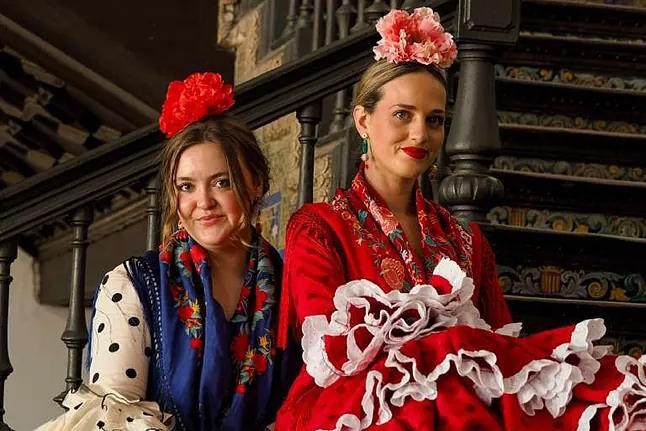
If in Spain it is usually amusing to hear a foreigner speak Spanish, the amusement multiplies by three when that Spanish comes out of the mouth of an American speaking in andalú. In Seville, there is a growing community of "guiri" Andalusian women who fell in love with "a boy," as they themselves say, and also with the city, to the point that they decided to stay.
This is the case of Sophie (25) and Shelby (28), two Americans who arrived in Seville to study and ended up becoming authentic "guiri" Andalusians. Victims of the Andalusian Crush and, of course, of ice-cold Cruzcampo beer and "montadito de pringá," neither of them expected that their stay would have such a permanent outcome.
Shelby's story reaches the altar this month: she is marrying her Sevillian boyfriend, Ignacio. She is from Maryland and came to Spain in 2018 to study for a semester. "I met my fiancé the first week. We were friends for a few months and then started dating. In 2020, I moved to Seville for three years. Then we went to the United States because we knew we wanted to live in Seville but also wanted to try living there first. My boyfriend's visa expired so we returned to Seville and now we are here forever. We bought an apartment and are getting married this month," Shelby excitedly confesses.
Shelby, known on social media as @shelbyinsevilla, has turned her life as an American in Seville into her profession. She has 128,000 followers and shares videos about the daily life of a "guiri" Andalusian. To start off, she reveals to this supplement that among her favorite places in Seville are the taverns Zurbarán and Tabanco La Duquesa, as well as the typical "piripi" at Bodeguitas Antonio Romero.
She also responds to the question about the stereotypes she had before arriving in Spain. "The truth is, I knew very little about Spain before coming, so I didn't have many. I think I imagined the typical Spanish man as dark-haired, handsome, and very charming. And now I'm going to marry a Sevillian, so I guess that one came true," she states. She also has no complaints about her Spanish mother-in-law. "Our families are quite similar. Both are very family-oriented, Catholic, and have similar values. Our mothers even look very much alike. The big difference is that my mother doesn't cook for us and my mother-in-law makes incredible food. Also, she takes care of me a lot because she knows my mother is not here. I am very lucky with her."
Sophie also speaks highly of her mother-in-law. "She is a blessing of a woman. She is very fun like me and takes care of me like a child. She gives us a lot of food, and I can say that I hit the jackpot because I know there are many jokes here about mothers-in-law." She started dating Salva, her boyfriend, shortly after arriving in Seville to spend a semester with a program similar to Erasmus but for Americans. Sophie is from Memphis, Tennessee, and arrived in Seville in 2023. She returned to the United States to finish her studies and came back to Spain, specifically to Gran Canaria, to work in a public school in 2024. In 2025, she was finally able to move to Seville and has been sharing a home with her boyfriend since 2026. She doesn't solely focus on social media but also works as an advisor for International Student Services. Her profile, @sophiegrayinspain, has almost one hundred thousand followers. Sophie was already studying Spanish in the USA, but upon arriving in Spain, she realized that the Spanish she spoke was not like the one she now masters. She speaks with the same grace as a native Sevillian and, in fact, is bothered by the prejudices surrounding the Andalusian accent. "Andalusians have to deal with the fact that people perceive them as lazy, I don't know. Most of the comments I receive on social media from haters tell me how sad it is that I speak Spanish with an Andalusian accent. I didn't think there would be so many prejudices about accent differences in such a small country compared to mine."
Sophie defends her "guiri" side when it comes to, for example, walking down the street and having breakfast at the same time. She doesn't understand why dinner is light when in her country dinner is significant, and she does acknowledge that some American clichés do hold true. "We do tend to have a sense of entitlement. We are like the sun, and others revolve around us. We should be more humble. It is also true that Geography is challenging for us, and something that happens to me a lot is people talking to me about politics. I don't mind, but people assume that all Americans are Trump supporters, and that's not the case."
Shelby, on her part, also shares her opinion on that. "They say the United States has no culture or gastronomy of its own, and that's not true. New Orleans has Cajun and Creole cuisine; Maine and Rhode Island have a whole culture around seafood and lobster, and other parts of the country have completely different traditions. We are a younger country, but that doesn't mean we don't have culture."
If they were to return to the USA, which is certainly not in their plans, they would take some things from Spain with them. "Walking everywhere possible, trying to go out and socialize instead of staying home alone all day, and of course, the "puchero." I would make a lot of "puchero" at home," confesses Shelby. Sophie, on the other hand, sums it up: "Frenadol. There is no better medicine." She also admits that she loves the siesta but had a hard time adapting because she felt she wasn't being productive. "I don't know why in the USA people see rest as something negative."
Of course, they also talk about the April Fair and Holy Week in Seville, crucial moments in the city. "I was very surprised that Spaniards could drink so much and go to work the next day. The most fun "botellón" of my life, but it is also true that it smells a lot like horse manure. But oh well. It's an incredible experience," Sophie concludes.